
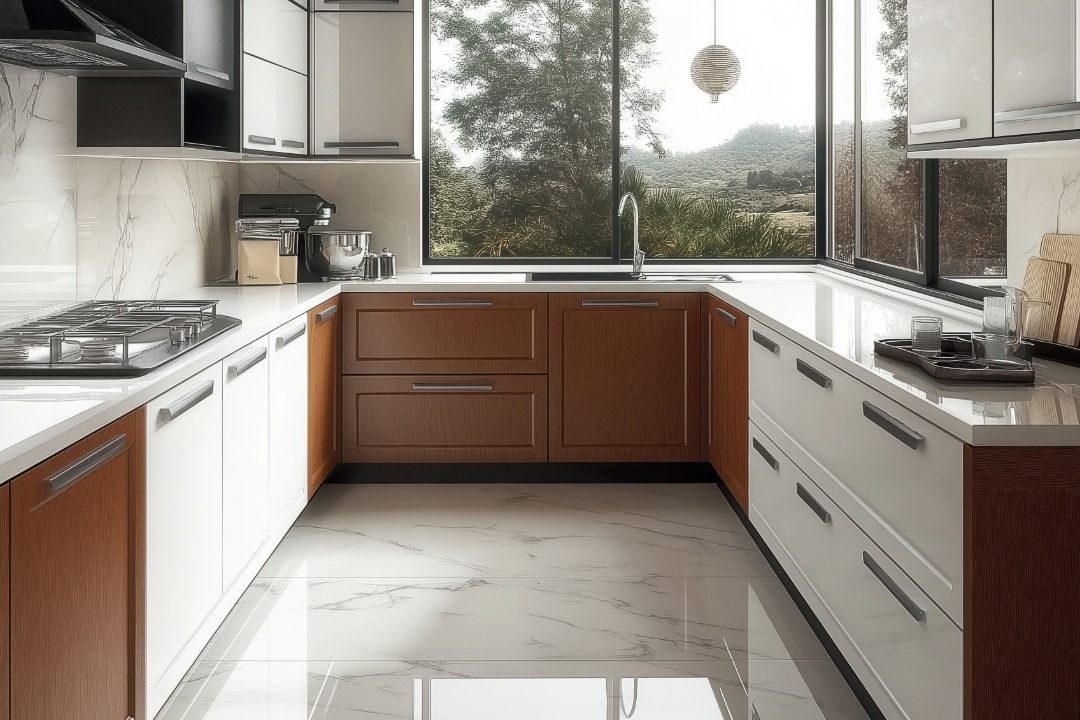
Your kitchen layout decides how you move, cook, store, and clean every single day. Pick the wrong one, and you spend years working around a design that fights your routine. Pick the right one, and the kitchen feels natural from the first meal you prepare.
Three layouts dominate Indian homes today: L-shaped, U-shaped, and parallel. Each one solves a different set of problems and fits a different kind of space. This guide breaks down all three modular kitchen layouts across space requirements, workflow, storage, cost, and suitability for Indian cooking. By the end, you will know exactly which kitchen layout fits your home.
Why Your Kitchen Layout Matters More Than Finishes
Most homeowners start kitchen planning with colour palettes and countertop textures. The layout conversation happens later, sometimes too late. A kitchen layout controls how far you walk between the stove, sink, and refrigerator. It determines how many people can cook simultaneously. It defines storage placement, counter space, and whether the kitchen feels open or boxed in.
The concept behind all good layouts is the kitchen work triangle. This principle places the cooktop, sink, and refrigerator at three points of a triangle. Shorter sides mean less movement. Every layout handles this triangle differently, and that single difference shapes how each kitchen performs daily.
L-Shaped Kitchen: Open, Versatile, and Space-Smart
An L-shaped kitchen design uses two adjacent walls joined at a right angle. Cabinets, countertops, and appliances line both walls, leaving the rest of the room open. It is one of the most widely installed modular kitchen layouts in India.
This layout works in areas starting from about 60 square feet. It suits open-plan apartments, 2BHK and 3BHK flats, and homes where the kitchen connects to the dining area. The work triangle stays compact because two stations sit on one wall and the third on the adjacent wall. You turn rather than walk, reducing fatigue during long cooking sessions.
Two walls provide a solid amount of base and wall cabinetry. Corner units can be fitted with carousel trays or magic corner mechanisms to prevent dead space. Tall pantry units work well at either end. For smaller families with moderate kitchen inventory, this layout provides sufficient storage without overwhelming the room.
The L-shaped kitchen is best suited for compact to medium kitchens, couples or small families, open-plan homes, and anyone who wants to add a breakfast counter later. Its main limitation is that large families with heavy cookware collections may find two walls insufficient for deep storage.
U-Shaped Kitchen: Maximum Storage and Multi-Zone Cooking
A U-shaped modular kitchen wraps cabinetry around three walls. The cook stands inside the U, surrounded by work surfaces on all sides. It delivers the highest storage density per square foot among all three layouts.
This layout needs a minimum of about 100 square feet with at least 3 feet of walkway width between opposite counters. Anything narrower, and the kitchen feels cramped during daily use. With three walls available, you can place the sink, cooktop, and refrigerator each on their own wall. The kitchen work triangle becomes tight and balanced. Every station is just one or two steps away.
Three walls of cabinetry give the U-shaped layout a clear advantage in storage. Base cabinets, wall-mounted units, and tall units fit across all three sides. Two corner junctions can be fitted with corner carousels or LeMans pull-outs. For families that store steel vessels, pressure cookers, mixers, and bulk groceries, this layout handles the load without compromise.
It is best suited for kitchens above 100 square feet, families of four or more, heavy daily cooking routines, and closed kitchen designs. The main downside is that it feels enclosed, costs more due to three walls of cabinetry, and does not suit open-plan homes where visual connectivity matters.
Parallel Kitchen: Peak Efficiency in Narrow Spaces
A parallel kitchen design, also called a galley kitchen, uses two facing walls with a walkway in between. No corners. Everything runs in straight lines. This layout was originally designed for ship galleys and professional kitchens where speed in tight spaces mattered most.
It works in spaces as narrow as 6 feet wide, provided the walkway is at least 3.5 to 4 feet. Many urban Indian apartments with long, narrow kitchen areas are naturally shaped for this layout. The work triangle becomes direct and linear. The sink and cooktop sit on one wall, with the refrigerator and prep area opposite. You pivot rather than walk. In terms of pure cooking efficiency, the parallel kitchen is arguably the fastest layout.
Two full walls deliver strong storage. Because there are no corners, you avoid dead space entirely. Every cabinet opens fully. Overhead cabinets on both walls double the vertical storage. The parallel kitchen is best for long narrow kitchens, enclosed kitchen rooms, two-person cooking, and anyone who values speed and minimal movement. Its limitation is that it feels corridor-like and does not suit open-plan homes.
Which Layout Handles Indian Cooking Best?
Indian cooking involves simultaneous tempering, frying, boiling, and grinding. Oil splashes, turmeric stains, and steam are daily realities. All three layouts can handle this when designed with the right materials and ventilation. However, the U-shaped layout handles heavy cooking loads best because of its storage depth and multi-zone separation. You can dedicate one wall entirely to the cooking zone with chimney, one to the wet zone with sink and dishwasher, and one to dry storage and appliances.
Parallel kitchens suit quick-turnaround daily cooking. The opposing walls create a natural separation between wet and hot zones. L-shaped kitchens work well for moderate cooking routines where the kitchen also serves a social function, with one person cooking and others sitting nearby at a dining table or breakfast counter.
Quick Comparison: L-Shaped vs U-Shaped vs Parallel
Space: L-shaped works from 60 sq ft. U-shaped needs 100+ sq ft. Parallel fits narrow rooms from 6 feet wide.
Storage: U-shaped leads with three walls. Parallel follows with two full walls and zero corner waste. L-shaped offers two walls with one corner requiring special fittings.
Workflow: Parallel is fastest for a single cook. U-shaped gives the best multi-zone setup. L-shaped provides a balanced, comfortable triangle.
Openness: L-shaped is most open and suits connected living spaces. Parallel is most enclosed. U-shaped leans enclosed.
Cost: L-shaped costs least (two walls, one corner). Parallel costs moderately more. U-shaped costs the most (three walls, two corners). Budget-conscious homeowners often find the L-shaped kitchen design the best starting point. For a detailed pricing breakdown, read our guide on cost breakdown of modular kitchens in India.
How to Choose the Right Layout for Your Home
Start with your room dimensions. Measure wall lengths, door placements, window positions, and plumbing points. These fixed elements decide which layouts are even possible.
Next, consider cooking habits and family size. Three meals a day with multiple dishes needs more counter space and storage. A couple cooking once daily can go leaner. Think about your floor plan too. Open-plan homes work best with L-shaped layouts. Enclosed rooms suit parallel or U-shaped designs.
If you are unsure, get a site measurement and 3D layout from a manufacturer with their own factory setup. Seeing your exact kitchen dimensions rendered in all three configurations makes the decision far simpler than guessing from images online. Factory-produced modular kitchens built on CNC machines with precision edge banding deliver a consistency that on-site carpentry cannot match.
Materials That Work Across All Three Layouts
For the carcass, BWP grade plywood or HDHMR boards resist moisture swelling in Indian conditions. For shutters, laminate is practical and budget-friendly. Acrylic delivers a high-gloss modern look. PU coating offers smooth premium finishes with custom colours. Countertops should match cooking intensity: granite for heavy use at lower cost, quartz for stain resistance. Hardware from brands like Hettich and Blum ensures soft-close doors and long-term reliability. For a deeper breakdown, read this guide on best materials for modular kitchen cabinets.
Common Mistakes When Choosing a Kitchen Layout
The most frequent mistake is choosing a layout based on someone else’s home. A U-shaped kitchen that looks stunning in 150 square feet will feel suffocating in 80 square feet. Always start from your measurements.
The second mistake is ignoring the work triangle. Placing the cooktop and sink on the same wall with the fridge far away creates unnecessary walking during every meal. The third mistake is skipping corner storage solutions. Corners in L-shaped and U-shaped kitchens waste significant space without internal fittings like carousels or pull-out trays.
Final Verdict
Choose L-shaped if your kitchen is compact to medium, open to the living room, and used by one or two people. Choose U-shaped if you have a spacious area, cook heavily every day, and need maximum storage for a large Indian family. Choose parallel if your kitchen is long and narrow with limited width but decent depth.
Whichever layout you choose, the next step is a proper site measurement followed by a 3D layout from a manufacturer like Holzbox who builds everything in their own factory. Factory-built modular kitchens manufactured on CNC machines with precision edge banding and pre-fitted hardware deliver consistency and durability that on-site carpentry cannot match. Start with your space. Measure it. Understand your cooking patterns. Then choose the layout that fits your life, not the one that looks best on a screen.
Frequently Asked Questions
Which kitchen layout is best for a small Indian apartment?
For small apartments with 60 to 80 square feet, the L-shaped kitchen layout is generally the best choice. It uses two walls efficiently, keeps the room open, and creates a natural work triangle. If the kitchen is very narrow (under 8 feet wide), a parallel layout may work better. The key is to measure your actual space and ensure at least 3 feet of movement clearance between counters.
Can a parallel kitchen handle heavy Indian cooking?
Yes. Use BWP-grade plywood or HDHMR for the carcass, and laminate or PU-coated shutters that resist oil stains. Place the cooktop on one wall with the sink opposite. This separates wet and cooking zones, improving ventilation. A good chimney with adequate suction is essential because the enclosed space traps heat faster than open layouts.
Is a U-shaped kitchen too expensive compared to L-shaped?
A U-shaped modular kitchen typically costs 30 to 50 percent more than an equivalent L-shaped kitchen. The higher cost comes from three walls of cabinetry and two corner mechanisms. However, the storage value per rupee is actually higher because you get significantly more cabinet space. For families that would otherwise need a separate pantry or storage rack, the U-shaped kitchen often eliminates those extra purchases.
How do I decide between L-shaped and U-shaped if both fit my space?
Choose L-shaped if you prefer an open kitchen connected to the living area, cook moderate meals, and want flexibility to add an island later. Choose U-shaped if you cook multiple meals daily, need deep storage for a larger family, and do not mind enclosure. A 3D layout showing both options in your exact room dimensions is the easiest way to compare.
What is the ideal walkway width in a parallel or U-shaped kitchen?
The ideal walkway is 3.5 to 4 feet (42 to 48 inches). This allows one person to cook while another opens a base cabinet on the opposite side without collision. Below 3 feet feels tight. Above 6 feet stretches the work triangle too much, creating unnecessary walking. Aim for 4 feet as the sweet spot for everyday comfort.