
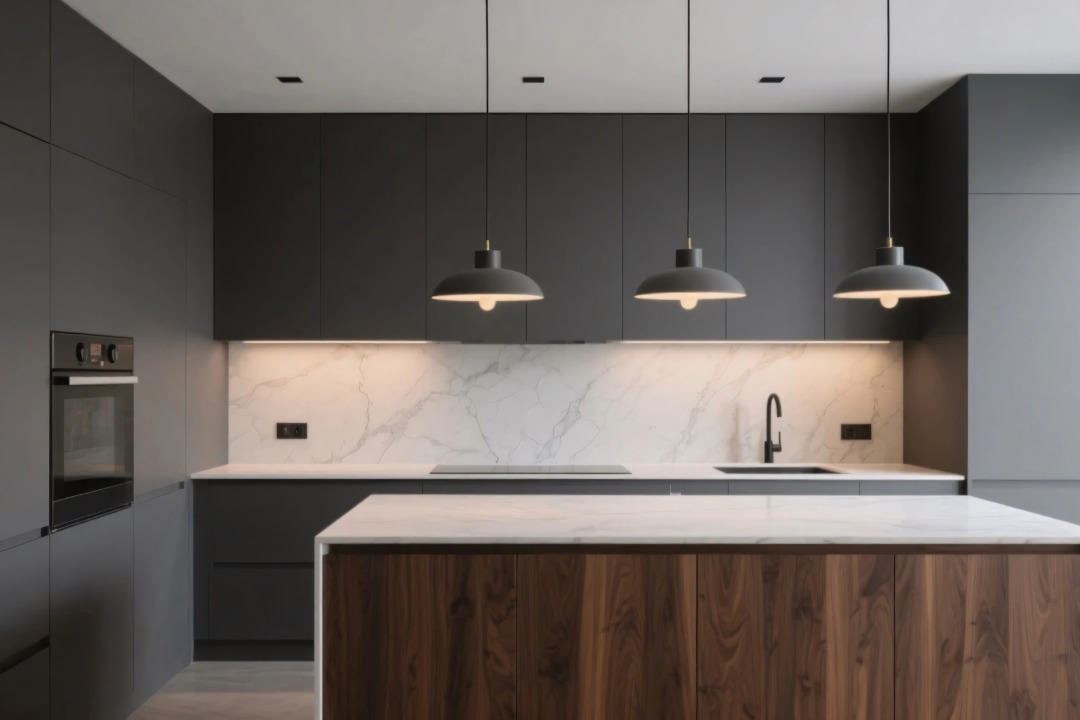
The first question every homeowner asks is how much. The second question is why does it cost that much. Most pricing guides answer the first question. This one answers both.
A modular kitchen in India can cost anywhere from one and a half lakhs to eight lakhs or more. That range is enormous. And the reason it is so wide is that every kitchen is made up of six or seven separate cost buckets. The material in each bucket, the brand of hardware, the type of finish, and the complexity of the layout all push the price up or down.
Understanding where your money goes gives you real power. You can make smarter trade-offs. You can spot overpriced quotations. And you can tell the difference between a company that is genuinely offering value and one that is hiding costs behind a low headline number.
Here is the real cost anatomy of a modular kitchen in India in 2026.
The Six Cost Buckets
Every modular kitchen price can be broken into six main categories. The percentages below are based on mid-range kitchens. Premium kitchens shift the balance toward hardware and appliances. Budget kitchens shift it toward carcass and shutters.
Carcass and internal structure takes up 25 to 35 percent of the total cost. This covers the boards, edge banding, internal shelves, and assembly.
Shutters and external finishes account for 20 to 30 percent. This is the visible face of your kitchen. Laminate, acrylic, PU coating, membrane, and veneer finishes all sit in this bucket.
Hardware and fittings take 10 to 20 percent. Hinges, drawer runners, pull-out baskets, corner solutions, lift-up mechanisms, and soft-close dampers fall here.
Countertops and backsplash cover 10 to 20 percent. Granite, quartz, and solid surface options vary significantly in price.
Appliances and fixtures add another 10 to 20 percent. This includes the chimney, hob, sink, and any built-in ovens or dishwashers.
Installation and site services make up 5 to 10 percent. Levelling, fitting, plumbing connections, and electrical adjustments sit in this final bucket.
Carcass: The Cost You Cannot See
The carcass is the structural skeleton of your kitchen. It is the box that holds the shelves, supports the drawers, and anchors the shutters. You never see it after the kitchen is installed. But it determines how long everything lasts.
Three materials dominate the Indian market.
Particle board is the cheapest option. It works for extremely tight budgets and rental properties. But it absorbs moisture fast, holds screws poorly over time, and has the shortest lifespan. Kitchen cabinets made with particle board in a humid Indian kitchen often show signs of swelling within two to three years.
MDF costs more than particle board and offers better density. It is suitable for dry zones. But standard MDF should not be used for base cabinets near the sink or in areas with regular water exposure.
BWR-grade plywood is the most reliable carcass material for Indian kitchens. It resists moisture, holds hardware firmly, and lasts ten years or more with proper edge banding. It is also the most expensive of the three. But on a cost-per-year basis, plywood is often the better investment because it avoids early replacement.
A typical L-shaped kitchen with BWR plywood carcass costs roughly 15 to 25 percent more than the same layout in particle board. That premium buys you years of trouble-free performance.
Shutters: Where Looks Meet Budget
Shutters are the doors of your cabinets. They are the most visible part of the kitchen and the element that defines its style. Five finish types are commonly used in India.
Laminate shutters are the most affordable and practical option. High-pressure laminates resist scratches, heat, and stains. They come in hundreds of colours and textures. A laminate shutter kitchen is ideal for Indian cooking environments where oil splatter and steam are daily realities.
Membrane shutters use a PVC film pressed over MDF. They allow CNC-routed patterns on the surface. Membrane is affordable but can peel in humid conditions.
Acrylic shutters deliver a high-gloss, reflective finish. They look stunning in modern modular kitchen designs. Fingerprints show easily and deep scratches are hard to repair.
PU-coated shutters offer the widest colour range and the most consistent surface. PU is a premium option and costs significantly more than laminate.
Veneer shutters use a thin layer of natural wood bonded to the panel. They bring warmth and texture that engineered finishes cannot replicate. Veneer is best suited for dry kitchens with good ventilation.
The price difference between the cheapest and most expensive shutter finish can be 40 to 60 percent of the total shutter cost. Choosing laminate over PU for the same kitchen layout can save one to two lakhs easily.
Hardware: The Hidden Price Driver
Two kitchens can look identical but feel completely different in daily use. The reason is almost always the hardware.
Budget hardware uses basic hinges without soft-close. Drawer runners are thin gauge steel. Pull-out baskets rattle when loaded. This hardware works for a year or two before problems appear.
Mid-range hardware from brands like Hettich gives you soft-close hinges rated for 50,000 to 80,000 cycles. Runners are full-extension with smooth glide.
Premium hardware from Blum offers the highest cycle ratings, tool-free adjustment, and integrated damping. A Blum-fitted kitchen feels noticeably smoother in daily use.
Hardware accounts for 10 to 20 percent of the total modular kitchen cost. Moving from budget to premium on an L-shaped kitchen adds roughly 30,000 to 60,000 rupees.
Countertops: Function Over Fashion
The countertop handles hot pots, sharp knives, water splashes, and turmeric stains daily. Material choice matters here more than aesthetics.
Granite is the most popular option in Indian kitchens. It is heat-resistant and affordable at 150 to 400 rupees per square foot depending on grade.
Quartz is engineered stone with a uniform surface and no natural pores. It resists staining better than granite. Quartz costs 300 to 800 rupees per square foot.
Solid surface materials like Corian allow seamless joints and integrated sinks. They suit premium kitchen interior design projects but cost more.
The countertop typically accounts for 10 to 20 percent of the total budget.
Appliances: The Budget That Grows
Many homeowners underestimate how much kitchen appliances add to the total cost. A chimney, hob, and sink are bare essentials. Add a built-in oven and a dishwasher, and the appliance budget can match the cabinetry budget.
A basic hob starts at 5,000 rupees. A premium four-burner model can cost 15,000 to 30,000. Chimneys range from 12,000 to over one lakh for island models. Kitchen sinks start at 3,000 and go up to 50,000 for composite models.
Plan your appliance budget separately. Share it with your designer before the layout is finalised. Appliance dimensions affect cabinet sizes. Adding a dishwasher after the cabinets are built means reworking base units entirely. Kitchen hardware costs and appliance costs together can account for 25 to 35 percent of the total spend.
Installation: The Cost Nobody Plans For
Installation is not just assembling cabinets. It includes levelling on uneven floors, drilling into concrete for wall units, connecting sink plumbing, positioning the gas line, and wiring electrical points.
Professional installation typically costs 5 to 10 percent of the total kitchen value. Some manufacturers include it in their quotation. Others list it separately.
Also factor in pre-installation civil work. Wall plastering, floor tiling, waterproofing, and electrical conduit routing must be done before the modules arrive. Delays at this stage are the most common reason projects overrun their timeline.
Why Factory Pricing Differs From Dealer Pricing
This is something most cost guides never explain. Two quotations for the same kitchen layout can differ by a lakh or more. The reason is not always the material. It is often the supply chain.
A dealer sources cabinets from one fabricator, shutters from another, and hardware from a distributor. Each link adds a margin. Each handoff introduces a risk of dimensional mismatch. When something goes wrong, the dealer has limited ability to fix it.
A manufacturer with in-house production and in-house manufacturing cuts out every middleman. They buy raw materials directly. They cut, band, assemble, and finish under one roof. They control quality at every stage. And they own the outcome.
Holzbox operates this way. Designing and manufacturing modular kitchens in their own factory means every cost is a production cost, not a resale margin.
Sample Cost Estimates by Kitchen Size (2026)
For a small straight kitchen of 40 to 50 square feet with laminate shutters, particle board or MDF carcass, and basic hardware, expect a starting range of 1.2 to 2 lakhs.
For a mid-size L-shaped kitchen of 60 to 80 square feet with BWR plywood carcass, laminate or acrylic shutters, Hettich hardware, and granite countertop, the range is 2.5 to 4.5 lakhs.
For a large U-shaped or island kitchen of 100 square feet or more with PU or veneer shutters, Blum hardware, quartz countertop, and built-in appliances, expect 5 to 8 lakhs or higher.
These estimates cover cabinetry, shutters, hardware, countertop, and installation. Appliances are usually additional.
How to Read a Quotation Without Getting Surprised
Ask for an itemised quote. Every line should specify the material, brand, and unit cost. Compare the carcass material. Compare the hardware brand. Compare what is included and excluded.
Common exclusions include countertop fabrication, backsplash, electrical points, plumbing modifications, and chimney installation. These can add 20 to 40 percent to the base price if not accounted for upfront.
A trustworthy modular kitchen manufacturer provides a complete scope document alongside the quote. That is the only way to compare prices fairly.
Frequently Asked Questions
What is the average modular kitchen cost in India in 2026?
Most Indian homeowners spend between 2 and 4 lakhs for a standard modular kitchen. A basic straight kitchen with laminate shutters and standard hardware starts around 1.2 to 2 lakhs. A mid-range L-shaped kitchen with plywood carcass and branded hardware falls between 2.5 and 4.5 lakhs. Premium kitchens with PU finishes, quartz countertops, and imported fittings can exceed 6 to 8 lakhs. The final price depends on kitchen size, layout complexity, material grade, and whether appliances are included.
Why do two kitchens with the same layout cost very different amounts?
Because the cost is driven by what goes inside the cabinets, not the shape of the layout. Two L-shaped kitchens can differ by two lakhs if one uses particle board with basic hardware and the other uses BWR plywood with Blum soft-close fittings. Shutter finish also plays a major role. Laminate costs significantly less than PU or acrylic. Always compare material specifications, not just layout diagrams, when evaluating quotations.
Is it cheaper to get a modular kitchen from a carpenter or a manufacturer?
A carpenter may quote a lower headline price. But carpenter-made kitchens lack the precision of factory-cut panels, the consistency of machine-applied edge banding, and the reliability of tested hardware integration. Factory-built modular kitchens offer tighter dimensional tolerances, better moisture resistance, faster installation, and proper warranty coverage. Over a ten-year lifespan, the total cost of ownership for a factory-built kitchen is often lower because it avoids the repair and replacement expenses that carpenter-built kitchens accumulate.
What are the most common hidden costs in a modular kitchen project?
The top hidden costs are countertop fabrication and installation, backsplash material and labour, electrical point relocation, plumbing modifications, chimney ducting, and pre-installation civil work like wall plastering or floor tiling. These items are frequently excluded from base quotations. They can add 20 to 40 percent to the original estimate. Always ask for a detailed scope document that lists every inclusion and exclusion before approving a quote.
How can I reduce my modular kitchen cost without sacrificing quality?
Choose laminate shutters instead of acrylic or PU. Use granite instead of quartz for the countertop. Stick to an L-shaped or straight layout instead of a U-shape or island. Reduce the number of pull-out accessories and corner carousels. Use open shelves where full cabinets are not essential. And most importantly, work with a manufacturer who builds in their own factory. Factory-direct pricing eliminates dealer margins and gives you better material quality at the same price point.