
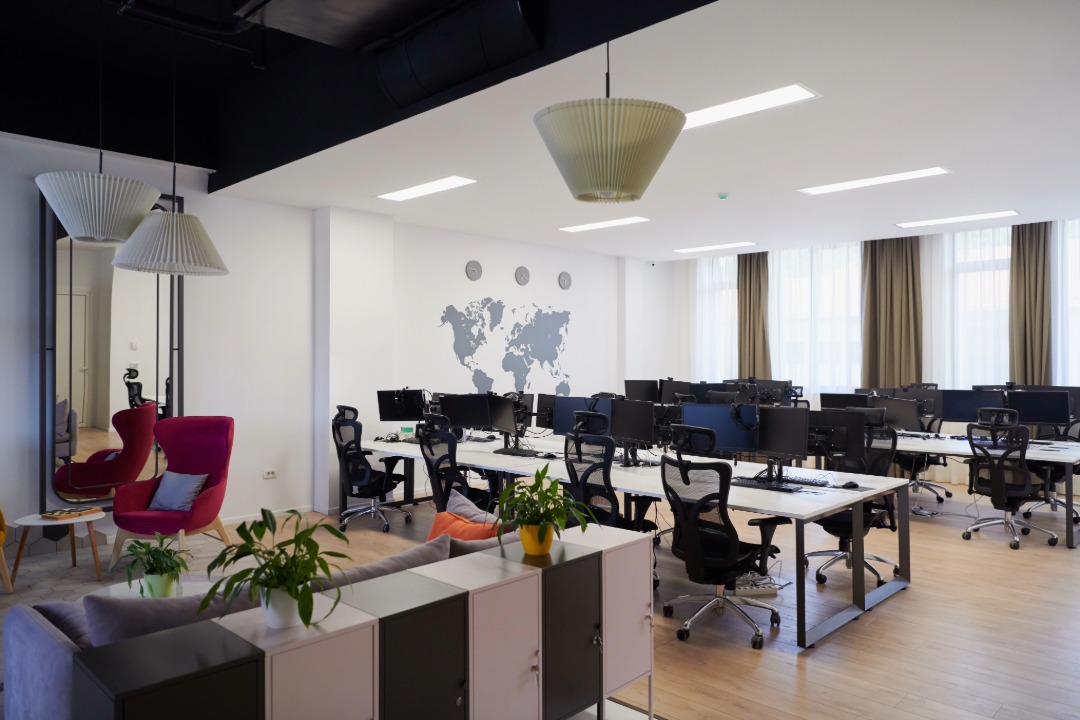
Most offices waste between 20 and 40 percent of their usable floor area. That is not a guess. It is a pattern that shows up repeatedly when businesses actually measure how their space is being used. Empty meeting rooms booked but never occupied, oversized cabins assigned to roles that rarely sit in them, and storage areas filled with things no one has touched in months. All of it costs money.
Efficient office space planning is not about squeezing as many desks as possible into a room. It is about making every square foot serve a purpose. When done well, the result is a workspace that feels spacious even in compact floor plans, supports both focused work and collaboration, and adapts as your team grows or changes shape.
This guide walks through the entire process from start to finish. Whether you are setting up a new office from scratch or rethinking an existing one, these steps will help you build a space that works harder for your business without expanding your rent bill.
Step 1: Understand How Your Team Actually Works
Office space planning starts with observation, not blueprints. Before you draw a single line on a floor plan, spend time understanding how your people spend their days. How much of the workday involves focused, heads-down tasks? How often do teams gather for meetings or informal discussions? How many employees are in the office every day versus two or three days a week?
This matters because the answers shape everything that follows. A team of 25 software developers needs a very different layout from a team of 25 sales professionals. Developers need quiet, uninterrupted zones. Salespeople need space for phone calls and quick team huddles. Designing the same layout for both would fail one group entirely.
Talk to department heads. Run a short internal survey. If possible, track desk and room usage for a couple of weeks. The data does not need to be perfect. Even a rough understanding of work patterns gives you a far better foundation than assumptions.
Step 2: Calculate Your Space Requirements
Once you know how your team works, you can estimate how much space each function needs. As a general benchmark, modern office space planning allocates between 80 and 150 square feet per employee in open layouts and 120 to 200 square feet per employee in setups with private cabins.
But raw square footage per person is just one part of the equation. You also need to account for circulation space, which is the area people use to move between zones. Hallways, pathways between desks, and access routes to exits typically consume 15 to 20 percent of total floor area. Ignoring this leads to offices that look spacious on paper but feel cramped in practice.
Meeting rooms, break areas, storage, reception, and server or IT rooms all need dedicated space. List every function your office must support. Assign a rough square footage to each. Add circulation. The total gives you a realistic picture of how much floor area you need or how much you can reclaim from an underutilized layout.
For Indian businesses operating in cities like Hyderabad, Pune, or Bangalore where commercial rent ranges from Rs 40 to Rs 100 per square foot per month, getting this calculation right can save lakhs annually.
Step 3: Define Your Zones
Efficient offices are built around zones, not individual desks. Zoning means grouping areas by function so that similar activities happen in proximity and different activities do not interfere with each other.
A practical workspace design for most businesses includes four core zones. First, a focus zone for individual, quiet work. This is where people write, code, analyze, or handle tasks that require concentration. It should be away from high-traffic areas and ideally have some acoustic treatment.
Second, a collaboration zone for group work, brainstorming, and informal discussions. This area can be more open and flexible, with movable tables and writable walls or boards. Third, a meeting zone with enclosed rooms for scheduled calls, client presentations, and private conversations. The number and size of meeting rooms should match actual usage, not aspiration. Many offices build five meeting rooms and find that three sit empty most days.
Fourth, a social and wellness zone for breaks, meals, and informal interaction. This area is often undervalued in office interior design, but it plays a direct role in employee satisfaction and retention. A comfortable break area reduces the need for people to leave the building for coffee or lunch, which saves time and keeps energy levels steadier through the day.
Step 4: Choose the Right Office Layout
Your layout is the skeleton of your office. It determines how people move, where they sit, and how zones connect. The three most common layouts for Indian businesses are open plan, private cabin, and hybrid.
Open plan layouts seat employees together in shared space without walls. They are space-efficient, promote visibility, and cost less to build. However, they struggle with noise and lack of privacy. Private cabin layouts give individuals or small teams enclosed rooms. They support focused work and confidentiality but consume more space and limit flexibility.
The hybrid office layout combines both. It uses open clusters for daily collaborative work, enclosed pods or cabins for tasks requiring quiet, and shared meeting rooms for group discussions. For most growing businesses, this is the most practical approach because it can be adjusted over time without tearing down walls.
Whatever layout you choose, make sure circulation paths are clear and logical. People should be able to move from the entrance to their workstation without crossing through a meeting zone. Bathrooms, pantries, and exits should be accessible from all areas without creating bottlenecks.
Step 5: Select Furniture That Supports the Plan
Furniture is where planning meets reality. A well-drawn floor plan fails if the furniture does not fit the space, the function, or the people using it. This is why furniture selection should happen alongside layout planning, not after it.
Modular office furniture is the strongest choice for efficient office space planning. Factory-manufactured modular systems are built to precise dimensions using CNC machinery and automated processes. Every desk, partition, storage unit, and extension is produced to exact specifications, so components fit together without gaps, misalignment, or on-site carpentry.
The advantage of modular furniture goes beyond fit. It offers scalability. When your team grows from 15 to 25 people, you add matching workstation modules to the existing cluster. When a department restructures, you rearrange partitions and desk configurations without a renovation. This kind of adaptability is only possible when the furniture comes from a manufacturer with its own factory setup, where production quality is controlled at every stage.
Prioritize ergonomic chairs, adjustable desks, and integrated cable management. In compact Indian offices, under-desk storage pedestals and wall-mounted shelves save floor area that would otherwise go to standalone cabinets. Choose finishes and colors that match your overall office interior design to maintain visual consistency across zones.
Step 6: Optimize Lighting and Acoustics
Two of the most overlooked elements in office space planning are light and sound. Both have a measurable impact on productivity, mood, and even health.
For lighting, maximize natural light by positioning workstations near windows and using glass partitions instead of opaque walls. Supplement with layered artificial lighting: ambient panels for general illumination, task lamps for individual desks, and accent lights for social or reception areas. Avoid relying on a single overhead fixture for an entire room. It creates harsh shadows and uneven brightness.
Acoustics matter more than most people realize. In open layouts, sound travels fast. A single loud phone call can distract an entire row of desks. Use acoustic panels on walls and ceilings in focus zones. Choose carpeting or acoustic flooring in quiet areas. Position noisy functions like sales teams and reception away from deep-work zones. Even simple interventions like fabric-covered partitions or upholstered seating reduce ambient noise significantly.
Step 7: Plan for Storage and Cable Management
Clutter kills the illusion of space. In offices where storage is treated as an afterthought, desks overflow, corridors fill up with boxes, and the workspace design looks chaotic regardless of how well the layout was planned.
Integrate storage into your office furniture interiors from the beginning. Under-desk pedestals, overhead compartments, and modular storage walls keep materials organized without consuming floor area. For shared resources like stationery, printing supplies, and filing, a centralized storage zone near the relevant department is more efficient than scattered cupboards.
Cable management deserves the same attention. In a typical office with 20 workstations, you are dealing with hundreds of cables for power, data, monitors, chargers, and peripherals. Factory-built modular workstations with built-in cable trays, grommets, and trunking channels keep wiring contained and invisible. This is not just an aesthetic concern. Loose cables are a tripping hazard and make reconfiguration difficult.
Step 8: Build Flexibility Into the Plan
No office plan should be permanent. Businesses change. Teams expand, departments merge, new functions emerge, and work patterns shift. An office that cannot adapt to these changes becomes a liability within 18 to 24 months.
The simplest way to build flexibility is to use modular office furniture that reconfigures without structural changes. Movable partitions, desk systems with detachable extensions, and storage units on casters allow you to reshape zones in hours rather than weeks.
Leave at least 10 to 15 percent of your floor area as flexible space. This zone can serve as overflow seating during busy periods, a project war room when needed, or an event area for team gatherings. Having this buffer prevents the office from feeling permanently maxed out and gives you room to absorb growth without an immediate move to a larger space.
Holzbox designs and manufactures modular interiors entirely in-house, which means businesses can order additional matching units months or even years after the original installation. The finishes, dimensions, and hardware remain consistent because everything is produced under the same factory roof. That kind of continuity is difficult to achieve when sourcing from traders or local carpenters who may change materials or suppliers between orders.
Step 9: Factor In Compliance and Safety
Efficient planning does not mean ignoring regulations. Every commercial office in India must comply with fire safety codes, building occupancy limits, and accessibility requirements. Ensure that exits are unobstructed, fire extinguishers are accessible, and aisle widths meet local building code standards.
Electrical load planning is another area that trips up growing offices. Adding 10 more workstations to a circuit that was designed for 15 can lead to overloaded panels and safety risks. Work with a qualified electrician to ensure your power infrastructure supports the planned layout with headroom for future additions.
Ventilation and air quality matter too, especially in dense open layouts. Ensure your HVAC system is rated for the number of occupants in the space. Poor air quality leads to drowsiness, headaches, and reduced cognitive performance. In Indian summers, this is not optional. It is a productivity essential.
Frequently Asked Questions
Q1. How much office space do I need per employee?
The answer depends on your layout and work style. Open plan offices typically require 80 to 150 square feet per person. Setups with private cabins need 120 to 200 square feet. Add 15 to 20 percent of total floor area for circulation, and account for meeting rooms, storage, break areas, and reception. For a team of 20 people in a hybrid layout, a total floor area of 2,500 to 3,500 square feet is a practical starting point.
Q2. What is the first step in office space planning?
Start by understanding how your team actually works. Audit daily activities, track desk and meeting room usage, and survey employees about their preferences and pain points. This data tells you how much space each function needs and what type of zones to prioritize. Skipping this step usually leads to layouts that look good on paper but fail in daily use.
Q3. Is modular office furniture worth the investment for small offices?
Yes. Modular office furniture manufactured in a factory setting offers precision, consistency, and scalability that carpenter-built furniture cannot match. It installs faster, reconfigures without renovation, and allows you to add matching units as your team grows. For small offices operating in 500 to 2,000 square feet, the space savings from integrated storage and compact modular workstations are especially valuable.
Q4. How can I make a small office feel more spacious?
Use light wall colors and maximize natural light to open up the space visually. Replace solid partitions with glass wherever possible. Choose vertical storage over floor-standing units to keep walkways clear. Consistent flooring throughout the office creates visual continuity and makes areas feel connected rather than fragmented. Modular furniture with slim profiles and built-in cable management also reduces visual clutter.
Q5. How often should office space planning be reviewed?
Review your space plan at least once a year, or whenever your team size changes by more than 15 to 20 percent. Major shifts in work patterns, such as adopting hybrid schedules or onboarding a new department, also warrant a review. Offices that go more than two years without reassessment often find that 20 to 30 percent of their space is being used inefficiently.