
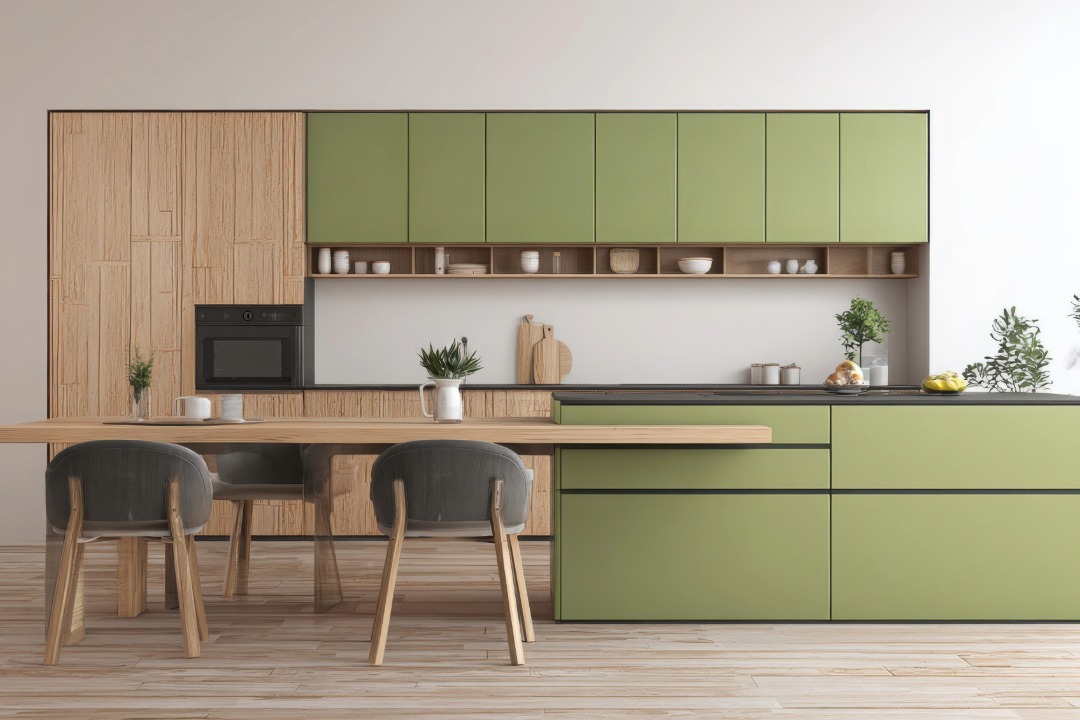
Planning a modular kitchen feels exciting until the kitchen is installed and something does not work. The drawer jams in week two. The shutter edge peels near the sink by month three. The countertop stains with turmeric because nobody mentioned it needed sealing. The base cabinet near the dishwasher swells because the wrong board was used.
These are not design failures. They are planning failures. And they happen because homeowners focus on how the kitchen looks and skip the decisions that determine how it performs.
After years of manufacturing modular kitchens and seeing what goes wrong after installation, here are the seven most common mistakes. Not the obvious ones you have already read about. The ones that actually cause problems once you start cooking every day.
Mistake 1: Choosing the Carcass Material Based on Price Instead of Location
This is the single biggest mistake in modular kitchen planning. The carcass is the structural box behind the shutter. You never see it after installation. But it holds the shelves, supports the drawers, and anchors the hardware. If it fails, everything fails.
Most homeowners compare carcass prices and pick the cheapest option without asking one critical question. Where will this cabinet sit?
A base unit next to the sink faces daily water splashes. A cabinet below the hob absorbs heat and steam. A unit near the dishwasher outlet is exposed to humid air every wash cycle. These locations need BWR-grade plywood. Nothing less.
Standard MDF and particle board absorb moisture through exposed edges. In a dry zone like a wall cabinet above the fridge, they work fine. But near the wet zone, they swell, warp, and crumble within two to three years.
The smart approach is to use different materials for different zones. BWR plywood for the wet zone. MDF or HDHMR for dry zones. This is standard practice in good modular kitchen design. But many companies quote a single material across the entire kitchen to simplify the quotation. That simplification costs you durability.
Mistake 2: Ignoring Edge Banding Quality
Edge banding is a thin strip applied to the exposed edges of every panel. It seals the board against moisture ingress. It is one of the smallest components in the kitchen and one of the most consequential.
Factory-applied edge banding uses industrial hot-melt adhesive under controlled temperature and pressure. The bond is airtight. The edge is flush with the panel surface. Moisture cannot penetrate.
Low-quality edge banding, whether applied by hand with a heat gun or using cheap adhesive, peels within months. The peeling starts near the sink where water exposure is highest. Once the edge lifts, moisture enters the board core. The panel swells from the inside. The damage is irreversible.
When you compare kitchen quotations, do not just ask about the board grade. Ask about the edge banding material, the thickness, and the application method. PVC or ABS edge banding applied on an automated machine is the standard for any serious modular kitchen manufacturer. Anything less is a compromise you will regret.
Mistake 3: Planning the Layout Without Studying Your Cooking Habits
The work triangle is important. But most planning guides stop there. They tell you to keep the stove, sink, and fridge within four to nine feet of each other. That is useful. But it is not enough for an Indian kitchen.
Indian cooking involves multiple burners running simultaneously. It involves heavy grinding, tempering, and pressure cooking. It involves large vessels that need deep base cabinets. It involves oil and steam in quantities that most international kitchen designs do not account for.
Ask yourself these questions before the layout is drawn. How many people cook at the same time? Do you store grains and pulses in bulk? Do you use a pressure cooker daily? Do you need space for a wet grinder or a heavy mixer? Where do you keep the hot vessels when they come off the flame?
A kitchen interior designer who understands Indian cooking will plan for these realities. They will place the chimney directly above the hob, not offset to the side. They will ensure the countertop near the stove is heat-resistant stone, not laminate. They will add a masala pull-out near the cooking zone so spices are within arm’s reach.
If your designer does not ask about your cooking habits, they are designing a generic kitchen. Not your kitchen.
Mistake 4: Underestimating Storage Needs in Year One
Every kitchen starts organised. Every kitchen slowly descends into clutter if the storage was not planned for real volume.
Indian kitchens carry more inventory than most Western designs assume. Bulk rice, multiple dal varieties, seasonal pickles, stacked steel vessels, pressure cookers of different sizes, heavy cast iron tawas, and a growing collection of small appliances. These things need real space. Not a few extra shelves.
Plan your storage based on a full inventory of what you currently own. Then add 20 percent for growth. A family of four that cooks daily will accumulate new kitchen items every year. If the storage is already full at move-in, it will overflow within six months.
Use the vertical space fully. Tall units and loft cabinets store seasonal items and rarely used appliances. Under-counter pull-out drawers hold heavy vessels without bending. Corner carousels recover dead space that a standard shelf cannot reach.
A manufacturer with in-house production can build custom-depth cabinets, extra-tall units, and non-standard drawer configurations to match your exact inventory. Off-the-shelf modules from a catalogue do not offer this flexibility.
Mistake 5: Accepting a Quotation Without an Itemised Breakdown
This mistake costs homeowners more money than any design decision. A quotation that says “L-shaped modular kitchen, complete, Rs 3.5 lakhs” tells you almost nothing.
What is the carcass material? What grade? What is the shutter finish? Which hardware brand? Are soft-close hinges included or is that an upgrade? Is the countertop included? Is the backsplash included? What about the chimney cutout, plumbing connections, and electrical points?
These details matter because two quotations at the same price can represent vastly different kitchens. One may use BWR plywood with Hettich hardware and a granite countertop. The other may use particle board with local hardware and no countertop at all.
Ask every company for a line-by-line breakdown. Compare material grades side by side. Compare hardware brand and model numbers. Compare what is included and what is listed as extra. This is the only way to make a fair modular kitchen cost comparison.
If a company resists giving you an itemised quote, that is a red flag. Transparent pricing is a sign of confidence in the product. Vague pricing is a sign that the real cost will appear later as surprise add-ons.
Mistake 6: Treating Lighting and Ventilation as Afterthoughts
Lighting and ventilation are planned last in most kitchens. Electrical points are placed wherever the electrician finds space. The chimney duct is routed after the cabinets are installed. The result is a kitchen that is either too dark to cook comfortably or too poorly ventilated to manage Indian cooking volumes.
Lighting should be planned in layers. Ambient ceiling lights for general visibility. Under-cabinet LED strips for task lighting on the countertop. Internal cabinet lights that activate when doors open.
Ventilation should be planned around the chimney placement. The chimney must sit directly above the hob. The duct route to the external wall should be as short and straight as possible. Every bend in the duct reduces suction power. A chimney with a long, twisted duct performs poorly regardless of its rated capacity.
Both lighting and ventilation affect your home interior design beyond the kitchen. Smoke that escapes into the living room because the chimney is undersized changes how the whole house smells. Shadows on the countertop because nobody planned task lighting make evening cooking frustrating.
Plan these systems before the kitchen layout is finalised. Not after.
Mistake 7: Choosing a Company Without Verifying Their Manufacturing Setup
This is the mistake that ties everything else together. The carcass quality, the edge banding, the hardware calibration, the dimensional accuracy of every module. All of these depend on who builds the kitchen and how.
Many companies present themselves as manufacturers but actually operate as assemblers or trading partners. They design the kitchen on screen and then outsource production to third-party fabricators. The cabinets come from one workshop. The shutters from another. The hardware from a distributor. Nothing is tested together as a complete system.
When something goes wrong, the company has no control over the fix. They cannot reproduce the exact panel. They cannot match the edge banding colour. They cannot guarantee that the replacement hinge will calibrate correctly with the existing door.
A company with its own factory controls every variable. Panels are cut on CNC machines. Edge banding is applied on automated lines. Hardware is tested on the actual panels before dispatch. Dimensions are verified at multiple checkpoints.
Holzbox operates this way. Designing and manufacturing modular kitchens in a single facility ensures that every module fits precisely, every edge is sealed properly, and every hinge is calibrated before the kitchen leaves the factory.
Before you sign a contract, ask to see the factory. If the company does not have one, you are not working with a manufacturer. You are working with a middleman.
Frequently Asked Questions
What is the most common mistake people make when planning a modular kitchen?
Choosing the wrong carcass material for moisture-prone areas. Many homeowners pick particle board or standard MDF for the entire kitchen because it is cheaper. But cabinets near the sink, dishwasher, and hob are exposed to water and steam daily. These locations need BWR-grade plywood to avoid swelling and warping within a few years. Using the right material in the right zone is the single most impactful decision in modular kitchen planning.
How do I know if a modular kitchen quotation is fair?
Ask for an itemised breakdown that lists every component separately. The carcass material and grade, shutter finish type, hardware brand and model, countertop material, accessories, and installation charges should each be on their own line. Compare two or three quotations on this basis. If a company only gives a lump-sum number without details, you cannot verify what you are paying for. Transparent pricing is non-negotiable.
Is it worth spending more on premium kitchen hardware?
Yes. Hardware is the part of the kitchen you interact with every single day. Soft-close hinges rated for 80,000 cycles last ten years of daily use. Budget hinges without soft-close can loosen within a year. Premium drawer runners from brands like Hettich or Blum provide full-extension, smooth glide, and consistent performance. The cost difference between basic and premium hardware on an L-shaped kitchen is typically 30,000 to 60,000 rupees. That investment saves you from annual repairs and replacements.
Should I finalise appliances before or after the kitchen design?
Before. Always before. Appliance dimensions directly affect cabinet sizes. A built-in oven needs a specific cutout width and depth. A dishwasher needs dedicated plumbing and drainage. A chimney needs a duct route to the external wall. If appliances are selected after the cabinets are built, the modules may need reworking. That costs time and money. Share your appliance list with your modular kitchen design team during the first consultation so the layout accounts for every unit from day one.
Can I avoid all these mistakes by hiring a professional kitchen designer?
A professional designer reduces the risk significantly but does not eliminate it entirely. The designer plans the layout, selects materials, and coordinates the project. But the manufacturing quality still depends on the company that builds the kitchen. A great design executed on a poor production line will still have edge banding issues, dimensional mismatches, and hardware calibration problems. The safest path is to work with a company that both designs and manufactures in-house. In-house manufacturing means the person who drew the plan and the person who built the module are part of the same team.