
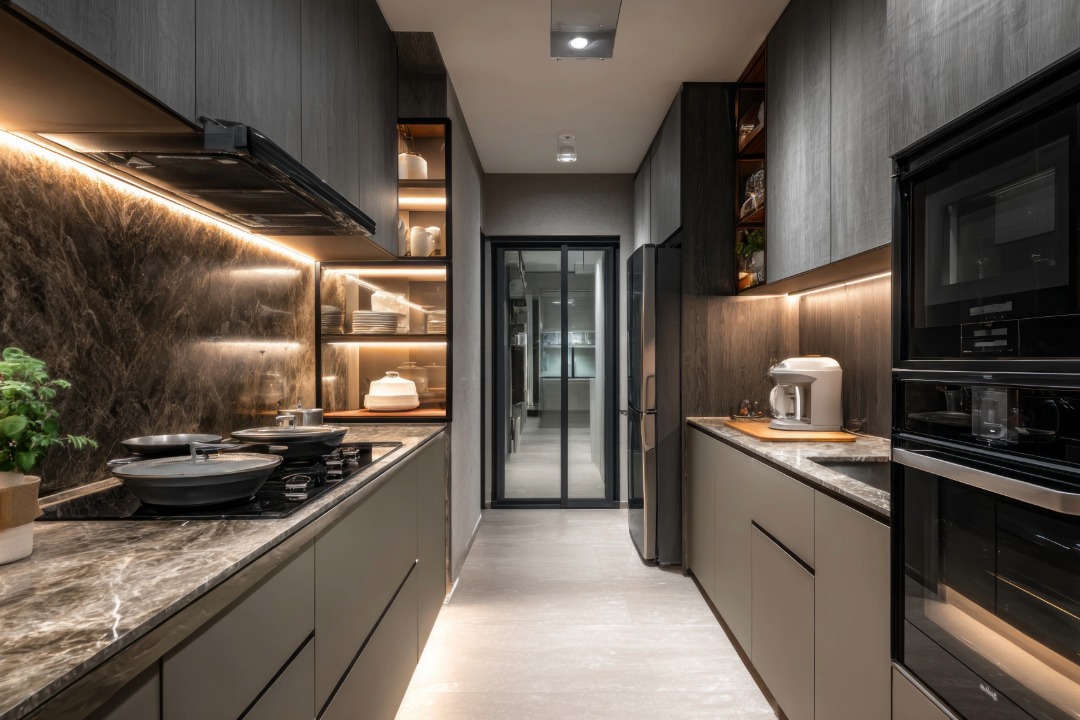
This is probably the most debated question in Indian home interiors. Ask your parents and they will vouch for the carpenter. Ask your interior designer and they will push modular. Ask the internet and you will get a hundred opinions pulling you in both directions.
The honest answer is that both options have real strengths. A carpenter-made kitchen is not automatically inferior. A modular kitchen is not automatically worth the premium. What matters is understanding the technical differences behind each approach so you can choose based on your space, your cooking habits, and your budget.
This guide compares both options across the factors that actually affect your daily experience. Not marketing claims. Not brand promotions. Just what happens when the kitchen is used every day for the next ten years.
How a Modular Kitchen Is Built
A modular kitchen is manufactured in a factory. The panels are cut on CNC machines to exact dimensions. Edge banding is applied using automated equipment that seals every exposed surface against moisture. Shutters are finished in dust-free booths with consistent temperature and humidity.
The kitchen arrives at your home as a set of pre-assembled modules. Base units, wall units, tall units, drawer systems, and corner units are each built as independent boxes. An installation team assembles them on site, levels them, and connects the plumbing and electrical points.
The entire process from design approval to finished kitchen typically takes three to five weeks. On-site installation takes two to three days. There is minimal dust and disruption in your home.
How a Carpenter-Made Kitchen Is Built
A carpenter-made kitchen is constructed entirely at your home. The carpenter buys raw materials separately. Plywood sheets, laminates, hardware, and edge strips are purchased from local dealers. Cutting, assembling, and finishing all happen on site.
The carpenter measures the space, cuts boards by hand or with a portable circular saw, assembles the cabinets against the wall, and applies laminate or paint. The entire process happens in your kitchen over a period of two to four weeks depending on the complexity.
This method gives you direct oversight of materials and construction. You see every board being cut. You approve every piece before it goes up. But it also means dust, noise, and workers in your home for an extended period.
Precision and Finish Quality
This is where the gap between the two methods is most visible.
A CNC machine cuts a panel to within 0.1 millimetres of the specified dimension. Every module in a factory-built kitchen is identical in measurement. Shutters align perfectly. Drawers fit flush. Gaps between units are uniform and tight.
A carpenter cuts by hand or with basic power tools. Even a skilled carpenter works to tolerances of 1 to 2 millimetres. Over the width of a full kitchen, these small variations add up. Doors may not close evenly. Drawers may rub against the frame. Gaps between units are inconsistent.
Edge banding tells the same story. Factory edge banding is applied with industrial hot-melt adhesive under controlled pressure. It seals the board completely and creates a smooth, moisture-proof edge. Carpenter edge banding uses a hand iron or heat gun. The bond is weaker. The edges often peel within a year, especially near the sink where water exposure is constant.
For Indian kitchens where moisture, steam, and oil are daily realities, edge quality is not a cosmetic detail. It is a durability essential.
Material Quality and Control
Both modular and carpenter-made kitchens use the same core materials. Plywood, MDF, particle board, and various laminates are available to both.
The difference is in how materials are selected and handled. A factory buys boards in bulk from certified suppliers. Every batch is tested for density, moisture content, and surface quality before it enters the production line. Boards are stored in climate-controlled areas to prevent warping before fabrication.
A carpenter buys boards from a local dealer. The quality depends on what is available that day. There is no testing. There is no controlled storage. Boards sometimes sit in open air for days before being used. In humid Indian cities like Mumbai, Chennai, and Kolkata, this exposure can compromise the board even before the first cut is made.
This is one area where working with a modular kitchen manufacturer that operates its own factory gives you a clear advantage. In-house manufacturing means material quality is verified at the source. You are not relying on a carpenter’s judgment at a local timber yard.
Hardware and Functional Performance
Hardware is where the daily experience of your kitchen is shaped. Hinges, drawer runners, pull-out baskets, corner carousels, and soft-close mechanisms determine how every cabinet opens, closes, and holds up over thousands of cycles.
Modular kitchens use branded hardware from companies like Hettich, Hafele, or Blum. These products are rated for 50,000 to 100,000 cycles. Soft-close action is standard. Drawer runners are full-extension. Pull-out accessories are weight-tested.
Carpenter-made kitchens typically use locally sourced hardware. Basic hinges without soft-close. Roller-type drawer runners that jam after a few months. Pull-out baskets that rattle and deform under load. The hardware works on day one. But by month six, the drawers start sticking. By year two, the hinges loosen. By year three, you are replacing kitchen hardware components that should have lasted a decade.
Some carpenters do install branded hardware if the homeowner provides it. But the installation calibration still depends on the carpenter’s skill. A Hettich hinge installed at the wrong depth or angle will not perform the way it was designed to.
Customisation Flexibility
This is the one area where carpenter-made kitchens genuinely hold an advantage. A carpenter can build to any shape, any dimension, and any configuration. Irregular walls, odd corners, exposed beams, and non-standard ceiling heights are all handled on the spot.
Modular kitchens are built in standard module sizes. Most manufacturers offer modules in widths of 300, 450, 600, and 900 millimetres. If your kitchen wall is 2,350 millimetres wide, the standard modules may leave a gap. A filler strip is used to cover the difference, but it is not as seamless as a custom-cut panel.
However, good modular kitchen design services can overcome this limitation. Manufacturers with in-house production facilities build custom-sized modules when needed. They adjust widths to match your exact wall dimensions. The key is to work with a manufacturer, not a retailer who stocks only fixed sizes.
Installation Time and Convenience
A modular kitchen installs in two to three days. The modules arrive pre-built. The installation team unpacks, positions, levels, and connects everything. Your kitchen is usable by the end of the third day.
A carpenter-made kitchen takes two to four weeks. All cutting and assembling happens in your home. Sawdust covers the floors. The sound of power tools fills the house. You need to supervise progress and manage material deliveries.
For families living in the home during renovation, the convenience difference is significant. A modular installation causes minimal disruption. A carpenter build turns your home into a workshop for weeks.
Cost Comparison
Carpenter-made kitchens are cheaper upfront. A basic carpenter kitchen for a standard L-shaped layout can cost 30 to 50 percent less than an equivalent modular kitchen with the same layout.
But the comparison is incomplete without factoring in what you get for that price. The carpenter kitchen typically uses lower-grade hardware. Edge banding is basic. The finish quality depends entirely on the individual carpenter’s skill. There is no warranty. If something fails, you pay for repairs out of pocket.
A modular kitchen costs more upfront but includes branded hardware, sealed edges, tested modules, and a warranty that typically covers five to ten years. Over the kitchen’s lifespan, the total cost of ownership often favours the modular option because it avoids the repair and replacement expenses that accumulate with carpenter-built units.
The price gap is also narrowing. As more manufacturers scale production and optimise their factory processes, mid-range modular kitchens are becoming accessible to a wider segment of Indian homeowners.
Warranty and After-Sales Support
This is a straightforward comparison. Modular kitchens come with a written warranty. Shutters, hardware, and carcass boards are covered for a defined period. If a hinge fails or a shutter edge lifts, the manufacturer sends a service team to fix it.
Carpenter-made kitchens come with no formal warranty. If the laminate peels or a drawer jams after six months, you call the same carpenter and hope he is available. If he has moved on to another project or another city, you start from scratch with someone new who does not know how the kitchen was built.
For a homeowner investing two to five lakhs in a kitchen, warranty coverage is not a luxury. It is basic risk management.
Relocatability
Modular kitchens are built as independent boxes. If you move homes, you can disassemble the modules, transport them, and reinstall them in the new kitchen. Some adjustments may be needed if the new room has different dimensions. But the core units remain usable.
Carpenter-made kitchens are fixed to the walls. Dismantling them usually damages the cabinets. Laminate cracks. Joints loosen. Hardware bends. Relocating a carpenter kitchen is technically possible but practically results in a significant loss of material and finish quality.
For homeowners in rental apartments or those who plan to move within five to seven years, this difference alone can justify the modular premium.
So Which One Should You Choose?
Choose a carpenter-made kitchen if you are on a very tight budget, your kitchen has highly irregular dimensions, you want complete control over material procurement, and you have access to a highly skilled carpenter whose work you have seen and verified.
Choose a modular kitchen if you want factory-level precision and consistent finish quality, you need branded hardware with guaranteed performance, you want a warranty and after-sales support, your timeline is tight, or you may relocate in the future.
For most urban Indian homes in 2026, a factory-built modular kitchen offers the better long-term value. It is the smarter kitchen interior design investment. Whether you are building a new home or upgrading an existing home interior design, the precision and reliability of factory production outperforms on-site construction in almost every measurable way. Holzbox, for example, designs and manufactures modular kitchens in its own factory, ensuring that every module is cut, sealed, tested, and delivered with the precision that only a controlled production environment can provide.
The right choice is not about which method is universally better. It is about which one fits your situation, your priorities, and your timeline.
Frequently Asked Questions
Is a modular kitchen really worth the extra cost over a carpenter-made kitchen?
Yes, for most homeowners. The upfront cost is higher, but the total cost of ownership over ten years is often lower. Modular kitchens use branded hardware that lasts longer, sealed edges that resist moisture, and factory-finished panels that maintain their appearance. Carpenter kitchens save money initially but tend to require repairs, hardware replacement, and surface touch-ups within three to five years. When you add those expenses, the gap narrows significantly.
Can a carpenter build a modular-style kitchen?
A carpenter can build kitchen cabinets that look similar to modular units. But the precision, edge sealing, and hardware calibration will not match factory production. CNC-cut panels have dimensional accuracy that hand-cutting cannot replicate. Machine-applied edge banding creates a stronger moisture seal than hand-ironed strips. The kitchen may look comparable on day one, but the performance gap becomes visible within two to three years.
How long does a modular kitchen last compared to a carpenter-made kitchen?
A well-built modular kitchen with BWR plywood carcass, branded hardware, and proper edge banding lasts 12 to 15 years with minimal maintenance. A carpenter-made kitchen with similar plywood but basic hardware and manual edge banding typically shows wear within 4 to 6 years. The lifespan depends heavily on material quality and the kitchen environment. Kitchens near the coast or in humid cities need stronger moisture protection regardless of the build method.
Can I upgrade a carpenter-made kitchen with modular accessories later?
Yes, to some extent. You can add modular pull-out baskets, soft-close hinges, and carousel units to an existing carpenter kitchen. However, the internal cabinet dimensions must match the accessory specifications. If the carpenter built the cabinets to non-standard sizes, some modular accessories may not fit. It is best to plan accessory compatibility at the design stage rather than as a retrofit.
What should I check when comparing quotes from a modular kitchen company and a carpenter?
Compare the carcass material and grade. Compare the hardware brand and product line. Compare the shutter material and finish type. Check whether edge banding is machine-applied or manual. Confirm what is included in each quote. Carpenter quotes often exclude countertops, backsplash, plumbing, and electrical work. Modular quotes sometimes exclude appliances and civil work. Get both quotes to list every inclusion and exclusion so you are comparing on equal terms.