
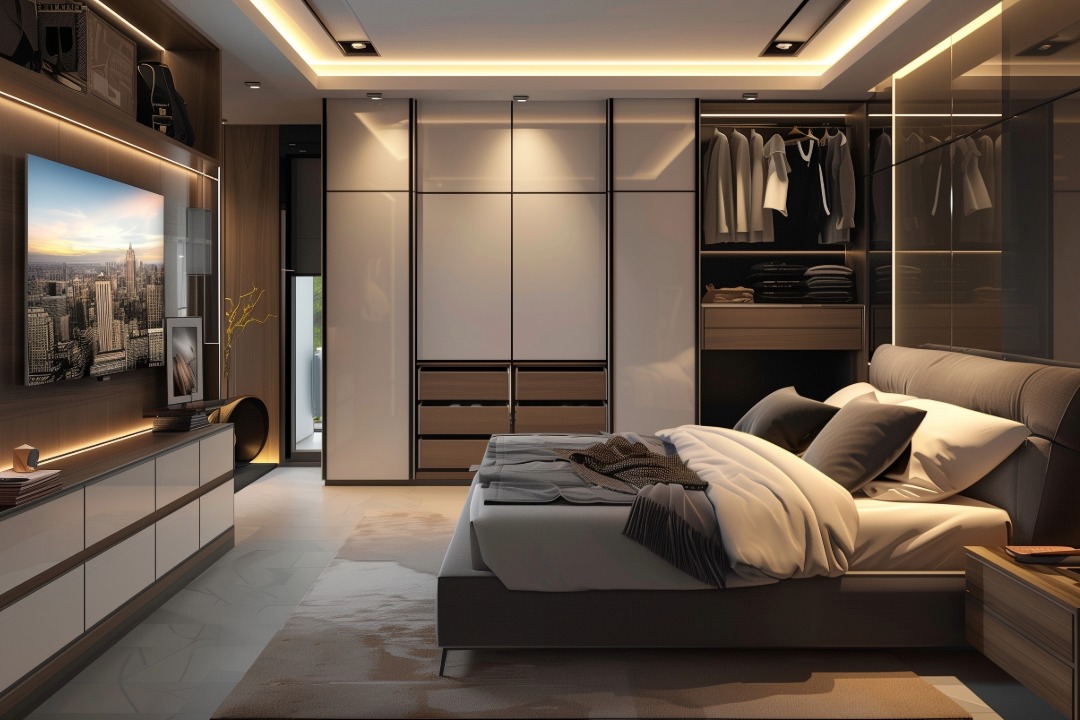
Ask any modular wardrobe company for a price and you will get a number. But that number alone tells you very little. Two wardrobes quoted at 80,000 rupees can differ dramatically in material, hardware, internal fittings, and finish quality. Without understanding what goes into the cost, you cannot tell which quotation represents genuine value and which one is hiding compromises.
This guide breaks down the cost of a modular wardrobe into its individual components. Each section explains what you are paying for, what the price range looks like across budget, mid-range, and premium tiers, and where the smart trade-offs lie.
How Modular Wardrobe Pricing Works
Most companies price modular wardrobes per square foot of the front face area. You multiply the wardrobe width by the height to get the total square footage, then multiply by the per-square-foot rate.
A standard bedroom wardrobe is 7 feet wide and 8 feet tall, which gives 56 square feet of face area. At a rate of 800 rupees per square foot, the base cost is 44,800 rupees. At 1,500 per square foot, it is 84,000 rupees. At 2,500 per square foot, it is 1,40,000 rupees.
But per-square-foot pricing can be misleading. Different companies include different things in their base rate. One may include the carcass, shutter, and basic hardware. Another may quote only the carcass and charge separately for shutters, hardware, and internal accessories.
The only reliable way to compare wardrobe per square foot pricing is to ask for an itemised quotation that lists every component separately.
Component 1: The Carcass
The carcass is the structural body of the wardrobe. It includes the side panels, top panel, bottom panel, back panel, and all internal shelves. It carries the weight and anchors the hardware.
Particle board carcass costs 400 to 600 rupees per square foot. It is the cheapest option and the weakest. It has poor screw-holding capacity and swells when exposed to moisture. Suitable only for temporary setups or very tight budgets.
MDF carcass costs 600 to 800 rupees per square foot. It offers a smooth surface and decent density. Standard MDF is not moisture-resistant. HDHMR, which is a higher-grade variant, adds 100 to 150 rupees per square foot and provides much better moisture resistance.
BWR plywood carcass costs 900 to 1,400 rupees per square foot depending on the brand and grade. This is the most durable option for Indian homes. It resists moisture, holds screws firmly over thousands of hinge cycles, and does not swell in humid conditions. For a wardrobe expected to last over a decade, BWR plywood is the recommended choice.
Component 2: The Shutter
The shutter is the visible door panel. Its cost depends on the base material and the finish applied to it.
Laminate on MDF is the most affordable shutter option, costing 350 to 600 rupees per square foot. High-pressure laminates are more durable than low-pressure variants. They resist scratches, are easy to clean, and come in hundreds of colours and textures. This is the most practical option for everyday Indian bedrooms.
Membrane finish on MDF costs 450 to 700 rupees per square foot. The PVC film wraps around grooved and profiled shutter panels, creating a seamless look. Membrane suits traditional or patterned wardrobe design styles.
Acrylic shutters cost 700 to 1,200 rupees per square foot. They deliver a high-gloss, mirror-like surface. Acrylic is visually striking but shows fingerprints and requires daily wiping to maintain its showroom look.
PU-coated shutters cost 900 to 1,500 rupees per square foot. Polyurethane coating offers the widest colour matching capability and a premium matte or satin finish. PU is the most expensive finish option but delivers the most refined aesthetic.
Veneer shutters cost 800 to 1,400 rupees per square foot. Real wood veneer adds warmth and natural texture. It suits classic and transitional bedroom interior design themes but requires a protective topcoat to resist moisture.
Component 3: Hardware
Hardware includes hinges, drawer runners, hanging rods, pull-out mechanisms, and soft-close dampers. This is the component that determines how the wardrobe feels in daily use.
Basic hardware with standard hinges and roller-type drawer runners costs 3,000 to 6,000 rupees for a full wardrobe. This tier works for light use but degrades within two to three years under daily Indian household usage.
Mid-range branded hardware from Hettich or Hafele with soft-close hinges and ball-bearing drawer runners costs 8,000 to 15,000 rupees. This tier lasts the full life of the wardrobe without needing replacement.
Premium hardware from Blum or equivalent with concealed hinges, full-extension soft-close drawers, and integrated dampers costs 15,000 to 30,000 rupees. This tier is suitable for high-end wardrobes where silent, effortless operation is a priority.
The difference between basic and mid-range hardware is typically 5,000 to 10,000 rupees. That investment protects you from five to seven years of hinge tightening, drawer jamming, and rod bending. It is one of the most cost-effective upgrades you can make.
Component 4: Internal Accessories
Internal accessories transform a wardrobe from a box with shelves into an organised storage system.
Trouser pull-outs cost 1,500 to 3,500 rupees. Tie and belt organisers cost 800 to 2,000 rupees. Saree rods cost 400 to 1,000 rupees. Shoe shelves cost 1,200 to 3,000 rupees per section. Pull-out laundry hampers cost 2,500 to 5,000 rupees.
Internal LED lighting with motion sensors costs 2,000 to 5,000 rupees depending on the strip length and sensor quality.
Mirror panels mounted on the inside of hinged doors cost 1,500 to 4,000 rupees per panel.
You do not need every accessory. Choose the ones that match your actual clothing inventory and daily habits. A couple with mostly formal wear benefits from trouser pull-outs and a tie organiser. A family with heavy ethnic wear needs long saree rods and deep shelf sections.
Component 5: Door Mechanism
The choice between hinged and sliding doors has a direct impact on cost.
Hinged doors with standard soft-close hinges add minimal cost beyond the shutter panel itself. The hinge hardware is relatively inexpensive and widely available.
Sliding doors require a track system, precision rollers, anti-jump clips, and buffer stops. This mechanism adds 5,000 to 15,000 rupees on top of the shutter panel cost, depending on the track quality and panel weight.
For a standard 7-foot wardrobe, sliding doors cost approximately 15 to 25 percent more than hinged doors of the same material and finish.
Component 6: Installation and Delivery
Factory-built modular wardrobes include professional installation as part of the package. The installation team positions the modules, levels them, secures them to the wall, mounts the doors, and adjusts all hardware.
Installation costs typically range from 2,000 to 6,000 rupees depending on the wardrobe size and complexity. Some manufacturers include this in the per-square-foot rate. Others list it separately.
Delivery charges vary by location. Local deliveries within the same city are often free. Deliveries to other cities carry transport costs that depend on the distance and shipment size.
Total Cost Examples
Here are three examples based on a standard 7-foot wide, 8-foot tall wardrobe (56 square feet face area).
A budget wardrobe uses particle board carcass, laminate shutters, basic hardware, and hinged doors. Total cost: 35,000 to 55,000 rupees.
A mid-range wardrobe uses HDHMR or BWR plywood carcass, laminate or membrane shutters, Hettich soft-close hardware, two pull-out drawers, a trouser pull-out, and hinged doors. Total cost: 65,000 to 1,10,000 rupees.
A premium wardrobe uses BWR plywood carcass, PU or acrylic shutters, Blum hardware, full internal accessories, LED lighting, and sliding doors. Total cost: 1,20,000 to 2,00,000 rupees or more.
These ranges reflect 2026 pricing across major Indian cities including Hyderabad, Bangalore, Mumbai, Delhi, and Chennai.
What Drives the Price Up and Down
The biggest cost driver is the shutter finish. Moving from laminate to acrylic or PU can increase the shutter cost by 50 to 100 percent. If your priority is durability over aesthetics, laminate delivers excellent value.
The second biggest driver is hardware. Upgrading from basic to branded soft-close hardware adds 5,000 to 15,000 rupees. This is money well spent because hardware determines the daily experience.
The third driver is the carcass material. BWR plywood costs more than MDF or particle board. But it lasts longer and avoids the replacement cost that cheaper boards incur within five to seven years.
Internal accessories are discretionary. You can start with a basic internal layout and add accessories later if the home interior design allows for retrofitting. Many modular systems support add-ons without dismantling the carcass.
How Factory-Direct Pricing Saves Money
A modular wardrobe manufacturer with in-house production offers a structural cost advantage. There is no dealer margin. No intermediary markup. The price you pay covers raw material, production, quality control, delivery, and installation.
A company that outsources production adds at least one layer of margin between the factory and you. The fabricator charges the company. The company charges you. That intermediary markup typically adds 15 to 25 percent to the final price without adding any value to the product itself.
Holzbox manufactures modular wardrobes in its own factory. That means factory-direct pricing with full visibility into material specifications and production quality. When the company that designs your wardrobe also builds it, there is no gap between what is promised and what is delivered.
Frequently Asked Questions
What is the average cost per square foot for a modular wardrobe in India?
The average ranges from 800 to 2,500 rupees per square foot depending on the material, finish, and hardware. Budget wardrobes with particle board and laminate start at 800 per square foot. Mid-range wardrobes with BWR plywood and branded hardware fall between 1,200 and 1,800 per square foot. Premium wardrobes with PU finish and Blum hardware can reach 2,500 per square foot or higher. Always confirm what is included in the per-square-foot rate before comparing.
Which component should I invest the most in?
The carcass and hardware. The carcass determines structural longevity. BWR plywood resists moisture and holds screws for over a decade. The hardware determines daily experience. Soft-close hinges and full-extension runners from Hettich or Blum last the life of the wardrobe. Together, these two components account for 50 to 60 percent of the total cost and 90 percent of the wardrobe’s long-term performance.
Is it cheaper to buy a modular wardrobe or get one made by a carpenter?
A carpenter-built wardrobe costs 30 to 50 percent less upfront. But it uses basic hardware, manual edge banding, and finishes that depend on the carpenter’s skill. Over ten years, the repair and replacement costs of a carpenter wardrobe often match or exceed the one-time cost of a factory-built modular unit. For a wardrobe expected to last a decade or more, a modular wardrobe from a manufacturer with in-house manufacturing is the better long-term investment.
Can I reduce costs without compromising quality?
Yes. Choose laminate over acrylic or PU finish. The cost savings are significant and laminate durability is excellent for daily use. Use BWR plywood only for the lower carcass sections where moisture exposure is highest. Use HDHMR for upper sections. Skip non-essential accessories like internal LED lighting and add them later. Choose hinged doors over sliding to save 15 to 25 percent on the door mechanism cost.
What should an itemised wardrobe quotation include?
The carcass material brand and grade. The shutter material and finish type. The hardware brand and model. Internal accessories listed individually. The door mechanism type and cost. Installation charges. Delivery charges. Warranty terms. Any exclusions such as loft units, electrical work, or mirror panels. If a company provides only a lump-sum figure without breakdown, you cannot verify what you are paying for.