
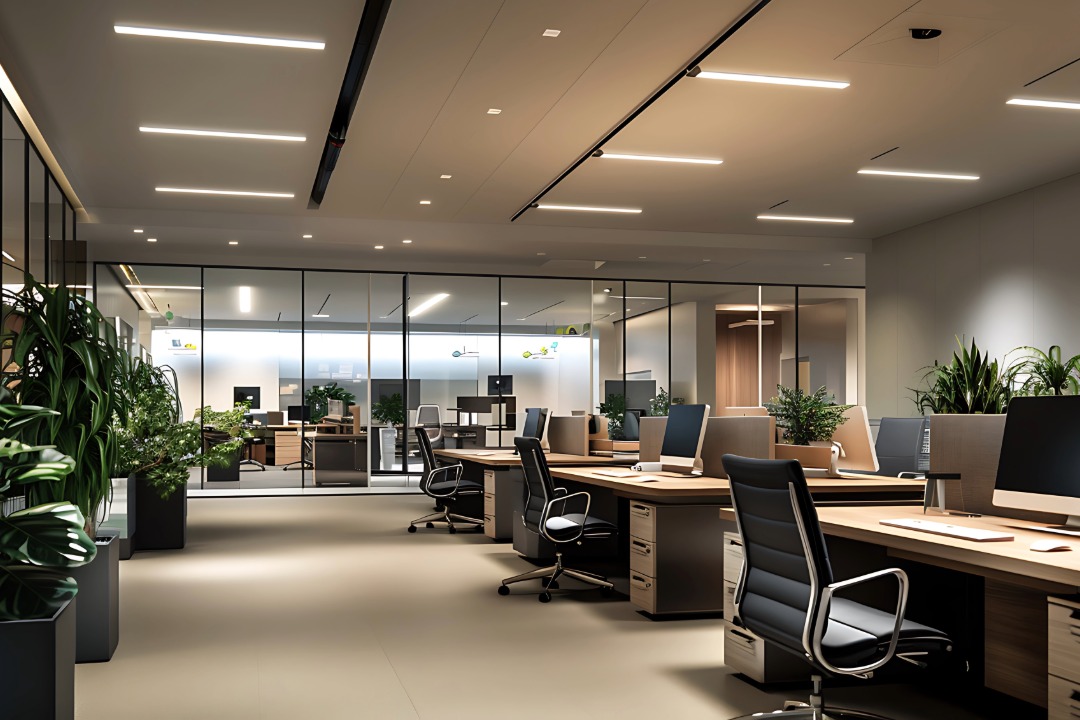
Every business owner setting up or renovating an office asks the same question first. How much is this going to cost? The answer is rarely straightforward because office interior design in India depends on dozens of variables. The size of your space, the city you operate in, the materials you choose, and the complexity of your layout all push the number up or down.
What makes pricing even harder to pin down is the gap between what you read online and what you actually pay. Many estimates you find are either outdated, region-specific, or based on residential projects that have very different requirements from commercial offices. An office needs cable management, acoustic treatment, compliance with fire safety norms, and furniture that can handle daily use by dozens of people. These factors change the cost equation significantly.
This guide breaks down the real cost of office interior design in India for 2026. It covers per square foot pricing at different quality levels, component-wise budget allocation, city-wise variations, and practical ways to control costs without cutting corners. Whether you are setting up a 500 square foot startup space or a 5,000 square foot corporate office, the numbers here will help you plan with confidence.
What Does Office Interior Design Actually Cost in India?
The cost of office interior design in India typically ranges from Rs 800 to Rs 2,500 per square foot for standard to mid-range projects. Premium and luxury office interiors can go from Rs 2,500 to Rs 5,000 or more per square foot, depending on material quality, design complexity, and the level of customization involved.
These figures include furniture, flooring, false ceiling, electrical work, lighting, partitions, and finishing. They do not usually include HVAC systems, structural modifications, or specialized IT infrastructure like server rooms, which are budgeted separately.
To put this in practical terms, a 1,000 square foot office with a mid-range fitout would cost between Rs 12 lakh and Rs 25 lakh. A 3,000 square foot office at the same specification would fall between Rs 36 lakh and Rs 75 lakh. These ranges are wide because every office is different, but they give you a realistic starting point for budget conversations.
Cost Range by Quality Level
| Quality Level | Cost per Sq Ft | Best For | 1,000 Sq Ft Estimate |
| Basic | Rs 800 – 1,200 | Startups, small teams | Rs 8L – 12L |
| Mid-Range | Rs 1,200 – 2,500 | Growing businesses, SMEs | Rs 12L – 25L |
| Premium | Rs 2,500 – 4,000 | Corporate offices, client-facing | Rs 25L – 40L |
| Luxury | Rs 4,000 – 5,000+ | Executive suites, flagship offices | Rs 40L – 50L+ |
Key Factors That Drive Office Interior Design Cost
1. Office Size and Layout Complexity
Larger offices benefit from economies of scale. The cost per square foot tends to decrease as the total area increases because certain fixed costs like design fees, project management, and mobilization get spread across more floor area. However, complex layouts with many cabins, meeting rooms, and custom zones push costs up because they require more partitions, doors, electrical points, and furniture configurations.
2. Furniture Selection
Furniture is typically the single largest cost component, accounting for 35 to 45 percent of the total budget. The choice between modular office furniture and custom carpenter-built furniture makes a significant difference here. Factory-manufactured modular furniture costs less per unit than on-site carpentry because production happens at scale using automated machinery. It also installs faster, which reduces labor costs on site.
Ergonomic chairs, sit-stand desks, and workstations with integrated cable management cost more upfront but reduce long-term expenses related to employee health issues and furniture replacement. For most mid-range offices, allocating Rs 3,000 to Rs 8,000 per workstation for the desk and Rs 5,000 to Rs 15,000 per ergonomic chair gives a comfortable setup without overspending.
3. Flooring
Flooring choices range from vinyl tiles at Rs 40 to Rs 80 per square foot to carpet tiles at Rs 80 to Rs 150 per square foot and wooden laminate at Rs 120 to Rs 250 per square foot. Most commercial offices in India choose carpet tiles for open areas because they absorb sound, are easy to replace in sections, and come in a wide range of finishes. Vitrified tiles are common in reception areas and high-traffic corridors.
4. False Ceiling and Lighting
A standard gypsum false ceiling costs between Rs 60 and Rs 120 per square foot, including installation. Grid ceilings with mineral fiber tiles are slightly cheaper and easier to maintain, especially in offices that need regular access to above-ceiling wiring and HVAC ducts. Lighting adds another Rs 30 to Rs 80 per square foot depending on whether you use basic panel lights or a layered system with ambient, task, and accent fixtures.
5. Electrical and Networking
Every workstation needs power outlets, data ports, and often USB charging points. Electrical work including wiring, distribution boards, MCBs, and earthing typically costs Rs 80 to Rs 150 per square foot. Structured cabling for networking adds Rs 40 to Rs 80 per square foot. Offices with server rooms, access control systems, or CCTV installations should budget an additional Rs 1 to Rs 3 lakh depending on scale.
6. Partitions and Glass Work
Full-height glass partitions with aluminum framing cost between Rs 350 and Rs 600 per square foot. Gypsum partitions with paint finish are more affordable at Rs 120 to Rs 200 per square foot. The number of cabins, meeting rooms, and enclosed pods directly impacts partition costs. Open layouts naturally spend less here, while private cabin-heavy designs allocate a significant portion of the budget to partitions.
7. Location and City
Office interior design cost varies by city. Metro cities like Mumbai, Delhi, and Bangalore command rates 15 to 30 percent higher than tier-2 cities like Pune, Hyderabad, Jaipur, or Ahmedabad. This difference comes from higher labor rates, logistics costs, and material procurement expenses in larger cities. Businesses operating in tier-2 cities often get better value for the same quality of workspace design and execution.
Where Does Your Budget Go? Component-Wise Breakdown
Understanding how your total budget gets distributed across components helps you make smarter decisions about where to invest and where to save. For a typical mid-range office interior design project in India, the allocation looks roughly like this.
Furniture and workstations take up 35 to 45 percent of the budget. This includes desks, chairs, storage, meeting tables, and reception counters. Flooring accounts for 10 to 15 percent. False ceiling and lighting together take another 12 to 18 percent. Electrical and networking work consumes 10 to 15 percent. Partitions, glass work, and doors take 8 to 12 percent. The remaining 5 to 10 percent goes toward painting, branding elements, soft furnishings, and finishing touches.
Knowing this breakdown lets you adjust spending strategically. If your budget is tight, investing in good office furniture interiors while choosing a simpler ceiling and flooring combination keeps the office functional and comfortable without inflating the total cost.
Practical Ways to Reduce Office Interior Design Cost
Choose Modular Over Custom Carpentry
Modular office furniture manufactured in a factory costs 20 to 35 percent less than equivalent custom-built pieces. Factory production uses CNC machines, automated edge-banding, and batch processing, which brings down the per-unit cost significantly. Installation is also faster because modular furniture arrives pre-cut and ready to assemble, reducing on-site labor charges. Companies that manufacture in-house and control their own production lines can offer even better pricing because there are no middlemen or trader markups in the supply chain.
Standardize Where Possible
Custom designs for every workstation, cabin, and meeting room look impressive but drive costs up. Standardizing desk sizes, chair specifications, and storage configurations across departments lets you order in bulk at lower per-unit rates. Consistency also simplifies future replacements and expansions because matching units remain available.
Prioritize Function Over Aesthetics
Premium finishes, imported materials, and decorative elements add visual appeal but rarely improve how well an office functions. A well-planned workspace design with standard materials and smart layout decisions will outperform a poorly planned office with luxury finishes. Spend on ergonomics, acoustics, and lighting before allocating budget to decorative upgrades.
Plan Ahead to Avoid Rework
Design errors and mid-project changes are the most expensive mistakes in any office space planning project. Getting the layout, electrical planning, and furniture specifications finalized before construction begins can reduce overall costs by 10 to 20 percent simply by eliminating rework, material waste, and schedule overruns.
Why Working with a Manufacturer Lowers Your Cost
The office interior supply chain in India typically involves designers, contractors, furniture dealers, and installation teams. Each layer adds margin. When you work with a company that designs, manufactures, and installs from its own factory, you eliminate at least two layers of markup.
Holzbox operates as an end-to-end modular interiors manufacturer with its own production facility. This means your office furniture interiors go from design to production to installation under a single roof. Pricing is transparent because there are no intermediaries inflating costs. Quality stays consistent because the same team that builds the product also controls the materials, finishes, and dimensions. And lead times are shorter because there is no waiting for third-party suppliers or subcontractors.
For businesses comparing quotes from traders versus manufacturers, the difference becomes clear quickly. The same workstation specification that costs Rs 7,000 through a dealer may cost Rs 4,500 to Rs 5,500 directly from a manufacturer. Multiply that across 30 or 50 workstations, and the savings are substantial.
Frequently Asked Questions
Q1. What is the average cost of office interior design per square foot in India?
The average office interior design cost in India ranges from Rs 800 to Rs 2,500 per square foot for standard to mid-range projects. Premium fitouts with high-end materials and custom designs can go from Rs 2,500 to Rs 5,000 or higher per square foot. These rates typically cover furniture, flooring, false ceiling, lighting, electrical work, and partitions. HVAC, structural changes, and specialized IT infrastructure are usually quoted separately.
Q2. How much does it cost to design a 1,000 square foot office in India?
A basic setup for a 1,000 square foot office starts at around Rs 8 to Rs 12 lakh. A mid-range fitout with ergonomic furniture, carpet tiles, glass partitions, and a proper false ceiling costs between Rs 12 and Rs 25 lakh. Premium designs with imported finishes, acoustic treatment, and branded office furniture can push the total beyond Rs 25 lakh. The final cost depends on your city, layout complexity, and material choices.
Q3. Is modular furniture cheaper than carpenter-built furniture for offices?
Yes, in most cases. Modular office furniture manufactured in a factory environment costs 20 to 35 percent less than custom carpentry for equivalent specifications. The savings come from automated production, bulk material procurement, and faster installation. Modular furniture also offers the advantage of easy reconfiguration and expansion, which avoids future renovation costs when your team grows.
Q4. How can I reduce office interior design costs without compromising quality?
Start by choosing modular furniture over custom carpentry. Standardize desk and chair specifications across the office to benefit from bulk pricing. Use carpet tiles instead of wooden flooring in work areas. Opt for grid ceilings in back-office zones and reserve gypsum ceilings for client-facing areas. Most importantly, finalize your layout and specifications before work begins to avoid costly mid-project changes.
Q5. Does office interior design cost differ between Indian cities?
Yes, significantly. Metro cities like Mumbai, Delhi, and Bangalore are 15 to 30 percent more expensive than tier-2 cities like Hyderabad, Pune, Jaipur, and Ahmedabad. The difference comes from higher labor rates, costlier logistics, and increased demand for commercial interior services. Businesses in tier-2 cities often achieve the same quality of office interior design at a noticeably lower total cost.