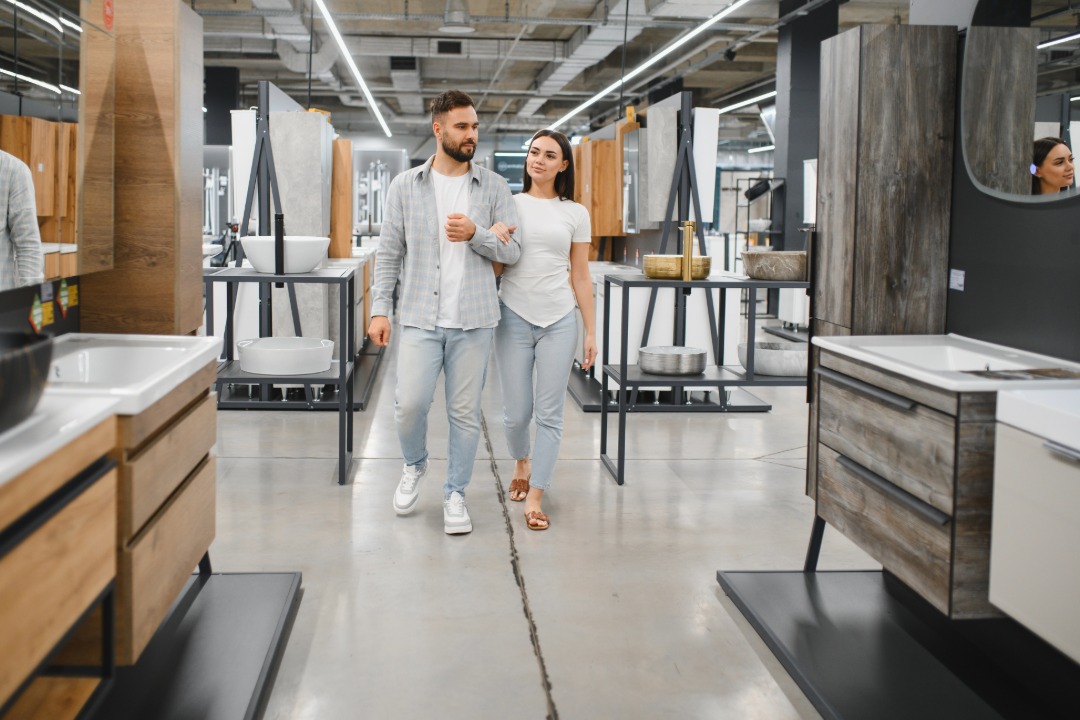
Walk into any successful retail showroom and look past the products. Look at the shelving. The display counters. The wall-mounted panels. The lighting rigs. The material sample stations. These are the fixtures. And in a well-branded showroom, every fixture tells the same story as the logo on the door.
Most businesses treat showroom fixtures as functional necessities. Something to hold the products. Something to fill the walls. They buy standard units from a catalogue, bolt them to the floor, and move on to the marketing budget.
That approach misses the point entirely. Custom showroom fixtures are not furniture. They are brand architecture. They shape how customers perceive your products, your quality standards, and your market position. When designed and built specifically for your brand, they become one of the most cost-effective branding investments a retail business can make.
This guide explains how custom fixtures translate directly into stronger branding, better customer engagement, and higher conversion rates.
Fixtures Communicate Brand Identity Before Anyone Says a Word
A customer walks into your showroom and absorbs dozens of visual signals within the first ten seconds. The colour palette. The material textures. The lighting quality. The spatial arrangement. These signals form an instant perception of your brand before a single salesperson approaches.
Standard off-the-shelf fixtures send a generic signal. They say nothing about who you are. A steel rack from a catalogue looks the same whether it holds luxury ceramics or budget hardware. It borrows no meaning from your brand. It contributes nothing to your brand story.
Custom fixtures speak your brand language. A premium kitchen brand can use solid wood display counters with precise joinery that mirrors the craftsmanship in its products. A modern furniture company can use clean-lined, modular steel frames finished in its signature brand colour. A sustainable brand can use recycled composite panels with visible texture that reinforces its environmental commitment.
Every material choice, every finish, every proportion in a custom fixture becomes a branding element. The customer does not analyse these details consciously. But their subconscious registers the consistency. And consistency is the foundation of brand trust.
Custom Fixtures Maximise Product Presentation
Standard fixtures are designed for generic use. They accommodate a range of products without being optimised for any specific one. The shelf depth may be too shallow for your product range. The display angle may not show the finish correctly. The lighting mount may not be positioned to highlight the texture or colour that differentiates your offering.
Custom showroom fixtures are designed around your specific products. The shelf depth matches the product dimensions exactly. The display angle is calculated to show the most attractive face. The lighting position highlights the material quality that sets your product apart from competitors.
For a modular interiors showroom, custom fixtures can display kitchen shutters at the exact angle that catches the grain pattern. They can present wardrobe hardware at hand height so customers can test the soft-close action. They can mount edge banding samples at eye level with proper lighting so the seal quality is visible.
This precision in product presentation is impossible with catalogue fixtures. A custom retail fixture designed for your specific product range turns every display into a selling tool rather than a storage surface.
Brand Consistency Across Multiple Locations
If your business operates multiple showrooms across different cities, brand consistency becomes a challenge. Each location may have a different floor plan, different ceiling height, and different available wall space. Standard fixtures from different suppliers create a patchwork look that weakens brand recognition.
Custom fixtures solve this by creating a unified design language. The same material palette. The same hardware style. The same proportions and finishes. Whether a customer visits your showroom in Hyderabad, Bangalore, Mumbai, or Delhi, the visual experience feels identical.
This consistency requires a manufacturing partner that can produce identical units at scale. A showroom fixture manufacturer with in-house production maintains the dimensional records, material specifications, and finish standards for every unit produced. When a new location opens, the fixtures match the existing ones exactly. No colour variations. No material substitutions. No dimensional drift.
This level of consistency is what separates a chain of branded showrooms from a collection of independent stores that happen to share a name.
Higher Perceived Product Value
The fixture quality directly influences how customers perceive the products displayed on them. A product sitting on a well-crafted wooden pedestal with concealed lighting appears more valuable than the same product sitting on a basic steel shelf.
This is not a design trick. It is a psychological reality. The display environment creates a quality context. Customers subconsciously extend the quality of the fixture to the product it holds. Premium fixtures elevate product perception. Cheap fixtures diminish it.
For brands selling mid-range to premium products, this perception gap matters. A showroom interior design that uses high-quality custom fixtures positions every product as worth the asking price. Good retail showroom design ensures the environment and the price tag speak the same language. The customer does not question the cost because the environment communicates value at every touchpoint.
The reverse is equally true. A premium product displayed on a flimsy, generic fixture creates cognitive dissonance. The product says quality. The fixture says budget. The customer leaves confused and unconvinced.
Space Optimisation Through Custom Dimensions
Indian retail spaces come in every shape and size. Column positions, irregular walls, stepped ceilings, mezzanine levels, and narrow frontages are common. Standard fixtures do not accommodate these realities. They leave awkward gaps. They block sightlines. They waste floor area that could be selling space.
Custom fixtures are built to the exact dimensions of your showroom. A wall unit that wraps around a structural column. A display counter that follows a curved wall. A ceiling-mounted fixture that hangs at the precise height allowed by the mezzanine above.
This dimensional precision maximises the number of products you can display without making the space feel crowded. Every square foot of floor and wall area is used productively. In cities where retail rent is measured in hundreds of rupees per square foot per month, this spatial efficiency has a direct impact on your return on investment.
A manufacturer with in-house manufacturing builds fixtures to non-standard dimensions as easily as standard ones. The CNC machines do not care whether the panel is 600 millimetres or 637 millimetres wide. Custom sizing is standard practice in factory production.
Modularity for Seasonal and Product Rotation
A showroom that looks the same every month becomes invisible to repeat visitors. The brain stops registering familiar patterns. Regular customers walk in, see nothing new, and walk out.
Custom modular fixtures solve this by enabling easy reconfiguration. Panels that slide into different positions. Shelves that attach and detach without tools. Display pods on wheels that can be moved to create new layouts.
This modularity allows you to refresh the showroom appearance every season without replacing the fixtures themselves. A new product launch gets a hero position at the entrance. A seasonal colour trend gets a dedicated feature wall. An outdated product line moves to a secondary zone.
The fixture system stays. The arrangement changes. The showroom feels fresh every quarter at a fraction of the cost of a full redesign.
Modular fixtures only work when every component is manufactured to precise tolerances. A shelf that does not click cleanly into a new position wobbles. A panel that does not slide smoothly along its track jams. Factory-built custom retail fixtures are engineered for repeated assembly and reconfiguration because the joints, channels, and connectors are tested for thousands of cycles.
Durability That Protects Brand Perception Long-Term
Showroom fixtures endure more daily wear than most home interior design furniture. Staff handle them constantly. Customers touch them. Products are loaded and unloaded. Cleaning chemicals contact the surfaces weekly.
Cheap fixtures show this wear quickly. Laminate edges peel. Paint chips on metal frames. Shelf surfaces scratch. The showroom starts looking tired within a year. And a tired-looking showroom tells the customer that the brand does not care about its own appearance.
Custom fixtures built with commercial-grade materials hold their finish for years. BWR plywood carcasses resist humidity and weight. High-pressure laminate surfaces handle daily cleaning without degradation. Powder-coated metal frames resist chipping and fading. Tempered glass panels withstand impacts.
The durability of the fixture is the durability of your brand impression. A showroom that looks as good on its third anniversary as it did on opening day communicates stability, quality, and pride. These are brand attributes that money cannot buy if the physical environment contradicts them.
The Factory Advantage for Showroom Fixtures
The quality gap between factory-built and on-site-assembled fixtures is most visible in a showroom. Because the customer is evaluating your products and your brand in this space, every imperfect joint, every misaligned panel, and every uneven finish undermines the trust you are trying to build.
Holzbox manufactures customised showroom fixtures in its own factory. Every display counter, wall unit, sample board, and consultation desk is designed, produced, and quality-checked under one roof. CNC-cut panels ensure dimensional accuracy across hundreds of identical units. Factory-applied finishes ensure colour consistency from the first fixture to the last.
When a brand’s showroom fixtures are built by the same team that builds the products on display, the quality language is unified. The fixtures and the products share the same manufacturing standards, the same material integrity, and the same finish quality. That alignment is something no off-the-shelf fixture can deliver.
Frequently Asked Questions
How do custom showroom fixtures improve branding?
Custom fixtures reinforce brand identity through material choices, colour consistency, proportions, and finish quality that align with the brand’s visual language. Unlike generic fixtures that communicate nothing about the brand, custom units create a cohesive environment where every surface, edge, and detail reflects the brand’s positioning. Customers absorb these signals subconsciously, which builds trust and strengthens brand recall without any verbal messaging.
Are custom showroom fixtures more expensive than standard ones?
The upfront cost is higher. Custom fixtures typically cost 30 to 50 percent more than standard catalogue units. However, they last longer because they are built with commercial-grade materials. They maximise space utilisation because they fit the exact showroom dimensions. And they contribute to higher conversion rates by presenting products in a more compelling context. Over the fixture’s lifespan, the return on investment usually exceeds what standard fixtures can deliver.
How long do custom showroom fixtures last?
Custom fixtures built with BWR plywood carcass, high-pressure laminate surfaces, and powder-coated metal components typically last 8 to 12 years with regular cleaning and minor maintenance. The modular components can be reconfigured multiple times during this period without losing structural integrity. Standard catalogue fixtures with lower-grade materials often need replacement within 3 to 5 years due to surface wear and structural fatigue.
Can custom fixtures be reused if I relocate my showroom?
Yes. Modular custom fixtures are designed for disassembly and reinstallation. The individual components can be transported and reassembled in a new location. Some adjustments may be needed if the new showroom has different dimensions. The carcass, panels, connectors, and most accessories remain reusable. This relocatability is a significant advantage over built-in carpentry fixtures that are permanently attached to walls.
What should I look for in a showroom fixture manufacturer?
Five things. First, verify that they manufacture in their own factory rather than outsourcing. Second, check whether they can produce identical units at scale for multi-location rollouts. Third, ask about the materials and finishes used for commercial-grade durability. Fourth, confirm whether the fixtures are modular and reconfigurable. Fifth, review past projects where they built fixtures for branded showrooms. A manufacturer with in-house manufacturing capability offers the precision, consistency, and accountability that branded retail environments demand.