
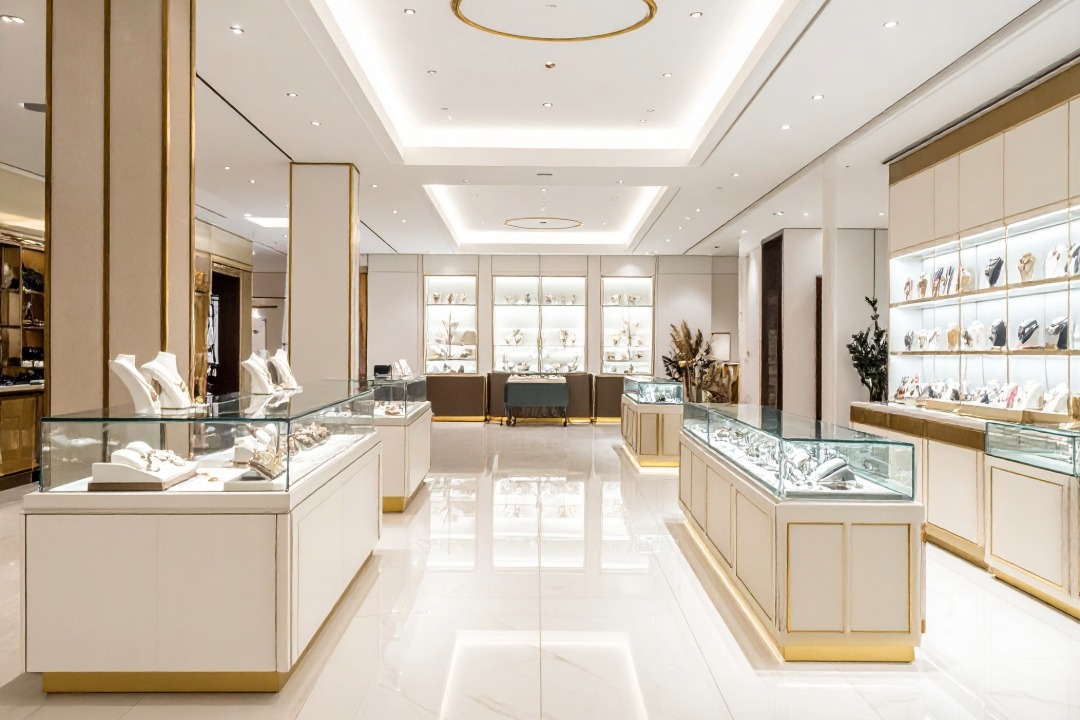
A jewellery showroom is not just a shop. It is a stage. Everything a customer sees, touches, and feels inside the space is either building the confidence to make a significant purchase or quietly eroding it. Unlike most retail categories, jewellery is bought slowly, compared carefully, and often revisited two or three times before a final decision. The interior has to work through every one of those visits, from the first walk in to the final closing conversation at the counter.
Getting a jewellery showroom interior right is a discipline of its own. Lighting has to reveal metal and stone in their most flattering form. Display cabinets have to protect valuable stock while making each piece look effortless. Seating has to allow long consultations without visible fatigue. Materials have to signal permanence and quality. Security has to be present but never obtrusive. Get these elements aligned and the showroom sells for you. Get them wrong and even excellent product struggles to move.
This guide walks through how to design a jewellery showroom interior for maximum impact, covering zoning, display cabinets, lighting, materials, seating, security integration, and the finishing details that turn a good store into a memorable one. Every recommendation is drawn from real retail showroom design projects across India, from single counter boutiques to multi floor flagships.
Why Jewellery Showroom Interiors Follow Rules of Their Own
Most retail interiors are designed to move volume quickly. Jewellery works differently. A single sale can equal a week of turnover in a garment store. The customer expects to spend time. They will inspect a piece from multiple angles, ask to see two more like it, sit down to think, meet a family member the next day, and only then commit. The interior has to sustain that entire cycle without ever feeling tired or transactional.
This means jewellery showroom design carries an unusual load. It must feel premium without being intimidating. Inviting without being casual. Secure without being clinical. And every design decision has to work under the specific optical demands of gold, silver, diamonds, and coloured stones, each of which reflects and absorbs light differently. Good jewellery showroom design is essentially the art of holding attention long enough for trust to build.
The showrooms that do this well tend to share a common backstage decision. Their fixtures, cabinets, and joinery are manufactured in a factory to precise specifications, not built on site by general carpenters. A full service modular furniture manufacturer with its own production floor is the only way to achieve the tight tolerances, flush finishes, and integrated lighting slots that jewellery display demands.
Zone the Showroom Around the Buying Journey
The best jewellery showrooms are planned as a sequence of experiences, not a single room full of counters. Break the floor into four zones and design each for its specific role.
The entry zone is where the customer forms their first impression. Keep it uncluttered, softly lit, and framed by a signature display of the current season or a heritage collection. The browse zone holds the main display cabinets, arranged so customers can move between categories without backtracking. Gold, diamond, silver, and coloured stone sections each get their own visual identity while sharing a common architectural language. The consultation zone is where serious buyers sit down with staff to review shortlisted pieces. This is where sales actually close. The support zone at the back holds billing, packaging, secure storage, and the private viewing room for high value clients.
Sightlines matter. The customer standing at the entry should get a sense of the whole floor without seeing everything at once. This is the kind of choreographed layout that thoughtful retail showroom design delivers when the space is planned around behaviour, not around available wall length.
Display Cabinets and Counters That Do the Selling
The display cabinet is the single most important piece of furniture in a jewellery showroom. Everything else supports it. A poorly built cabinet with wobbly glass, uneven lighting, or visible cable joints devalues the product inside it, no matter how expensive the jewellery is.
There are three cabinet formats every jewellery showroom needs. The wall counter runs along the perimeter and holds the main inventory. It should be built at 900 to 950 mm height for comfortable standing browsing, with the sloped viewing glass tilted at roughly 15 to 20 degrees to reduce glare. The island counter sits in the centre of the floor for high margin categories like diamond solitaires or bridal sets, allowing 360 degree viewing. The pedestal display or hero cabinet showcases signature pieces at eye level, often at the entry or between zones.
Inside each cabinet, the details are everything. Low iron glass, sometimes called extra clear glass, prevents the greenish tint that standard tempered glass adds to displayed pieces. Micro LED strips concealed in a slim aluminium channel deliver even light across the display without hot spots. Removable velvet or suede lined trays make restocking quick and allow the store to change layouts without dismantling the cabinet. Every one of these details is easier to specify when working with a purpose built modular cabinet manufacturer that produces the units in a controlled factory environment.
Lockable access from the staff side, integrated wire routing for lighting, and reinforced base panels for security fittings all need to be planned into the cabinet design from the beginning. Retrofitting these later is difficult and rarely looks clean. Working with a modular cabinet manufacturer that produces showroom furniture in a controlled factory environment is what makes these details achievable at scale.
Lighting: The Single Most Important Design Decision
Lighting sells jewellery. Nothing else in the interior comes close. A brilliant piece placed under the wrong light looks dull. An average piece placed under the right light looks brilliant. The lighting design deserves as much attention as the entire rest of the interior combined.
A jewellery showroom needs three overlapping layers of light. Ambient light fills the space at a comfortable overall level, typically warm white in the 3000 to 3500 Kelvin range for gold heavy stores and cooler 3500 to 4000 Kelvin for diamond focused showrooms. Accent light is delivered through concealed strips inside display cabinets and directional spots aimed at hero pieces. This is where the sparkle comes from. Task light supports the consultation area so staff can see clearly when handling small pieces and the customer can inspect detail comfortably.
Colour rendering index, or CRI, matters more than wattage. Insist on CRI 90 plus for all display fixtures. Below this threshold, colours in stones and metal tones look flat and slightly off, and customers notice without being able to name why. Beam angles should be tight, typically 15 to 24 degrees, so the light lands precisely on the piece and not on surrounding cabinet edges.
Glare control is the final piece. Deep set fixtures, honeycomb louvres, and anti glare shields prevent bright spots from bouncing off the glass into the customer eye line. A cabinet that forces the customer to tilt their head to avoid glare loses sales it should have won.
Material and Finish Palette That Says Timeless
Jewellery showroom interiors age in public view. The palette should still feel current five years from now. Restraint wins over trend chasing every time. Three material families usually cover the design brief.
The primary surface is a warm wood veneer or PU coated panel in a muted tone such as walnut, oak, or a soft champagne. This carries the joinery, feature walls, and cabinet framing. The secondary material is a natural or engineered stone such as beige marble, quartzite, or a subtle terrazzo used on counter tops and select feature panels. The metallic accent, in brushed brass, champagne gold, or matte black, ties hardware, light fittings, and signage together.
Sustainable sourcing matters here too. Serious buyers increasingly ask about the origin of materials used in a space. Working with a manufacturer that offers responsible material sourcing across timber and finishes gives the store an honest answer to that question and protects the brand from future scrutiny.
Flooring deserves a separate mention. Polished natural stone or large format porcelain in a mid tone hides scuffs, cleans easily, and reflects just enough of the cabinet lighting to make the whole showroom feel luminous without becoming a mirror.
Integrate Security Into the Interior
Security in a jewellery showroom cannot look like security. Visible cameras pointing directly at customers, metal shutters inside the sales floor, and obvious sensor boxes on cabinets all cheapen the experience. The design brief should include security from day one so cameras are recessed into ceiling coves, cabinet locks are integrated flush into the frame, and safe rooms are accessed through joinery panels that read as regular wall.
Discreet sensors on high value cabinets, panic buttons built into the underside of consultation tables, and cash counting nooks placed away from the customer sight line all belong in the design conversation. Security consultants and interior designers should be talking to each other before the first cabinet is manufactured, not after installation.
Consultation Seating That Supports Long Conversations
Jewellery is often bought sitting down. The consultation seating is where the final decision happens, so it needs to work harder than most people realise. Upholstered chairs with medium firm cushioning support 30 to 60 minute conversations without fatigue. The table between the customer and the staff member should be low enough to place trays comfortably, roughly 700 to 750 mm, with a soft matte surface that does not reflect overhead light onto the piece being examined.
A mirror at appropriate height is essential for necklaces, earrings, and bangles. Position it so the customer sees themselves under warm, flattering light, similar in quality to what they will experience when actually wearing the piece. Cold overhead mirror light kills more sales than any other lighting mistake.
Signage, Storage, and the Small Details
Wayfinding inside a jewellery showroom should be visual, not textual. Category identity is communicated through cabinet design and lighting temperature, not through printed signs above each section. Behind the scenes, storage for stock, packaging, tools, and daily supplies needs to be planned as carefully as the display side. Considered space optimization and planning at the back of house keeps the sales floor clean and lets staff work efficiently.
Packaging counters, gift wrap stations, tea and coffee service for waiting family members, a discrete washroom for high value clients, and dedicated storage for stationery and forms all deserve a place in the plan. The best showrooms treat these support elements with the same care as the display cabinets. And once everything is installed, professional installation and long term after sales support matters because a cabinet lock or lighting driver failing during business hours costs real money.
Frequently Asked Questions
How much does it cost to design and fit out a jewellery showroom in India?
Jewellery showroom fit out costs vary widely depending on floor area, material grade, lighting specification, and security integration. A boutique of 500 to 800 square feet with premium materials typically costs significantly more per square foot than a general retail store because of custom cabinets, low iron glass, high CRI lighting, and integrated security. A mid size showroom of 1500 to 2500 square feet with island counters, a consultation zone, and a private viewing room falls into a higher total range. The right approach is to get an itemised quote after a site visit rather than working from per square foot averages, because material and lighting choices swing the total significantly.
What is the best material for jewellery display cabinets?
The cabinet carcass should be built from BWP grade plywood or HDHMR board for dimensional stability and long life. Exterior finishes commonly use wood veneer with a matte PU topcoat for warmth, or high pressure laminate for durability. The glass should be low iron tempered for clarity, ideally 8 to 10 mm thick with polished edges. Interior linings are usually velvet, suede, or ultrasuede in a colour that flatters the product, cream or grey for gold, dark charcoal or navy for diamonds. LED strips should be housed in aluminium channels for even light distribution and easy replacement.
What kind of lighting works best in a jewellery showroom?
Layered LED lighting works best. Ambient light between 3000 and 4000 Kelvin depending on whether the store leans gold or diamond, accent spots at 15 to 24 degree beam angles aimed at hero pieces, and integrated cabinet strips for even display illumination. Colour rendering index should be CRI 90 or higher across every fixture. Standard shop lighting with CRI 70 to 80 makes stones look flat and metal tones look off. Dimmers and warm white options in consultation areas let staff adjust the mood for high value discussions.
How long does it take to build a jewellery showroom from scratch?
For a mid size jewellery showroom of 1500 to 2500 square feet, the typical timeline is ten to fourteen weeks from design approval to store ready. Civil work, false ceiling, flooring, and electrical run in parallel with factory manufacturing of cabinets, counters, and joinery. On site installation of modular units happens in the last three to four weeks, followed by lighting fine tuning, security integration, and merchandising. Delays usually come from civil work or last minute design changes, not the furniture itself. Locking the design early and keeping the scope stable is the single largest factor in hitting the target open date.
Should jewellery showroom furniture be modular or custom built on site?
Modular furniture built in a factory almost always outperforms on site carpentry for jewellery showrooms. Factory production delivers uniform panel thickness, precise glass fits, integrated lighting channels, flush hardware, and consistent finishes that are almost impossible to achieve with hand tools on site. Installation is also faster and cleaner, which matters when the store has an opening date. Modular units can be reconfigured or expanded later without a full renovation, which is useful for stores that plan to add categories or refresh the layout every few years. For any jewellery showroom that reflects a serious brand, factory built modular is the more reliable choice.
Ready to Design a Showroom That Sells for You
A well designed jewellery showroom interior does more than display product. It builds the confidence that lets customers spend meaningfully, brings them back for repeat purchases, and turns them into the source of the next referral. Achieving that outcome takes a combination of considered zoning, precise cabinets, disciplined lighting, restrained materials, and showroom furniture built by a manufacturing partner who can deliver every fixture at the tolerance the category demands.
Working with a full service modular furniture manufacturer that operates its own factory setup gives you tighter control over quality, timelines, and cost. Every cabinet, counter, and joinery panel is measured, produced, and finished for your exact showroom, then installed by a team trained on the same product family. That is what turns a retail space into a jewellery showroom worth visiting.
Ready to plan a showroom that reflects the value of what you sell? Book a free consultation with our design team.