
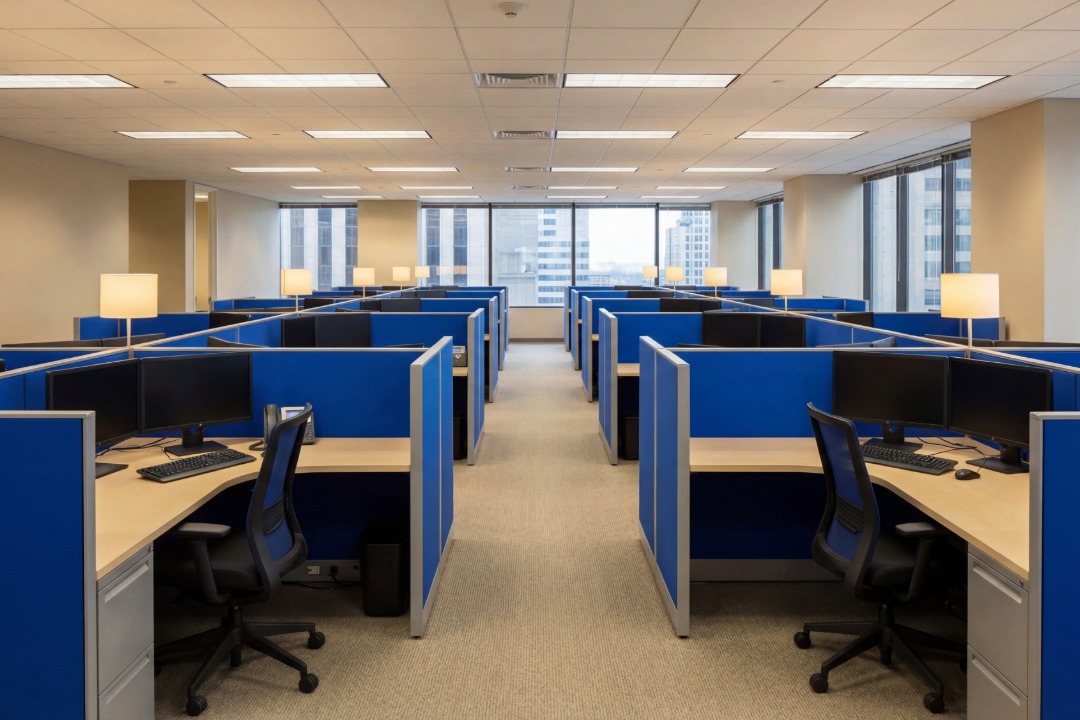
Every growing company hits the same wall. The team doubles in eighteen months, a new department gets carved out of the sales floor, hybrid rotations shift how many people sit in the office on any given day, and the furniture stops keeping up. The layout that once felt roomy now feels boxed in. Rows of heavy pedestal desks refuse to move without three people and a screwdriver. Meanwhile, a competitor down the road just reconfigured their entire floor in a weekend. The furniture decision made two years ago is quietly slowing the business down. This is the real cost of choosing wrong between modular workstation clusters and fixed desks, and it is why scalability now sits at the centre of every serious office fit-out conversation.
Understanding What You Are Actually Comparing
Fixed desks are exactly what the name suggests. Each unit is a standalone piece of furniture, usually with an attached pedestal, sometimes bolted to the floor or paired with individual partitions. They are built as complete objects, delivered as complete objects, and expected to stay where they are placed. Any change to the layout means uninstalling the piece, potentially damaging finishes, and often ordering a replacement because the old one no longer fits the new geometry.
Modular workstation clusters take a different structural approach. The system is built on a shared spine of components. Common legs, shared beam frames, interchangeable worktops, snap-on partitions, movable pedestals, and integrated cable trays. The individual seat is not a standalone unit. It is a slot within a larger system that can be extended, shortened, split, or rearranged by adding or removing panels rather than rebuilding from scratch. This is the core difference that determines how each option behaves when your team grows, shrinks, or restructures.
The Cost Economics of Scaling Up
On day one, a well-made fixed desk can look cheaper per seat than a modular workstation cluster. The comparison usually stops there in most procurement decks. But the cost picture changes sharply once you factor in what happens over three to five years of typical business growth.
Where fixed desks quietly get expensive
- Rebuys on every reconfiguration. When you add ten seats to a row of fixed desks, you often need matching units. If the model is discontinued, the entire row gets replaced for visual consistency.
- Higher installation labour every time. Fixed desks require the same install effort each time they move. Modular systems reuse the frame and swap only what changed.
- Wasted panels and shells. Removed fixed desks rarely find a second life inside the same office. They end up in storage or scrapped.
Where scalable office furniture earns back its price
Scalable office furniture built on a modular chassis lets you add a seat by clipping in one more worktop and pedestal. You reuse the beam, the legs, the wiring channel, and the partition system. The marginal cost of the eleventh seat is a fraction of the cost of the first seat. Over three years, most growing teams recover the price premium of modular workstation clusters within the second reconfiguration. From then on, every layout change is nearly free compared to the fixed desks alternative.
Flexibility When Business Priorities Shift
No business plans for its own reorganizations, but they happen every eighteen to twenty four months in most growing companies. A new product team spins up. A department merges. Hybrid attendance drops seat requirements by thirty percent. A leadership change wants an open pod near the CEO. Every one of these events is a layout problem in disguise.
Fixed desks answer these events with disruption. Furniture gets uninstalled, teams work from cafes for two days, IT reruns cables, cleaners come in on the weekend. Modular workstation clusters answer the same events with a Saturday morning. Partitions unclip, worktops slide along the beam, pedestals wheel to new positions, and the pod is ready by Monday. The productive difference between these two scenarios, multiplied by every restructure over five years, is not a minor operational detail. It is a real budget line.
For businesses actively planning growth, our
For businesses actively planning growth, our space optimization and planning services show how modular clusters absorb changes without turning every reorganization into a fit-out project.
What Manufacturer Control Actually Changes
Most office furniture in India is assembled from imported knock-down components, sold through trading channels with limited say in what actually gets built. That model works for standard sizes and standard finishes. It falls apart when you need custom depths, non-standard runs, specific cable pathways, or a cluster shape that does not match a catalogue drawing.
As a modular office furniture manufacturer with our own factory setup in Hyderabad, the calculation is different. Every panel is cut on precision CNC machinery under our own quality control. Every edge-band, drilling pattern, and hardware placement is verified in-house before dispatch. If a client needs a cluster with a curved outer edge, an eighty centimetre worktop instead of the standard seventy, or a partition height between the two catalogue heights, we make it. Trading partners cannot do this because they are limited to what their upstream supplier ships. This is why manufacturer-direct modular office furniture consistently outperforms imported fixed desks on both fit and durability in Indian offices.
Density, Wellbeing, and the Hybrid Question
Post pandemic, the seat count question has fundamentally changed. Attendance on a Tuesday is not attendance on a Friday. Assigned seating is losing ground to shared clusters, hot desking zones, and quiet focus pods. Fixed desks were designed for a workplace model that assumed everyone showed up every day. They do not adapt gracefully when three out of ten seats are empty for half the week.
Modular workstation clusters are naturally suited to variable occupancy. A cluster of eight can be reset overnight into two collaboration tables and four focus seats. Storage pedestals migrate to a lockers wall so the desks stay clear for whoever books them. Height-adjustable frames slot into the same footprint without redesigning the row. The office starts to breathe with the week instead of standing empty when attendance dips.
Wellbeing factors that get overlooked
- Cable management. Modular systems route power and data through the beam. Fixed desks often push cables to the floor, creating trip hazards and cleaning headaches.
- Acoustic control. Snap-on acoustic partitions upgrade a cluster in minutes. Adding acoustics to fixed desks usually means retrofitting screens that were not designed for the desk.
- Personal territory. Modular pedestals and screen dividers give employees a defined space without walling them off, which fixed rows either overdo or ignore.
When Fixed Desks Still Make Sense
This is not a case against fixed desks in every scenario. There are workplaces where a fixed setup is genuinely the better answer. Executive cabins where the desk is a statement piece. Reception counters that anchor a brand experience. Design studios where a specific desk depth or drawer configuration matters more than modularity. Small teams in permanent single-floor offices with no growth plans.
In these cases, custom fixed desks manufactured to exact requirements deliver a look and permanence that modular systems intentionally avoid. The right question is not modular versus fixed as a blanket rule. It is which parts of your floor plan actually benefit from permanence, and which parts need to stay ready for change.
A Straightforward Framework for Choosing
Rather than a checklist, a few honest questions cut through most of the noise.
- Team headcount in three years. If your projected count sits within twenty percent of today, fixed desks are viable. If it swings more than that, modular is safer.
- Frequency of reorganizations. Two or more restructures inside three years tilts the answer decisively toward modular workstation clusters.
- Hybrid attendance pattern. If office attendance varies by more than thirty percent through the week, modular scales down and up without wasted footprint.
- Cable and tech intensity. Roles with multiple monitors, docking stations, and daily power draw benefit from integrated modular cable management.
- Fit-out timeline. Modular clusters install faster because the frame is a shared system. Fixed desks require unit-by-unit alignment.
For a broader view of how office layout decisions connect to team performance, our related read on designing conference rooms that encourage productive meetings covers the collaboration side of the same floor plan.
The Bottom Line on Scalability
Fixed desks solve a static problem. They work best when the office is a fixed environment. Modular workstation clusters solve a moving problem. They work best when the office is expected to grow, shrink, restructure, or shift between assigned and shared use. Most modern businesses fall into the second category, whether they admit it in the initial procurement brief or discover it eighteen months later when the first reorganization forces the question.
The scalability advantage of modular office furniture is not marketing language. It is a compounding cost, time, and disruption advantage that shows up every time the business changes. And in a market where the business always changes, that is the difference between furniture as an asset and furniture as a recurring liability. If you are planning the next phase of growth, choosing a manufacturer with in-house production and modular expertise is what protects the investment from day one.
Frequently Asked Questions
Are modular workstation clusters more expensive than fixed desks upfront?
The per seat cost of a well-built modular workstation cluster is usually five to fifteen percent higher than a comparable fixed desk on the first purchase. The gap closes and reverses within the first reconfiguration because modular systems reuse frames, legs, cable channels, and partitions. Fixed desks typically need full replacement units when the layout changes. Over three years, most companies with any growth or restructuring plans save meaningful money on modular. The right comparison is not day one price. It is total cost of ownership across the expected life of the furniture.
How fast can a modular cluster be reconfigured compared to fixed desks?
A typical eight seat modular cluster can be reset into a new layout in four to six hours by a two person team, without ordering new material. The same layout change on fixed desks usually takes two to three days because units must be uninstalled, sometimes stored, and matching replacements ordered. Cable management adds another day for fixed desks since the wiring is not integrated into the frame. This speed difference is why modular systems are the default choice for offices that expect to restructure every twelve to twenty four months.
Do modular workstation clusters compromise on aesthetics or durability?
Not when they are manufactured properly. Modern modular office furniture uses the same core materials as premium fixed desks. High grade engineered boards, powder coated steel frames, laminate or veneer finishes, and branded hardware from Hettich, Blum, or equivalent. The visible finish quality depends entirely on the manufacturing process, not on whether the system is modular. Factory-produced modular clusters from a full manufacturer often surpass trading channel fixed desks on both look and lifespan because every panel is cut, edge-banded, and finished under one quality regime rather than sourced from multiple upstream suppliers.
Can modular workstation clusters support height-adjustable desks and ergonomic upgrades?
Yes. Most contemporary modular systems are designed to accept height adjustable frames within the same footprint. Motorized sit-stand mechanisms slot in as a direct swap for fixed height legs. Monitor arms, keyboard trays, task lighting, and cable spines integrate through the shared beam. This is significantly harder on fixed desks, where the desk shell is often built as a single moulded unit that cannot accept aftermarket ergonomic upgrades. If ergonomic flexibility is a priority for the workforce, modular clusters are the more future ready choice.
How do I decide between modular and fixed desks for a mixed office layout?
Very few offices need only one type. The practical answer is usually a hybrid layout. Modular workstation clusters for open floor teams that grow, shift, or restructure. Fixed desks for executive cabins, reception counters, and specialist workstations where the setup is permanent by design. A good office workstation manufacturer will design the two systems to share a visual language, common finishes, and matching hardware families, so the office reads as one coordinated environment rather than a mix of unrelated pieces. Starting the conversation with a proper site measurement and layout study prevents both over-modularising permanent zones and under-preparing flexible zones.
Planning Your Next Office Fit-Out
If your growth plans call for office furniture that scales with the business rather than against it, working with a manufacturer that runs its own factory and controls every stage of production makes the difference. Holzbox designs, manufactures, and installs modular workstation clusters and custom fixed desks across India, all under one quality-controlled roof. To discuss your layout, visit our office interior design services page or book a free consultation to start with a precise site measurement.