
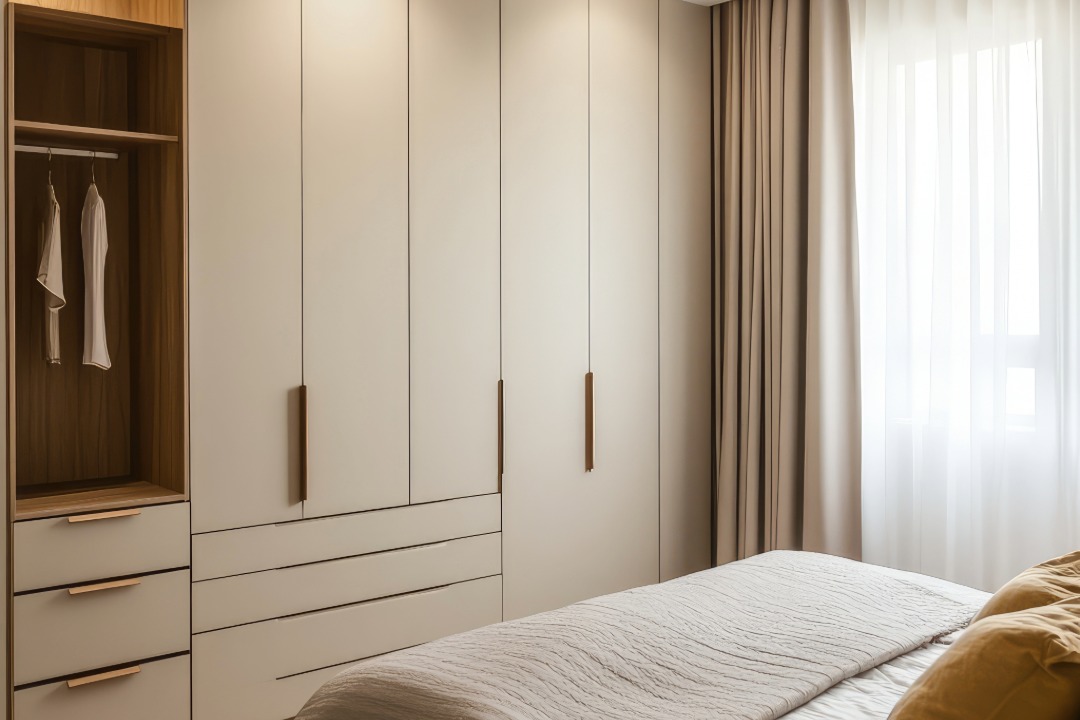
A wardrobe is one of the few pieces of furniture you use every single day without exception. Morning and night. Weekday and weekend. Rushed and relaxed. Over ten years, that adds up to roughly 7,000 interactions with the same shelves, hinges, drawers, and hanging rods.
When the wardrobe is designed well, you barely notice it. Everything is in its place. Your mornings run smoothly. When the wardrobe is designed poorly, you feel it every day. Clothes pile up on shelves that are too high. Drawers jam because the runners are cheap. The finish peels near the edges because nobody checked the material grade.
After years of manufacturing modular wardrobes and seeing what works and what fails after installation, here are the most common mistakes homeowners make during the design stage. These are not cosmetic issues. They are functional failures that affect how the wardrobe performs for the next decade.
Mistake 1: Designing the Interior Without Taking a Clothing Inventory
This is the most frequent mistake and the one with the biggest impact on daily use. Most homeowners design their wardrobe based on a rough idea of what they own. They ask for “some shelves, some hanging space, and a couple of drawers” without calculating what actually needs to fit inside.
The result is a wardrobe that runs out of hanging space within six months. Folded clothes overflow the shelves. Accessories end up in plastic bags on the floor of the wardrobe because there is no dedicated section for them.
Before the internal layout is drawn, take a complete inventory. Count your hanging garments separately by type. Shirts, trousers, kurtas, sarees, dresses, jackets, and coats all need different hanging heights. Count your folded items. Measure the stack heights. Count your accessories. Note the shoe pairs, bags, and bulky items like blankets and suitcases.
This inventory becomes the design brief. A wardrobe design professional will use it to allocate the right amount of long-hang, short-hang, shelf, drawer, and loft space. Without it, the internal layout is a guess. And guesses always run short.
Mistake 2: Using One Carcass Material for the Entire Wardrobe
Not every section of the wardrobe faces the same conditions. The base cabinet near the floor is exposed to moisture from floor mopping. The section near an external wall may face condensation during monsoon in humid cities like Mumbai, Chennai, or Kochi. The loft section at the top is dry and rarely touched.
Using particle board or standard MDF for the entire carcass saves money upfront. But the lower panels start swelling within two to three years because they absorb moisture from the floor. The edges near external walls peel because the material was never designed for sustained humidity.
The smart approach is zone-based material selection. BWR plywood for the base and any section adjacent to external walls. HDHMR or MDF for the upper sections and internal shelves where moisture exposure is minimal. This approach costs 10 to 15 percent more than a uniform material choice but prevents the premature failure that forces an expensive replacement.
A modular wardrobe manufacturer with in-house production can use different board grades in different zones within the same unit. A company selling fixed catalogue modules typically uses one material throughout because their production does not support mixed-material assembly.
Mistake 3: Choosing the Door Type Before Measuring Room Clearance
Many homeowners walk into a showroom, see a beautiful sliding wardrobe, and decide on the spot. They do not check whether their bedroom has the right conditions for sliding doors. Or they choose hinged doors because they are cheaper without confirming that the bed does not block the swing path.
Hinged doors need 18 to 24 inches of clearance in front. If your bed sits closer than that, the doors hit the frame every time you open them. The constant impact loosens the hinges and damages the shutter edge.
Sliding doors need a minimum wardrobe width of 5 to 6 feet to work well. On a narrow wardrobe under 4 feet, the overlapping panels leave very little visible interior. You end up seeing only one-third of the wardrobe at any time.
Measure first. Decide second. This simple sequence avoids one of the most expensive mistakes in bedroom interior design.
Mistake 4: Ignoring Future Storage Needs
Your wardrobe needs to work for the next ten to fifteen years. But most people design based on what they own today. They do not account for the natural growth of a household’s clothing inventory.
A couple setting up their first home will accumulate winter wear, formal wear, traditional clothing for festivals, and children’s items over the next few years. A single professional who travels frequently will add luggage, seasonal gear, and work accessories.
Build in a 20 percent storage buffer. If your current inventory fills 80 percent of the wardrobe at move-in, you have room for five to seven years of growth. If it fills 100 percent on day one, you are already out of space before the first anniversary.
One practical solution is to include adjustable shelves. Shelves mounted on removable pins can be repositioned as your storage needs change. Fixed shelves cannot be moved without disassembling the carcass.
Mistake 5: Accepting Budget Hardware to Save Money
Hardware is the most underestimated component of a wardrobe. Homeowners spend hours choosing the shutter colour and five minutes on the hinges. But the hinges, drawer runners, and hanging rods determine how the wardrobe feels in your hands every single day.
Budget hinges without soft-close action allow the door to slam. Within a year, the slamming loosens the hinge screws. The door starts to sag. The alignment goes off. The shutter rubs against the adjacent panel.
Roller-type drawer channels jam after a few months of daily use. They do not extend fully, so you can only access the front half of the drawer. Items at the back become invisible and forgotten.
Upgrading from basic to branded soft-close hardware from Hettich or Blum costs 5,000 to 12,000 rupees on a standard wardrobe. That investment protects you from a decade of daily frustration. It is one of the highest-return upgrades available.
Mistake 6: Not Planning Internal Lighting
A wardrobe without internal lighting forces you to rely on room lights, which cast shadows inside the cabinet. You cannot see colours accurately. Dark-coloured garments all look the same. The back of deep shelves is a black hole where things disappear.
Internal LED strips with motion sensors solve this completely. They activate when you open the door and illuminate every corner of the interior. Colours are visible. Patterns are distinguishable. Finding what you need takes seconds instead of minutes.
LED strips are inexpensive. A full wardrobe lighting setup costs 2,000 to 5,000 rupees. But it needs to be planned during the design stage. The electrical point must be positioned correctly. The LED channel must be integrated into the carcass structure. Retrofitting lighting into a finished wardrobe is possible but always messier and more expensive than building it in from the start.
Mistake 7: Skipping the 3D Render Before Approving the Design
A floor plan sketch shows dimensions. But it does not show you how the wardrobe will look in your room. It does not show the proportions of the shutter panels relative to the wall. It does not reveal whether the wardrobe overwhelms the room or leaves awkward gaps on either side.
A 3D render shows all of this. It lets you see the wardrobe from multiple angles with the actual finish, handle style, and height visible in the context of your bedroom. It reveals design problems before production begins, when fixing them costs nothing.
If your bedroom interior design includes a matching headboard wall, side tables, or a dresser, the 3D render shows how all the pieces relate to each other. Without it, you are relying on imagination. And imagination frequently misses the details that matter.
Any serious home interior design company offers 3D visualisation as a standard part of the design process. If a manufacturer skips this step and goes straight to production, they are cutting a corner that could cost you a rework.
Mistake 8: Not Verifying the Manufacturer’s Production Setup
This mistake ties everything else together. The material grade, edge banding quality, hardware calibration, and dimensional accuracy all depend on how the wardrobe is built and where.
A company with its own factory controls every variable. Panels are cut on CNC machines. Edge banding is applied on automated lines. Hardware is tested on the actual panels before dispatch. Every module is inspected before it leaves the production floor.
A company that outsources production has no control over these variables. Panels may come from one workshop. Shutters from another. Hardware from a distributor. Nothing is tested together. When something does not fit during installation, the blame gets passed around while you wait.
Holzbox manufactures modular wardrobes in its own factory. That means every panel, every edge, every hinge, and every drawer is produced, assembled, and quality-checked under one roof. This level of integration is what separates a wardrobe that performs for a decade from one that starts failing in year two.
Before you sign a contract, ask to see the factory. If the company does not have one, you are not working with a manufacturer.
Frequently Asked Questions
What is the most common mistake people make when designing a wardrobe?
Designing the internal layout without taking a clothing inventory. Most homeowners estimate their storage needs loosely and end up with too little hanging space, shelves that are the wrong height, and no dedicated sections for accessories. The fix is simple. Count your garments by type. Measure your stacks. Note your accessories. Hand this inventory to your wardrobe design professional and let the layout follow the data, not a guess.
Should I use the same material for the entire wardrobe carcass?
No. Different zones of the wardrobe face different conditions. The base section near the floor and any panels adjacent to external walls should use BWR plywood for moisture resistance. Upper sections and internal shelves can use HDHMR or MDF, which cost less and perform well in dry conditions. This zone-based approach saves money where possible and protects the wardrobe where it matters most.
How much should I spend on wardrobe hardware?
Mid-range branded hardware from Hettich or Hafele costs 8,000 to 15,000 rupees for a standard bedroom wardrobe. This tier includes soft-close hinges, full-extension ball-bearing drawer runners, and sturdy hanging rods. The upgrade from basic to branded hardware is one of the most cost-effective investments in the wardrobe because it directly affects daily comfort and long-term durability.
Is internal lighting really necessary in a wardrobe?
It is not strictly necessary. But it makes a significant difference in daily usability. LED strips with motion sensors cost 2,000 to 5,000 rupees and illuminate the entire interior when you open the door. Colours are visible. Deep shelves are no longer dark corners. Morning outfit selection becomes faster and more accurate. Plan the electrical point during the design stage to avoid retrofitting costs later.
How do I verify if a company is a real manufacturer or just a dealer?
Ask to visit the factory. A genuine modular wardrobe manufacturer will show you the CNC machines, edge banding lines, assembly stations, and quality inspection checkpoints. Look at how raw materials are stored and whether incoming boards are tested before production. A company with in-house manufacturing will welcome this visit. A dealer or assembler will either decline or redirect you to a showroom. The factory visit is the most reliable verification available.