
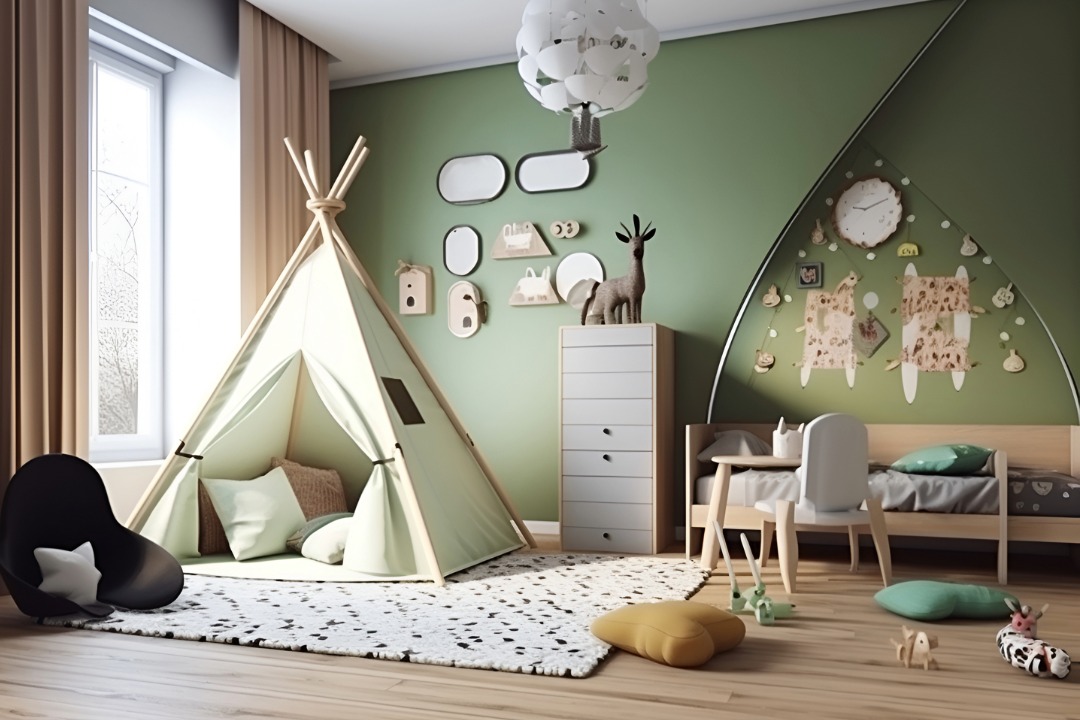
A child’s room in an Indian apartment is rarely larger than 80 to 100 square feet. In many 2BHK flats, it is closer to 60. That small room needs to function as a bedroom, a study zone, a play area, and a storage unit for clothes, toys, books, and school supplies. All at the same time.
Most kids room design guides show you beautiful images of themed rooms with open floor space and custom furniture. Those rooms are 200 square feet in a villa. They do not solve the problem you are facing in a compact apartment where the bed alone occupies 40 percent of the floor.
This guide focuses on the engineering side of kids room design for small spaces. Whether you are working with a small bedroom under 80 square feet or a shared room for two children, these space saving ideas go beyond decoration. How to recover floor area. How to build storage that does not crowd the room. How to create a study zone that fits without sacrificing play space. And how to design a room that grows with your child instead of needing a complete redesign every three years.
The Bed Decides Everything in a Small Room
In a small kids room, the bed is the largest piece of furniture. Where it goes and what it does determines how much usable space remains for everything else.
A standard single bed occupies roughly 18 to 20 square feet of floor area. In a 70-square-foot room, that is nearly 30 percent of the space consumed by one function: sleeping. The goal is to make the bed do more than just hold a mattress.
A storage bed with pull-out drawers underneath recovers the entire footprint of the bed for storage. Toys, seasonal clothes, extra bedsheets, and school supplies can live in those drawers instead of occupying a separate cabinet.
A loft bed elevates the sleeping surface to five or six feet above the floor. The space below becomes a study desk, a reading nook, or a play zone. In a room where floor area is the scarcest resource, lifting the bed off the ground effectively doubles the usable space.
For two children sharing a room, a bunk bed is not just space-efficient. It is necessary. A bunk bed occupies the same floor area as one single bed but sleeps two. Stairs with built-in drawers in each step add storage without adding any additional footprint.
These bed configurations require precise manufacturing. A loft bed that wobbles is unsafe. A bunk bed with uneven legs creates anxiety for the parent and the child. A storage bed with drawers that jam is worse than no drawers at all. Factory-built modular furniture with CNC-cut panels and tested hardware eliminates these risks. Every joint is calibrated. Every drawer is tested. Every surface is edge-sealed and child-safe.
Vertical Storage: Using Walls Instead of Floor
When the floor is limited, the walls become your primary storage surface. Most small kids rooms use only the lower four feet of the wall. The upper four feet sit empty, collecting nothing but dust.
Wall-mounted shelves at varying heights store books, toys, and display items without consuming any floor space. Open shelves for frequently used items. Closed cabinets with soft-close doors for items that should stay out of sight.
A floor-to-ceiling wardrobe along one wall replaces the need for a separate dresser, a standalone bookshelf, and a toy storage unit. The internal layout can be divided into hanging sections for school uniforms and daily wear, shelves for folded clothes, drawers for accessories, and a dedicated section for toys and games.
Pegboard panels mounted on the wall above the study desk hold stationery, art supplies, and small shelves in a customisable arrangement. The child can rearrange the pegs and hooks as their needs change. This flexibility makes the pegboard useful from age five through fifteen.
A manufacturer with in-house production builds wall units to the exact room dimensions. In a small kids room where every centimetre counts, a wardrobe that is even two inches too narrow leaves a gap. Two inches too wide means it does not fit at all. Custom sizing from a factory ensures the unit fills the wall precisely.
The Study Zone That Fits Without Stealing Space
Every child needs a dedicated study zone. But in a small room, a standalone study table and chair occupy 10 to 12 square feet. That is space the child also needs for playing and moving around.
The solution is to integrate the study zone into another element. A fold-down desk mounted on the wall folds flat when not in use. The child pulls it down for homework. Pushes it up when done. The floor space is recovered instantly.
A desk built into the window sill uses the natural light source for study and the wall depth for the desktop surface. Shelves on either side of the window hold books and stationery. The child studies with daylight falling on the notebook instead of relying on a table lamp.
In a loft bed configuration, the study desk sits directly below the sleeping surface. The child climbs up to sleep and sits down to study. Two functions share one footprint.
The desk surface should be at least 36 to 40 inches wide and 18 to 20 inches deep. Anything smaller restricts the workspace. The chair should be height-adjustable so it grows with the child over the years.
Colour and Light That Make the Room Feel Larger
A small room with dark walls feels smaller than it is. A small room with light walls feels more open. This is basic visual perception, but it makes a significant difference in a compact kids bedroom.
Use light base colours on three walls. White, soft cream, light grey, or pale blue. Reserve one wall for a feature treatment. A cheerful accent colour, a themed wall decal, or a chalkboard panel that the child can draw on.
This single accent wall gives the room personality without making the entire space feel busy. The three neutral walls provide calm and visual space. The one feature wall provides energy and interest. The contrast between the two creates depth that makes the room feel larger than its dimensions suggest.
Lighting follows the same layered principle used in home interior design. Ambient ceiling light for general brightness. A desk lamp for focused study. Warm LED strips under the loft bed or inside the wardrobe for soft, functional illumination.
Avoid heavy curtains that block light. Use sheer or light-filtering blinds that let natural light fill the room during the day. Natural light makes a 60-square-foot room feel noticeably more open than artificial light alone.
Safety and Material Choices for Children
Children interact with their furniture differently than adults. They climb on wardrobes. They slam drawers. They bang doors. They sit on desk edges. They pick at laminate corners. The materials and hardware must account for this intensity.
Round all exposed edges. A sharp corner on a bed frame or a shelf edge at head height is a bruise waiting to happen. Factory-produced modular furniture can be specified with rounded edge profiles at no additional cost during production. On-site carpentry rarely offers this level of finish detail.
Use low-VOC finishes. Children spend more time in their rooms than adults do. The paint, laminate adhesive, and edge banding materials should not off-gas chemicals into the breathing zone. A manufacturer that controls its own material sourcing can verify the emission levels of every component used in the production process.
Install soft-close hinges on every door and drawer. A child’s finger caught in a slamming cabinet door is a preventable injury. Soft-close mechanisms slow the closing action to a gentle stop. The additional cost of soft-close hardware on a kids room wardrobe and study unit is typically 2,000 to 4,000 rupees. That investment prevents years of worry.
Use BWR plywood for the wardrobe carcass if the room faces an external wall where monsoon humidity is a concern. HDHMR works well for internal furniture pieces like the study desk, bookshelf, and bed frame where moisture exposure is minimal.
Designing for Growth: The 3-5 Year Rule
A child’s needs change dramatically every three to five years. A room designed for a five-year-old does not work for a ten-year-old. A room designed for a ten-year-old does not work for a fifteen-year-old.
The smart approach is to build the permanent elements in neutral, adaptable configurations and change only the temporary elements as the child grows.
Permanent elements include the wardrobe, the bed frame, the desk structure, and the wall-mounted shelves. These should be built in neutral colours and timeless proportions. Light wood tones. White or cream finishes. Clean lines without themed shapes.
Temporary elements include bedding, wall decals, cushion covers, desk accessories, and display items. These are inexpensive to replace and allow the child to express their current interests without requiring structural changes to the furniture.
A wardrobe designed for a five-year-old with adjustable shelves can be reconfigured for a fifteen-year-old simply by moving the shelf positions. A desk built at standard height with an adjustable chair serves a child from age six through eighteen. A loft bed designed with a removable desk module can convert to a standard bed when the child outgrows the loft configuration.
This approach saves the cost of a full room redesign every few years. The kids room design services from a good manufacturer plan for this growth from the start.
The Factory Advantage in Kids Room Furniture
Small-space kids furniture demands more precision than adult furniture. The tolerances are tighter because every component sits close to every other component. A loft bed that is 10 millimetres too wide does not fit between the wardrobe and the wall. A study desk that is 15 millimetres too short leaves a visible gap.
Holzbox manufactures kids room furniture in its own factory. Every bed frame, wardrobe module, desk unit, and shelf system is cut on CNC machines, edge-banded on automated lines, and tested for safety and dimensional accuracy before dispatch. The result is a room where every piece fits precisely, operates smoothly, and meets the safety standards that children’s furniture demands.
A carpenter working on site cannot achieve this consistency. Hand-cut panels vary. Manual edge banding peels. Hardware calibration depends on the carpenter’s skill that day. In a room used by a child, these inconsistencies are not just aesthetic issues. They are safety concerns.
Frequently Asked Questions
What is the best bed type for a small kids room in India?
A loft bed is the most space-efficient option for a single child. It lifts the sleeping surface to create usable space underneath for a study desk or play area. For two children sharing a room, a bunk bed with built-in stair drawers maximises sleeping and storage capacity in a single footprint. Storage beds with pull-out drawers are ideal when the ceiling height does not accommodate a loft or bunk configuration.
How do I create a study zone in a room under 80 square feet?
Three options work well. A fold-down wall-mounted desk that folds flat when not in use. A desk integrated into the window sill that uses natural light and wall depth. Or a desk built under a loft bed so the study and sleep functions share the same floor area. Each option keeps the study zone functional without permanently occupying floor space needed for play and movement.
What materials are safest for kids room furniture?
BWR plywood with low-VOC laminate is the safest structural combination. It resists moisture, holds hardware firmly, and does not off-gas harmful chemicals. All edges should be rounded during production. All doors and drawers should use soft-close mechanisms to prevent finger injuries. A manufacturer with in-house manufacturing can verify the emission levels of every material and apply rounded edge profiles as a standard production step.
How do I design a kids room that grows with the child?
Build permanent elements in neutral finishes. White, cream, or light wood tones. Use adjustable shelves in the wardrobe so heights can change as the child grows. Choose a desk with a height-adjustable chair. Keep the bed frame in a standard configuration that does not lock into a theme. Change temporary elements like bedding, wall decals, and accessories every few years to match the child’s evolving interests. This approach avoids the cost of a full redesign.
Can modular kids room furniture be relocated if we move homes?
Yes. Factory-built modular furniture is designed as independent boxes that can be disassembled, transported, and reinstalled. Loft beds, wardrobes, study desks, and shelf units can all be moved to a new room. Minor adjustments may be needed if the new room has different dimensions. This relocatability makes modular furniture a practical choice for families in rented apartments or those who expect to move within five to seven years.