The office layout debate is older than most people think. Decades ago, private cabins were the default. Then the open plan movement swept through, promising collaboration, transparency, and cost savings. Now, in 2026, the conversation has matured. Neither layout is universally right or wrong. What matters is whether the space you build actually matches the way your team works.
This is not a minor decision. The layout of your office shapes daily interactions, individual focus, team energy, and even employee retention. Get it right and the workspace becomes an invisible advantage. Get it wrong and you end up paying for square footage that actively works against you.
This guide breaks down the real strengths and limitations of both open and private office layouts. It also explores the hybrid approach that a growing number of Indian businesses are adopting to get the best of both formats without committing entirely to either one.
What Is an Open Office Layout?
An open office layout removes walls, cabins, and cubicles. Employees sit together in a shared space, usually at long desks or clustered workstations. There are no physical barriers between team members, and in many setups, even senior management sits in the same area.
The idea behind this office layout is straightforward. When people can see each other and talk freely, communication speeds up. Ideas travel faster. Decisions happen in real time instead of getting stuck behind closed doors. For startups, creative agencies, and fast-moving teams, this kind of energy can be a genuine asset.
Open plan office designs also tend to be more space-efficient. Without individual cabins eating into floor space, you can seat more people in the same area. This is especially valuable in cities like Hyderabad, Bangalore, and Mumbai where commercial rent per square foot is a serious line item.
From a cost perspective, open layouts require less construction, fewer partitions, and simpler electrical planning. If your team size fluctuates seasonally or you are scaling up quickly, the flexibility of an open setup allows you to add desks without tearing down walls.
Where Open Offices Work Well
Open layouts perform best in environments that depend on frequent, unplanned interactions. Marketing teams brainstorming campaign ideas, design teams reviewing visual assets together, or customer support teams that need quick handoffs between agents all benefit from sitting in the same open area.
Transparency is another genuine advantage. When managers and team leads sit alongside their teams, it reduces the sense of hierarchy. New employees integrate faster because they can observe and absorb the culture simply by being present. Questions get answered in seconds rather than hours.
For growing businesses, the adaptability of an open office layout is hard to match. Modular office furniture, like reconfigurable workstations and movable partitions, allows you to reshape the floor plan as your headcount changes. A 12-person team today might become 20 in six months. With factory-manufactured modular desks, you add extensions and new clusters without a full renovation.
Natural light distribution is another practical benefit. Without interior walls blocking windows, daylight reaches more of the workspace. This improves mood, reduces reliance on artificial lighting, and contributes to a healthier indoor environment.
Where Open Offices Fall Short
The biggest criticism of the open plan office is noise. Conversations, phone calls, keyboard clicks, and foot traffic create a constant background hum. For employees doing analytical work, writing, coding, or any task that requires deep concentration, this level of ambient noise is a real productivity killer.
Research has consistently shown that frequent interruptions cause more damage than people realize. It takes an average of 15 to 25 minutes for a person to return to full focus after being interrupted. In an open office, interruptions happen dozens of times a day. The cumulative cost in lost output is significant.
Privacy is the other major concern. Sensitive conversations about performance, salary, legal matters, or client data cannot happen at an open desk. Employees who handle confidential information need enclosed spaces to do their work properly. Without those spaces, they either avoid necessary conversations or have them in places that are not secure.
Health is also a factor. When people sit close together in shared spaces, illnesses spread faster. Seasonal flu, common colds, and other infections move through open offices more quickly than through spaces where individuals have some physical separation.
What Is a Private Office Layout?
A private office layout assigns enclosed rooms to individuals or small teams. These rooms have walls, doors, and in many cases, dedicated climate control and lighting. The traditional corporate model where senior leaders had corner offices and department heads had individual rooms is the most familiar version of this layout.
Private offices excel at providing the conditions for focused, uninterrupted work. For roles like finance, legal, executive leadership, software development, and research, the ability to close a door and concentrate for hours at a stretch is not a luxury. It is a productivity requirement.
The acoustic separation that comes with private spaces also makes them ideal for roles involving frequent phone calls or video conferences. Sales teams, account managers, and client-facing professionals perform better when they can have conversations without background noise from the rest of the office.
Where Private Offices Excel
Focus and deep work are the clearest advantages. When an employee has a space they can control, including temperature, lighting, and noise level, their ability to produce high-quality work improves. Tasks that require sustained attention, such as financial analysis, contract review, or content strategy, are completed faster and with fewer errors in private settings.
Confidentiality is another strength. Businesses that handle sensitive data, whether in healthcare, law, finance, or consulting, need physical spaces where private conversations stay private. An enclosed office with proper acoustic treatment ensures that a discussion about a client account or an employee concern does not leak across the floor.
Employee satisfaction data also supports private offices. Multiple surveys have found that workspace privacy ranks among the top concerns for knowledge workers. When employees feel they have personal space, their stress levels drop and their sense of ownership over their work increases.
For client-facing businesses, private offices project professionalism. A well-furnished meeting room or an organized executive cabin creates a stronger first impression than a chaotic open floor. Your office furniture interiors become part of the brand experience when clients visit.
Where Private Offices Fall Short
Space consumption is the most obvious drawback. A private cabin for one person might use 100 to 150 square feet. An open workstation for the same person might use 40 to 60 square feet. For companies operating in expensive commercial areas, this difference adds up fast.
Private offices can also create silos. When departments are separated by walls and closed doors, spontaneous collaboration drops. Team members may default to emails and scheduled meetings instead of quick face-to-face conversations. Over time, this can slow down decision-making and reduce the kind of informal knowledge sharing that keeps teams aligned.
Cost is another consideration. Private offices require more construction, more partitions, more electrical and data points, and often more furniture per person. For a growing company that might need to restructure its floor plan every 12 to 18 months, this rigidity becomes expensive.
There is also the perception issue. In many modern workplaces, especially in the tech and creative sectors, private offices can feel outdated or hierarchical. Younger employees may associate them with old-school management styles. This does not mean private offices are wrong, but it does mean the company culture needs to support the layout for it to work.
The Hybrid Layout: Getting the Best of Both
The most effective office space planning in 2026 does not force a choice between open and private. It combines both in a single floor plan, creating zones that serve different types of work.
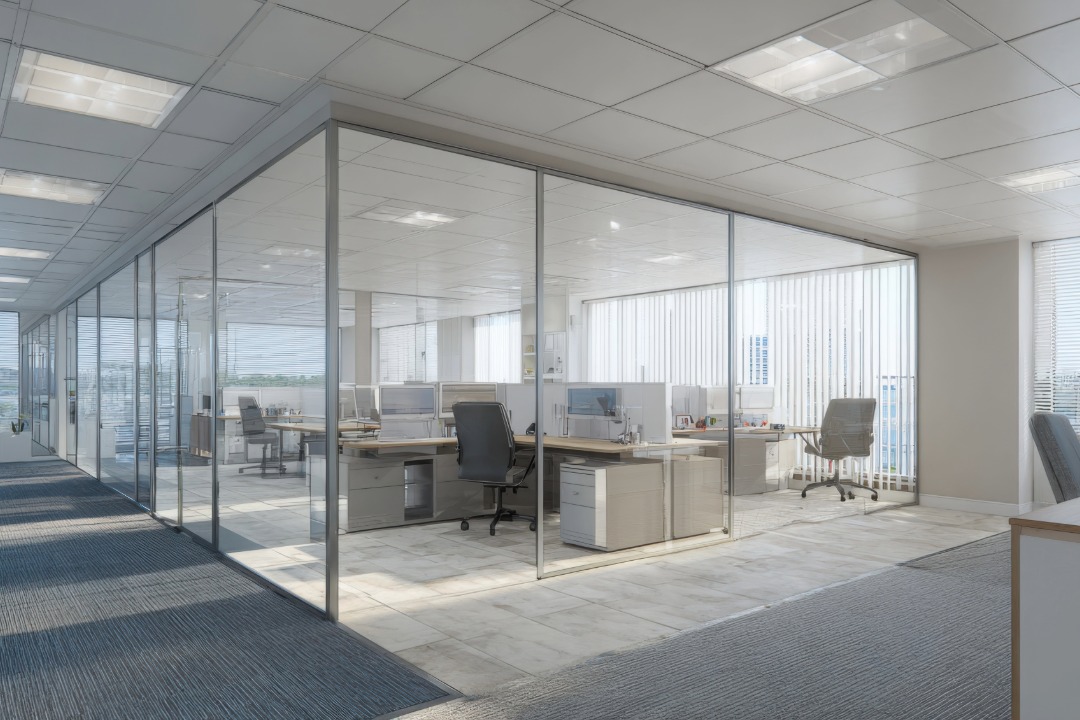
A well-designed hybrid layout might include an open collaborative zone with modular workstations for day-to-day teamwork, a set of enclosed focus rooms or phone booths for tasks requiring privacy, one or two private cabins for leadership or confidential work, and shared meeting rooms of varying sizes.
The key is understanding the ratio. A software company might need 40 percent open space and 60 percent private or semi-private zones. A marketing agency might flip that ratio entirely. The right balance depends on how your team spends its time, not on what looks good in a design magazine.
Modular office furniture plays a central role in making hybrid layouts practical. Factory-built modular systems allow you to reconfigure zones without structural renovation. Movable partitions, reconfigurable desk clusters, and modular storage walls can shift a collaborative area into a focused work zone within hours. This flexibility is only possible when the furniture is precision-manufactured to consistent dimensions, so pieces fit together seamlessly even after multiple reconfigurations.
How to Choose the Right Layout for Your Business
Assess Your Work Patterns
Before settling on any office layout, audit how your team actually works. Track how much time goes into collaborative tasks versus focused individual work. If 70 percent of the workday is heads-down analytical work, a majority-open layout will hurt more than help. If collaboration drives your output, too many private offices will slow your team down.
Consider Your Industry
Legal and financial services lean toward private offices for confidentiality. Creative, media, and tech companies lean toward open layouts for collaboration. Most businesses today fall somewhere in between. Workspace design should reflect your specific operational needs, not a general industry trend.
Factor In Growth
If you expect your team to grow by 30 to 50 percent over the next two years, build flexibility into your office interior design from day one. Modular furniture manufactured in a controlled factory environment gives you this flexibility. You can add matching workstations, swap partition heights, or reconfigure clusters without starting from scratch.
Listen to Your Team
Employee preferences matter. A layout that looks perfect on a floor plan but frustrates the people using it daily will fail. Survey your team. Ask about noise tolerance, privacy needs, and collaboration habits. Use that data to inform the design rather than imposing a layout from the top down.
Why Modular Furniture Solves the Layout Problem
The open-versus-private debate loses much of its tension when your furniture system supports both. Modular office furniture manufactured in-house, at a dedicated factory, is designed to adapt. The same base frames and panel systems can create open clusters, semi-enclosed pods, or fully enclosed cabins depending on what you need.
Factory production using CNC machines and automated edge-banding ensures that every unit is dimensionally precise. This matters because modular systems only work well when components align perfectly. A desk extension built six months after the original workstation should fit without gaps, without mismatched finishes, and without requiring on-site carpentry.
Holzbox manufactures its modular office furniture and interiors entirely in-house, giving businesses the advantage of consistent quality, shorter lead times, and the ability to scale their workspace design as needs evolve. When the same team that designs the product also controls production and installation, the result is a workspace that works from day one and adapts without disruption.
Frequently Asked Questions
Q1. Is an open office layout better than a private office for productivity?
It depends entirely on the type of work. Open offices support collaboration, quick communication, and team visibility. But they reduce individual focus and increase distractions. Private offices are better for tasks requiring deep concentration, confidentiality, or extended uninterrupted time. Most businesses find the highest productivity with a hybrid layout that offers both options.
Q2. How much space does an open office save compared to private offices?
On average, an open office workstation uses 40 to 60 square feet per person, while a private cabin uses 100 to 150 square feet. This means open layouts can accommodate roughly twice the number of employees in the same floor area. For businesses in Indian metros where rent is high, this difference translates directly into cost savings.
Q3. What is a hybrid office layout and how does it work?
A hybrid office layout combines open and private zones within the same floor plan. It typically includes open workstation areas for everyday tasks, enclosed rooms for focused work or calls, and shared meeting spaces. The ratio between open and private zones depends on how the team works. Modular furniture makes it easy to adjust this ratio over time without major renovation.
Q4. How does modular furniture help with office layout changes?
Factory-manufactured modular furniture is built to standard dimensions using precision machinery. This means components can be added, removed, or rearranged without custom carpentry. Need to convert an open bay into a semi-private pod? Swap the partitions. Need to expand a workstation cluster? Add matching desk units. This adaptability is what makes modular systems ideal for growing businesses.
Q5. Which office layout is best for small businesses in India?
For most small businesses in India with teams of 10 to 30 people, a hybrid layout works best. Keep the majority of the floor open for collaboration and teamwork, but include at least one or two enclosed spaces for private calls, client meetings, and focused work. Invest in modular office furniture that can be reconfigured as your team size and work patterns change over the next one to two years.