
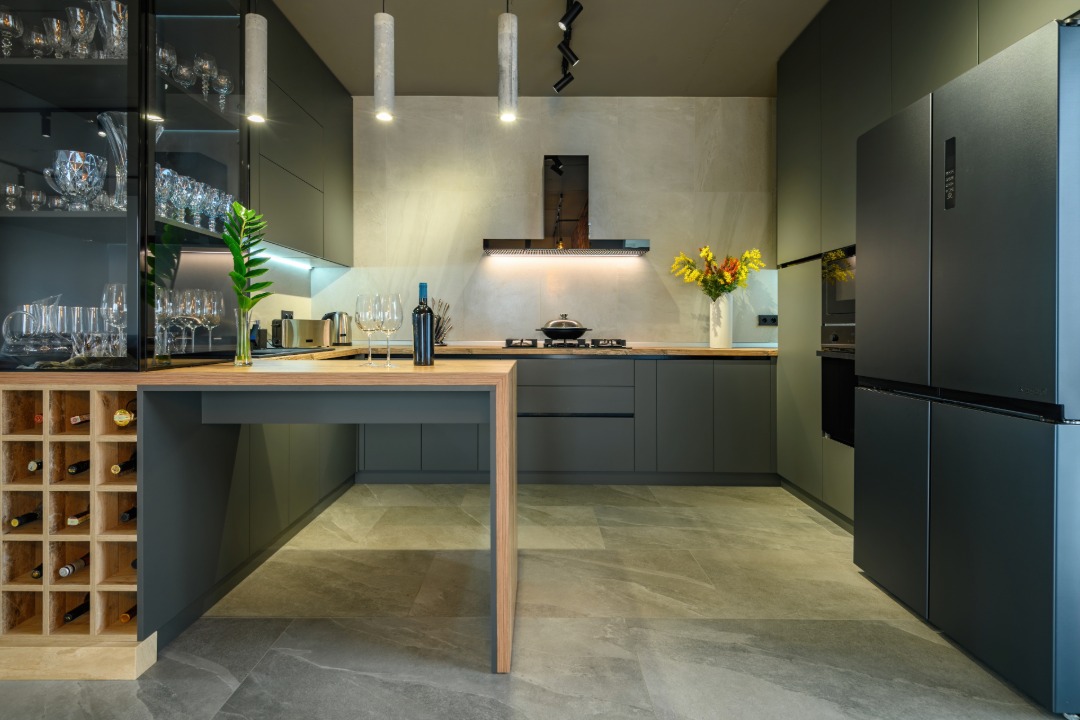
A modular kitchen is not a quick purchase. It is one of the most expensive and most used installations in your entire home. You will open those cabinets fifteen to twenty times a day. You will wipe those countertops after every meal. You will test the hinges, the drawers, and the shutters thousands of times over the next decade.
That is why the manufacturer you choose matters more than the design you pick. A stunning kitchen layout means nothing if the cabinets swell in two monsoons. A beautiful countertop is useless if the edge banding peels within a year. The design is what you see. The manufacturing is what you live with.
If you are planning a modular kitchen for your home, here is a practical guide to choosing the right manufacturer. Not the flashiest brand. Not the cheapest quote. The right one.
Understand What a Manufacturer Actually Does
This is the first and most important distinction. Many companies that call themselves modular kitchen manufacturers are actually assemblers or trading partners. They design the kitchen on screen and then outsource production to third-party fabricators. The cabinets come from one vendor. The shutters from another. The hardware from a third. Nothing is built or tested as a complete system.
A true manufacturer operates a factory. They cut panels on their own CNC machines. They apply edge banding on their own production line. They assemble and test every module before it leaves the facility. The cabinet dimensions match the shutter dimensions exactly. The hardware is calibrated to the panel weight.
When something goes wrong with an outsourced kitchen, nobody takes ownership. The designer blames the fabricator. The fabricator blames the material supplier. When something goes wrong with a factory-built kitchen, there is one company responsible for the entire product. That accountability changes everything.
Visit the Factory, Not Just the Showroom
Showrooms are designed to impress. Everything is perfectly lit. The hardware is brand new. The surfaces are freshly wiped. But a showroom tells you nothing about how the kitchen is actually made.
Ask to visit the factory. A manufacturer who is proud of their production process will welcome this request. Look at the machines they use. Are panels cut on CNC routers or by hand? Is edge banding applied with automated machines or manually with a heat gun? Is there a quality inspection station at the end of the line?
A factory visit also reveals how the company handles materials. Good manufacturers store boards in climate-controlled areas to prevent moisture absorption before fabrication. These steps make a real difference in how your modular kitchen performs three to five years after installation.
Ask About the Core Material
The material inside your kitchen cabinets matters more than the finish outside. Most modular kitchens in India use one of three core materials. Plywood, MDF, or particle board.
BWR-grade plywood is the strongest and most moisture-resistant option. It holds screws firmly and resists swelling even in humid Indian kitchens. It is also the most expensive.
MDF offers a smooth surface ideal for painted or lacquered shutters. It is suitable for shutter panels but not recommended for carcasses in moisture-prone areas. Standard MDF absorbs water through exposed edges and swells permanently.
Particle board is the cheapest option. It is acceptable for dry zones and budget projects. But for a kitchen that faces daily exposure to steam, water splashes, and heat, particle board has a limited lifespan.
The right approach is to use plywood for the carcass and MDF for the shutter panels. This gives you the structural reliability of plywood where it matters and the smooth finish of MDF where it shows. A knowledgeable modular kitchen manufacturer will recommend this combination based on your specific kitchen environment.
Evaluate the Hardware Independently
Hardware is the skeleton of your modular kitchen. Hinges, drawer runners, pull-out mechanisms, lift-up systems, and soft-close dampers determine how the kitchen feels in daily use. You interact with the hardware every single time you open a cabinet or pull out a tray.
Cheap hinges loosen within months. Budget drawer runners jam after a few thousand cycles. Low-quality soft-close mechanisms stop working within a year. These failures are frustrating and expensive to repair because replacing kitchen hardware often means removing and refitting entire modules.
Ask your manufacturer which hardware brands they use. Hettich, Blum, and Hafele are the most trusted names in India. Ask specifically about the hinge type and its rated cycle life. A good soft-close hinge is rated for at least 80,000 opening and closing cycles. That translates to roughly ten to twelve years of daily use.
Also ask whether the hardware is included in the base quotation or listed as an add-on. Some companies quote a low base price with basic hardware and then charge extra for premium fittings. Get clarity on this before you compare prices.
Check How They Handle the Design Process
A reliable kitchen design process starts with a site visit. The manufacturer’s team should measure your kitchen space precisely. Not just the width and height. They should note the window positions, plumbing points, electrical outlets, gas line location, and ventilation openings.
After measurement, you should receive a detailed 2D layout and a 3D render. The 3D view should show exactly how the kitchen will look from different angles. It should include the countertop, backsplash, shutters, handles, and appliance placement.
The design consultation should also cover your cooking habits. Do you cook with a lot of oil and steam? Do you need extra-deep base units for heavy vessels? Do you store large quantities of dry goods? These questions shape the internal layout of every cabinet.
A manufacturer who skips this step is cutting corners. The kitchen may look good on screen but fail in daily use because nobody asked how you actually cook.
Compare Quotations on Equal Terms
Price comparison only works when you are comparing like with like. A quote of four lakhs from one company and six lakhs from another means nothing if the first uses particle board and the second uses BWR plywood. If the first includes basic hardware and the second includes Blum soft-close systems, they are not the same product.
Ask every manufacturer for an itemised quotation. It should list the carcass material, shutter material, shutter finish, countertop material, hardware brand, and installation charges separately. It should also state what is excluded.
Common items that get excluded from base quotes include the countertop, backsplash, appliances, chimney cutout, and electrical work. If these are not included, they will show up as additional charges later.
Ask About Installation and Timeline
A great kitchen poorly installed is a bad kitchen. Installation involves precise alignment of every module. Cabinets must be level. Shutters must open and close without rubbing. Drawers must slide smoothly. The countertop must sit flush against the wall with no gaps.
Ask your manufacturer who handles the kitchen installation. Is it their own trained team or a subcontracted carpenter? Companies with in-house manufacturing typically also have in-house installation teams. This ensures the people installing the kitchen understand exactly how it was built.
Timeline matters too. A standard modular kitchen in India takes three to five weeks from design approval to completed installation. If a company promises delivery in one week, they are likely using pre-cut stock modules rather than building a custom modular kitchen to your specifications. If they quote eight to ten weeks, ask why. Delays usually signal production backlogs or dependency on external vendors.
Investigate After-Sales Support
The kitchen will need attention after installation. A hinge may need adjustment. A drawer runner may need re-alignment. These are normal maintenance tasks.
What matters is whether the manufacturer responds when you call. Ask for their after-sales policy in writing. How long is the warranty? What does it cover? What is the typical response time?
A manufacturer with their own production facility offers better after-sales support because they control the supply of replacement parts. A trading company that sourced from multiple vendors may struggle to find the exact matching part three years later.
Holzbox, for example, handles design, manufacturing, and post-installation support under one roof. That integrated setup means replacement parts are always compatible and service response is faster.
Trust Reviews but Verify Claims
Online reviews help but they are not the full picture. Ask the manufacturer for references from clients who got their kitchen installed at least two years ago. Speak to those clients. Ask about the finish condition, the hardware performance, and the after-sales experience.
Also look for red flags. A company that pressures you to sign quickly, offers steep discounts for immediate commitment, or avoids answering questions about materials and hardware is not operating with transparency.
Make the Decision That Lasts
Your modular kitchen will serve you for ten to fifteen years if it is built well. It is the centrepiece of your kitchen interior design and the most functional part of your home interior design. That is over 5,000 meals. Over 50,000 cabinet openings. Over a decade of daily steam, oil, and water exposure.
The manufacturer you choose determines whether the kitchen handles all of this gracefully or starts falling apart in year three. Choose a company that builds in its own factory. That uses tested materials. That installs with its own team. And that stands behind the product long after the final payment clears.
A kitchen is the hardest working room in the house. Build it with someone who understands that.
Frequently Asked Questions
What is the difference between a modular kitchen manufacturer and a modular kitchen dealer?
A manufacturer operates its own factory and builds kitchen modules in-house. They control raw material selection, panel cutting, edge banding, hardware fitting, and quality inspection under one roof. A dealer sources ready-made or semi-finished modules from third-party fabricators and assembles them at your site. The key difference is accountability. With a manufacturer, one company owns the entire product. With a dealer, responsibility is split across multiple vendors, which makes warranty claims and after-sales service harder to enforce.
How much does a modular kitchen cost in India in 2026?
Costs vary based on materials, size, finish, and hardware. A basic modular kitchen with particle board carcass and laminate shutters starts at roughly two to three lakh rupees for a standard L-shaped layout. A mid-range kitchen with BWR plywood carcass, acrylic shutters, and Hettich hardware falls between four and six lakhs. Premium kitchens with PU-coated shutters, quartz countertops, and Blum fittings can go above eight lakhs. Always compare itemised quotations rather than headline prices to ensure you are comparing equal specifications.
Which layout is best for Indian kitchens?
It depends on the room dimensions and cooking style. L-shaped kitchens suit most Indian apartments because they provide the work triangle between the stove, sink, and refrigerator. U-shaped layouts work for larger spaces and offer more storage and counter area. Parallel kitchens suit narrow, elongated rooms. Island kitchens need at least 150 square feet of floor space. A good modular kitchen designer will recommend the layout based on your room measurements and how many people cook simultaneously.
How long does it take to install a modular kitchen?
A custom-built modular kitchen typically takes three to five weeks from design approval to completed installation. This includes one to two days for site measurement, one week for design finalisation, two to three weeks for manufacturing, and two to three days for on-site installation. Manufacturers with in-house production tend to deliver faster because they are not waiting on third-party vendors. If someone promises delivery in under two weeks for a custom kitchen, ask whether they are using pre-cut stock modules rather than building to your exact specifications.
What should I check during the final kitchen inspection?
Run through a detailed checklist. Open and close every cabinet door to check for smooth hinge operation and proper alignment. Pull every drawer fully open and push it back to confirm smooth runner action and soft-close function. Check every shutter edge for proper edge banding with no gaps or bubbles. Inspect the countertop joints for seamless finishing. Verify that the backsplash sits flush against the wall. Test all electrical points and plumbing connections. Ask the installation team to walk you through the care and maintenance instructions before signing off.