
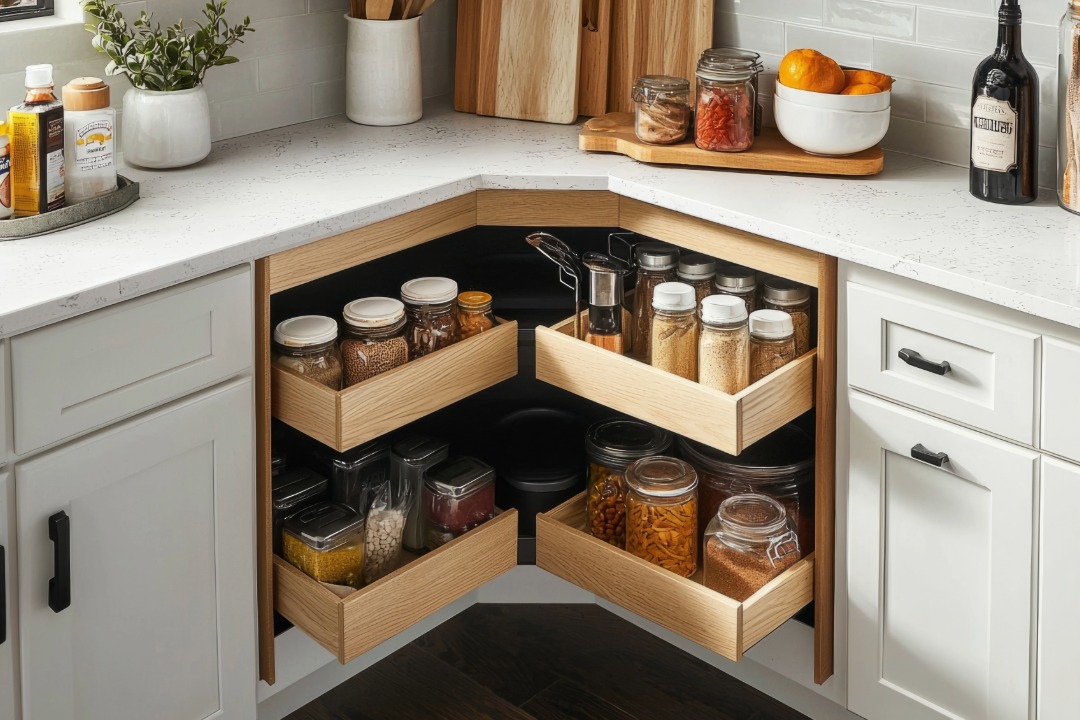
Your modular kitchen cabinet is not one material. It is at least two. The carcass is the structural box that holds weight, anchors hardware, and resists moisture. The shutter is the visible door that defines the look and gets touched every day. These two parts do completely different jobs. They need different materials.
Most guides list “kitchen cabinet materials” as if the entire cabinet is made from one sheet. That oversimplification leads to bad choices. A homeowner picks MDF because it looks smooth. But the MDF goes into the base cabinet next to the sink. Within two years, the board swells and the hinge screws pull out.
This guide separates the two clearly. It covers the five most common carcass materials and the six most common shutter finishes used in Indian modular kitchens. For each one, it explains what the material actually is, where it works, where it fails, and what to look for when buying.
Part 1: Carcass Materials
The carcass is the body of the cabinet. It includes the side panels, top panel, bottom panel, back panel, and internal shelves. It carries the load. It holds the hinges and drawer runners. It determines how long the cabinet lasts.
BWR Plywood
BWR stands for Boiling Water Resistant. This plywood is made by bonding thin layers of wood veneer with phenol formaldehyde resin. The cross-grain construction gives it excellent strength in all directions. The adhesive makes it resistant to moisture, steam, and water splashes.
BWR plywood is the gold standard for modular kitchen carcasses in India. It holds screws firmly even after years of hinge use. It does not swell near the sink. It handles the humidity of coastal cities like Mumbai, Chennai, and Kochi without warping.
It is also the most expensive carcass option. But on a cost-per-year basis, it outperforms every alternative because it avoids premature replacement. A BWR plywood carcass lasts 12 to 15 years with proper edge banding.
Look for IS 303 certification when buying BWR plywood. Ask your modular kitchen manufacturer which brand and grade they use. Not all plywood labelled BWR actually meets the standard.
HDHMR
HDHMR stands for High Density High Moisture Resistant board. It is an engineered wood panel made from compressed wood fibres bonded with moisture-resistant resin. It is denser and stronger than standard MDF. It also has better screw-holding capacity.
HDHMR works well for kitchen carcasses in moderately humid environments. It is lighter than plywood, which reduces the load on wall-mounted cabinets. Many modular kitchen design companies use HDHMR for wall units while reserving BWR plywood for base cabinets near the wet zone.
The key limitation is that HDHMR is not as moisture-resistant as BWR plywood when exposed to standing water. Edge banding quality becomes even more critical with HDHMR because any unsealed edge allows moisture to enter the dense core.
Standard MDF
MDF stands for Medium Density Fibreboard. It is made from fine wood fibres compressed with resin under high heat and pressure. The result is a smooth, uniform board with no grain.
Standard MDF is not recommended for kitchen carcasses in India. It absorbs moisture quickly through exposed edges and swells permanently. In a kitchen where water splashes, steam, and oil are constant, MDF carcasses deteriorate within two to three years.
MDF works well for shutter panels in dry zones. It accepts paint, lacquer, and membrane finishes beautifully. But for the carcass, it should only be used in climate-controlled environments or in areas with zero water exposure.
Particle Board
Particle board is made from wood chips and sawdust bonded with resin. It is the cheapest option available. It is also the weakest.
Particle board has poor screw-holding strength. Hinges loosen within a year of daily use. The board swells and crumbles when exposed to moisture. Edge banding peels faster because the core density is too low for strong adhesive bonding.
Particle board may suit extremely tight budgets for rental properties where the kitchen will be replaced within three to four years. For a permanent home, it is not a sound investment for any kitchen cabinet material.
Marine Plywood
Marine plywood uses the same cross-grain construction as BWR plywood but with even higher-grade adhesives. It is designed for prolonged water submersion. It is typically used in boat building and outdoor applications.
For kitchen cabinets, marine plywood is overkill. BWR plywood handles the moisture levels found in Indian kitchens more than adequately. Marine plywood costs significantly more without offering a proportional benefit in a kitchen environment.
However, for the specific cabinet under the sink where standing water is a recurring risk, marine plywood is a smart upgrade. It provides an extra layer of protection in the single most vulnerable spot in the kitchen.
Part 2: Shutter Materials and Finishes
The shutter is the face of your kitchen. It defines the colour, texture, and overall aesthetic. It is also the surface you clean, touch, and look at every day. Shutter materials must resist scratches, stains, heat, and daily fingerprint buildup.
Laminate
Laminate is a thin decorative sheet bonded to the shutter panel. High-pressure laminates are the most durable variant. They resist scratches, heat, and stains better than low-pressure alternatives.
Laminates come in hundreds of colours, textures, and wood-grain patterns. They are the most cost-effective shutter finish for Indian kitchens. They handle oil splatter and turmeric stains with easy wiping. They do not fade quickly under kitchen lighting.
For most Indian homes, laminate shutters on an MDF or HDHMR panel offer the best balance of price, durability, and appearance. This is the most commonly specified combination in modular kitchen design across all budget segments.
Acrylic
Acrylic shutters deliver a high-gloss, mirror-like surface. They reflect light and make small kitchens appear larger. The finish is smooth, easy to clean, and available in vibrant solid colours.
The downside is visibility. Fingerprints, water marks, and grease spots show up clearly on glossy surfaces. Acrylic kitchens require daily wiping to maintain their showroom look. Deep scratches are also harder to repair compared to laminate.
Acrylic works best in kitchens with minimal cooking or in homes where the kitchen is primarily a display space. For heavy Indian cooking with oil and spices, laminate is the more practical choice.
PU Coating
PU stands for Polyurethane. The coating is sprayed onto an MDF panel and cured to a hard, even surface. PU finishes are available in matte, satin, and gloss variants. They offer the widest colour matching capability of any kitchen finish.
PU-coated shutters are a premium option. The colour consistency is excellent. The surface feels smooth and refined. It is more resistant to yellowing over time compared to membrane finishes.
The cost is higher than laminate and acrylic. But for homeowners who want a specific colour matched to their kitchen interior design theme, PU coating delivers the most precise result.
Membrane
Membrane shutters use a PVC film vacuum-pressed over an MDF panel. The film wraps around grooves and contours, making membrane the best finish for CNC-routed shutter designs.
Membrane finishes are affordable. They come in matte, gloss, and wood-grain options. They are popular for kitchens that want a profiled or patterned shutter look without the cost of PU.
The risk is delamination. In hot, humid Indian cities, the PVC film can lift from the MDF surface if the adhesive quality is poor. Good membrane shutters use industrial-grade vacuum pressing with high-temperature adhesive. Low-quality membrane work peels within a year or two near the stove area.
Veneer
Veneer is a thin slice of natural wood bonded to the shutter panel. It brings the warmth and texture of real wood to the kitchen without the cost or weight of solid timber.
Veneer shutters suit traditional and transitional home interior design styles. They add a natural elegance that engineered finishes cannot replicate. Oak, walnut, and teak are the most popular veneer choices in India.
The limitation is moisture sensitivity. Veneer must be properly sealed and should only be used in dry zones of the kitchen. Near the sink or stove, veneer can discolour, warp, or peel if not protected with a polyurethane topcoat.
Glass
Glass shutters use frosted, lacquered, or back-painted glass panels set in aluminium frames. They add visual lightness to wall cabinets and work well in open kitchen layouts.
Glass is not load-bearing and should only be used for wall-mounted display cabinets or upper shutter panels. It requires careful handling during installation and is not recommended for homes with young children due to breakage risk.
How Material Quality Varies by Manufacturer
Two boards labelled “BWR plywood” can perform very differently depending on where they come from. The grade, the veneer quality, the resin used, and the pressing conditions all vary between suppliers.
A modular kitchen manufacturer with in-house production and in-house manufacturing capability buys boards in bulk from certified mills. Every incoming batch is checked for density, thickness consistency, and moisture content. Boards that do not meet the specification are rejected before they enter the cutting line.
A company that outsources production has no control over this. The fabricator uses whatever material is available at the local dealer that week. There is no incoming inspection. No quality threshold. The homeowner has no visibility into what actually went into their cabinets.
This is the hidden advantage of factory-built kitchens. Holzbox, for example, tests raw materials on its own production floor before cutting a single panel. That level of material verification is impossible in a carpenter’s workshop or a third-party assembly unit.
The material specification on the quotation is important. But the material actually used in production is what determines the kitchen’s lifespan.
Choosing Materials by Kitchen Zone
The smartest approach is to match materials to zones rather than picking one material for the entire kitchen.
For the wet zone near the sink and dishwasher, use BWR plywood for the carcass and laminate for the shutters. This combination handles daily water exposure without degradation.
For the cooking zone near the hob and chimney, use BWR plywood or HDHMR for the carcass and heat-resistant laminate or PU for the shutters. Avoid membrane near the stove as heat can cause the film to lift.
For the dry zone covering wall cabinets and pantry units, HDHMR or MDF carcass with any shutter finish works well. This zone has minimal moisture exposure and can accommodate lighter, more cost-effective materials.
This zone-based approach optimises your budget without compromising durability where it matters most.
Frequently Asked Questions
Which is the best material for modular kitchen cabinets in India?
BWR-grade plywood is the most reliable carcass material for Indian kitchens. It resists moisture, holds screws firmly, and lasts over a decade with proper edge banding. For shutters, high-pressure laminate offers the best balance of durability, appearance, and cost. This combination of BWR plywood carcass and laminate shutters is the most widely recommended by experienced modular kitchen manufacturers in India.
Is MDF safe to use in kitchen cabinets?
MDF is safe for shutter panels in dry zones of the kitchen. Its smooth surface accepts paint, membrane, and laminate finishes beautifully. However, standard MDF should not be used for the carcass of base cabinets, especially near the sink, dishwasher, or cooking area. MDF absorbs moisture through exposed edges and swells permanently. If you must use an MDF-based board for structure, opt for HDHMR which has significantly better moisture resistance.
What is HDHMR and is it better than plywood?
HDHMR is High Density High Moisture Resistant fibreboard. It is denser and stronger than standard MDF with added moisture-resistant resin. It offers good screw-holding capacity and a smooth surface. HDHMR is a viable alternative to plywood for wall cabinets and dry-zone carcasses. However, for base cabinets in the wet zone, BWR plywood remains the stronger and more moisture-resistant choice. Many manufacturers use a combination of both to balance cost and performance.
How do I know if my kitchen uses genuine BWR plywood?
Ask your manufacturer for the plywood brand name and IS 303 certification. Genuine BWR plywood has a stamp on each board indicating the grade and manufacturer. During a factory visit, you can verify the boards in storage. If you are working with a company that builds in their own facility, they will show you the incoming material inspection records. A trading company or assembler rarely has this level of traceability.
Does the shutter finish affect kitchen durability or just appearance?
Both. The shutter finish protects the underlying panel from moisture, heat, scratches, and stains. A poor-quality laminate or membrane that peels exposes the MDF core to humidity. Once moisture enters, the panel swells and the shutter loses its shape. Good-quality high-pressure laminates and factory-applied PU coatings protect the panel for years. The finish is not just cosmetic. It is the first line of defence for the shutter panel underneath.