
Interior trends come and go. What stays is the furniture you built based on a trend that faded six months later. That glossy all-white kitchen from 2022 already looks dated. The industrial-pipe shelving from 2019 collects dust in bedrooms across the country. The rose gold hardware craze left behind fixtures that nobody wants to match anymore.
The smartest approach to trends is not to chase them blindly. It is to understand which ones solve real problems for Indian homes and which ones are purely aesthetic fads that will not age well. This guide evaluates the biggest home interior design trends in India for 2026 through a practical lens. Which trends improve how your home functions? Which ones hold up over five to ten years? And which ones require specific manufacturing capabilities to execute well?
Warm Minimalism Replaces Cold Minimalism
The stark white, all-grey, handle-less kitchen aesthetic that dominated Indian interiors from 2020 to 2024 is fading. It looked spectacular in photographs but felt cold to live in. Indian homes need warmth. Families gather in the kitchen. Children play in the living room. Grandparents visit for months. A clinical white space does not support this reality.
Warm minimalism keeps the clean lines and uncluttered surfaces but shifts the palette. Soft beige, warm grey, muted clay, and off-white replace pure white. Natural wood grain textures appear on wardrobe shutters and kitchen cabinets. Brushed brass and matte black hardware replace chrome.
This trend works exceptionally well for Indian apartments because the warm tones hide daily wear better than white. Fingerprints on a soft beige laminate are invisible. Fingerprints on a high-gloss white acrylic panel are visible from across the room.
For homeowners planning a modular kitchen, warm minimalism translates into wood-grain laminate shutters, a quartz countertop in warm tones, and matte-finish hardware. The result is a kitchen that feels inviting without being cluttered. It is a trend that will age gracefully over the next decade because it is rooted in comfort, not novelty.
Multifunctional Furniture for Compact Urban Homes
Indian urban apartments are not getting bigger. A 2BHK in Hyderabad, Bangalore, or Mumbai offers the same 600 to 900 square feet it has offered for the last decade. But the demands on that space have grown. A home office. A study zone for children. A workout corner. A guest sleeping area. All within the same footprint.
Multifunctional furniture is not new as a concept. But in 2026, the execution has matured. A sofa with an integrated pull-out bed that does not feel like a compromise. A coffee table with a hydraulic lift top that converts to a work desk. A TV unit with concealed storage that doubles as a room divider.
The critical requirement for multifunctional modular furniture is manufacturing precision. A lift-top mechanism that jams is worse than a regular table. A sofa-bed that cannot switch modes smoothly gets stuck in one configuration permanently. These pieces demand factory-level engineering with tested mechanisms and calibrated joints.
A manufacturer with in-house production builds these multifunctional units with hardware that is cycle-tested before dispatch. The lift mechanism works after 10,000 uses. The pull-out bed frame does not scrape the floor. The room divider stands stable without wall anchoring. This level of reliability is impossible with on-site carpentry.
Biophilic Design Beyond Potted Plants
Every interior trend article in 2024 and 2025 told you to add plants. That advice was fine but shallow. Biophilic design in 2026 goes deeper than placing a monstera in the corner.
Natural materials are replacing synthetic ones in furniture surfaces. Real wood veneer on wardrobe shutters. Stone-textured laminate on kitchen counters. Jute and cane inserts on cabinet doors. These textures bring the tactile quality of nature into the home without the maintenance demands of live greenery.
Natural light optimisation is another biophilic priority. Sheer curtains replacing heavy drapes. Glass partitions replacing solid walls between the kitchen and dining area. Mirror panels on wardrobe doors that reflect daylight deeper into the room.
The colour palette follows nature too. Forest greens, terracotta, sand, and clay are the accent colours of 2026. They replace the bright teals and mustard yellows that dominated accent walls in previous years. These earth tones have a calming effect that complements the warm minimalism trend and creates visual harmony across rooms.
Fluted and Ribbed Surface Textures
Flat panel shutters are giving way to textured surfaces. Fluted panels with vertical grooves add depth and shadow play to wardrobe doors, TV unit facades, and kitchen overhead cabinets. Ribbed textures on drawer fronts create a tactile quality that flat laminate cannot match.
This trend works because it adds visual interest without adding colour complexity. A warm beige fluted panel looks richer than a flat beige panel. The grooves catch light differently throughout the day, making the surface appear dynamic rather than static.
From a manufacturing perspective, fluted panels require CNC routing on the shutter surface before the finish is applied. The groove depth, spacing, and radius must be consistent across every panel. A single inconsistent groove is visible from across the room. This is a trend that only factory production can execute reliably. In-house manufacturing with CNC routing ensures every groove is identical across every panel in the room.
A carpenter can attempt fluting with a handheld router. But the groove spacing will vary. The depth will fluctuate. The finish inside the grooves will be uneven. For a surface texture that depends entirely on consistency, factory production is not optional. It is essential.
Integrated Smart Storage
Storage has always been important in Indian homes. But in 2026, the approach has shifted from “more cabinets” to “smarter cabinets.” The goal is to store more in less space while keeping everything accessible.
Pull-out pantry units in the kitchen replace deep, hard-to-reach shelves. Corner carousels recover dead space in L-shaped layouts. Vertical pull-out drawers between the fridge and the wall store bottles and spices in a narrow 6-inch gap.
In wardrobes, dedicated zones for specific clothing types replace generic shelves. Short-hang sections for shirts. Long-hang sections for ethnic wear. Pull-out trouser racks. Felt-lined jewellery drawers. Adjustable shelves that can be repositioned as storage needs change.
These space optimisation solutions are not new individually. What is new in 2026 is the expectation that every cabinet comes with purpose-designed internal organisation. The days of empty shelves and a single hanging rod are over. Homeowners now expect their interiors to be engineered for how they actually store things.
Handleless Cabinets and Push-to-Open Systems
The handleless cabinet trend has been building for two years and reaches its peak in 2026. Instead of visible handles or knobs, cabinets use push-to-open mechanisms or recessed groove profiles that serve as invisible pulls.
The visual result is a clean, unbroken surface. No protruding hardware. No visible lines of metal or plastic. The shutter panel flows from one unit to the next without interruption. This creates a streamlined look that makes small rooms feel larger because there is less visual clutter.
Push-to-open mechanisms require precise calibration. The catch must release cleanly with a gentle push and hold firmly when closed. Cheap push-to-open hardware fails within months. The catch weakens. The door drifts open on its own. Branded mechanisms from Hettich or Blum are rated for tens of thousands of cycles and maintain their tension throughout the furniture’s lifespan.
For a handleless home interior design to work, the hardware must be invisible and reliable. That combination requires factory installation at calibrated depths and pressures. It is a detail that separates a premium home from one that merely looks premium on day one.
Sustainable and Low-Impact Materials
Sustainability in Indian interiors has moved from aspiration to expectation. Homeowners in 2026 ask about material origins, emission levels, and environmental certifications before placing orders.
FSC-certified plywood confirms that the wood comes from responsibly managed forests. E1-rated boards limit formaldehyde emissions to safe levels. Low-VOC paints and water-based finishes reduce indoor air pollution. These specifications were niche two years ago. They are now standard questions in every design consultation.
A manufacturer that controls its own material sourcing can verify every certification. They buy boards from certified mills. They test incoming batches for density and emission levels. They reject boards that do not meet the specification before production begins.
Holzbox applies this verified sourcing process across every project. From the plywood in the kitchen carcass to the laminate on the wardrobe shutter, every material is traceable. This traceability is the foundation of genuine sustainability. Without it, a “sustainable” label is just marketing.
Curved Furniture and Soft Geometry
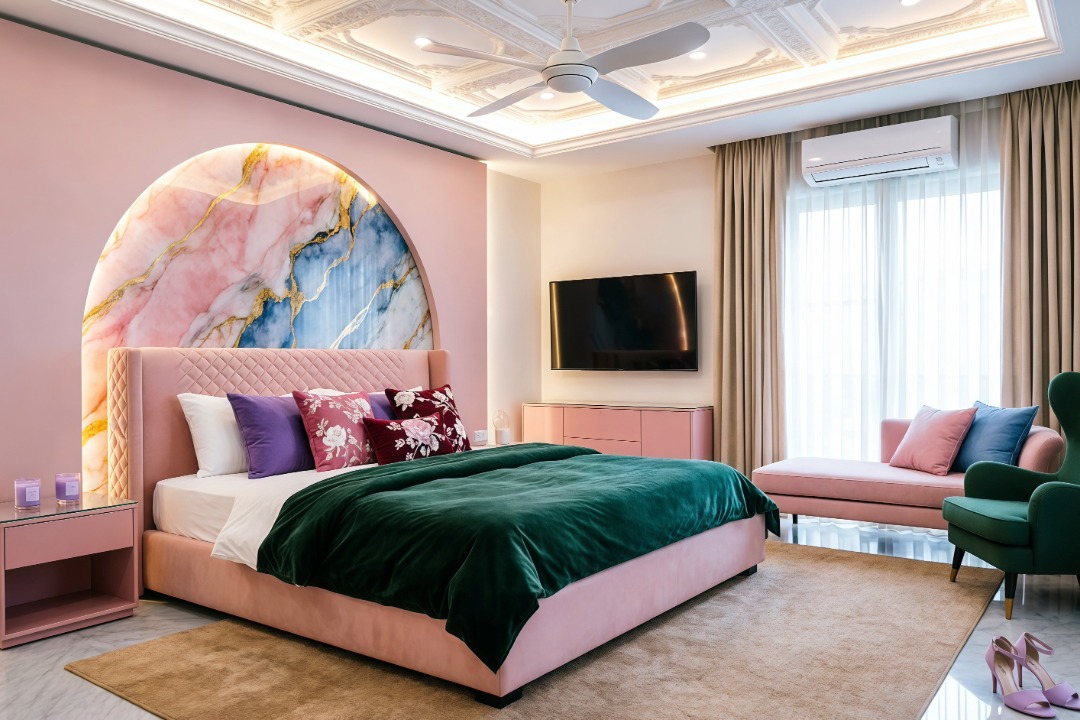
Sharp 90-degree edges are softening across Indian interiors in 2026. Rounded corners on dining tables. Curved backrests on chairs. Arched display niches in living room walls. Pill-shaped mirrors replacing rectangular ones.
This trend has practical benefits beyond aesthetics. Rounded furniture edges reduce injury risk, especially in homes with children. Curved surfaces feel more inviting and less institutional. An arched niche adds architectural interest without structural modification.
Curved elements in modular furniture require advanced CNC capabilities. A curved shutter panel is not simply a flat panel bent into shape. It is routed from a thicker board to achieve the precise radius. The finish must be applied uniformly across the curve without cracking or bubbling. This is specialist factory work.
What Will Fade by 2028
Not every 2026 trend will last. Some are already showing signs of overexposure.
All-terrazzo everything is peaking. Terrazzo countertops work. Terrazzo flooring works. Terrazzo on the wardrobe shutter, the TV unit, and the bathroom vanity simultaneously does not.
Bold maximalist colour blocking is exciting but exhausting. A single accent wall in deep teal ages well. An entire room in deep teal with contrasting orange furniture does not.
The wisest approach is the 80/20 rule. Keep 80 percent of your home in timeless neutrals and proven materials. Use 20 percent for trend-forward elements that can be updated inexpensively. The shutter finish and wall colour belong in the 20 percent. The carcass material and hardware belong in the 80 percent.
Frequently Asked Questions
Which 2026 interior design trend has the most staying power?
Warm minimalism. It replaces the cold, clinical all-white aesthetic with warm neutrals and natural textures that feel inviting and age gracefully. Unlike colour-specific trends that feel dated within three years, warm minimalism is rooted in comfort and functionality. It works across kitchens, wardrobes, living rooms, and bedrooms without requiring dramatic updates as trends shift.
Are handleless cabinets practical for Indian homes?
Yes, when the push-to-open hardware is from a reputable brand like Hettich or Blum. Budget mechanisms fail within months. Quality mechanisms maintain their tension for tens of thousands of cycles. Handleless cabinets work particularly well in compact Indian kitchens and wardrobes because the absence of protruding handles creates a cleaner visual line and makes the space feel less cluttered.
How do I incorporate biophilic design without maintaining live plants?
Use natural material textures on furniture surfaces. Wood veneer shutters, cane inserts on cabinet doors, jute accents on shelving, and stone-textured laminates all bring natural tactile quality indoors without maintenance. Maximise natural light through sheer curtains and glass partitions. Choose earth-toned colour palettes inspired by forest, clay, and sand. These elements create a biophilic atmosphere that does not depend on watering schedules.
Is fluted panel design just a fad or a lasting trend?
Fluted and ribbed textures have historical roots in architectural detailing that go back decades. The 2026 version applies this texture to furniture surfaces using CNC routing, creating a modern interpretation. Because the texture adds visual depth without relying on a specific colour, it ages better than colour-based trends. A warm beige fluted panel will look current in 2030. A bright coral flat panel may not.
How do I adopt trends without a complete home redesign?
Follow the 80/20 rule. Keep 80 percent of your interiors in timeless configurations: neutral carcass finishes, proven hardware, and classic layout principles. Use 20 percent for trend-forward elements: a fluted feature wall panel, a terracotta accent in the kitchen backsplash, or curved display niches in the living room. These elements can be updated in a few years without touching the structural furniture. This approach lets you stay current without the cost and disruption of a full redesign.