
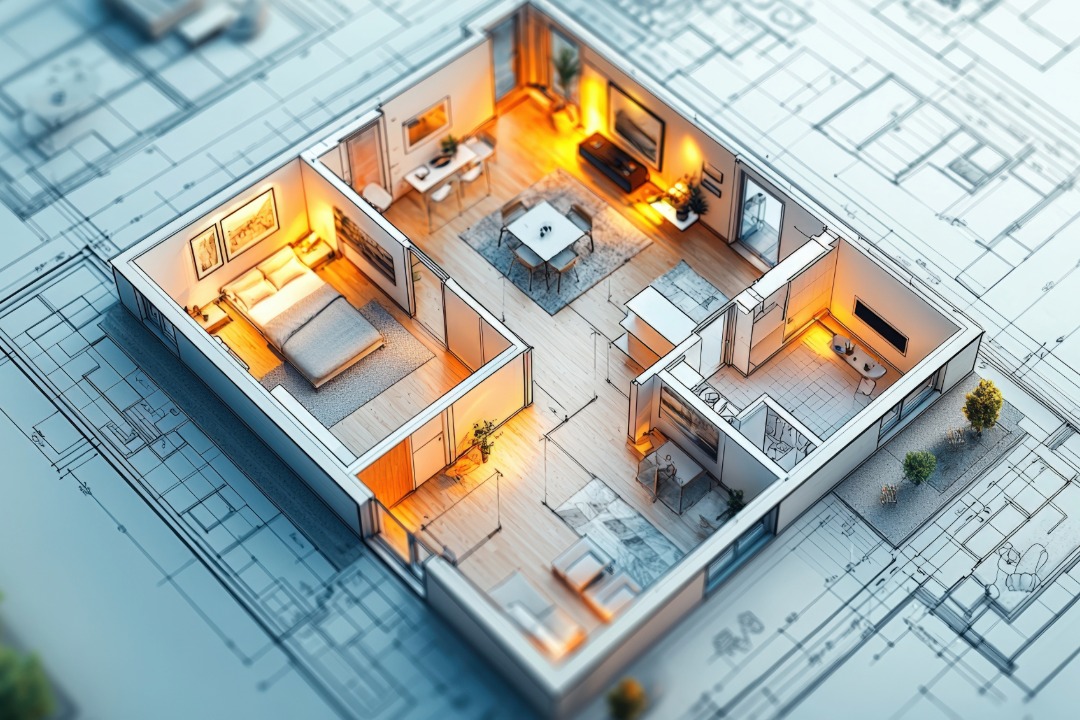
Space planning is the discipline that determines how a room works before anything is built, bought, or installed. It is not decoration. It is not styling. It is not picking colours or finishes. Those decisions come later. Space planning comes first. It answers the fundamental questions that every other design decision depends on.
Where does the furniture go? How do people move through the room? What activities happen in each zone? How much clearance does each function need? Where do the electrical points go based on where the furniture sits?
If you skip space planning, you design from instinct. You buy furniture that looks right in the showroom but does not fit the room. You install outlets that end up behind a wardrobe. You build a kitchen with a work triangle that forces you to walk around an island every time you need to reach the fridge.
This guide explains what space planning is, how it works as a process, what principles govern it, and why it must happen before any manufacturing or material decision is made.
The Definition: What Space Planning Actually Means
Space planning is the process of analysing a room’s dimensions, purpose, and occupant behaviour to create a layout that maximises functionality and movement within the available area. It produces a scaled floor plan that shows the exact position, size, and orientation of every piece of furniture, every built-in unit, and every fixed element in the room.
The output of space planning is not a mood board. It is not a colour palette. It is a technical document that tells the manufacturer what to build, the electrician where to wire, and the plumber where to connect.
In Indian residential interiors, space planning is especially critical because apartments are compact. A 600-square-foot 2BHK does not have room for layout errors. Every misplaced unit wastes space that the home cannot afford to lose. Every overlooked clearance creates a daily physical inconvenience that no amount of decoration can fix.
The Five Stages of Space Planning
Professional space planning follows a structured process. Each stage builds on the previous one. Skipping a stage creates problems that surface during installation.
Stage 1: The Brief
The brief captures how the home will be used. Not what it will look like. How it will function.
How many people live in the home? What are their daily routines? Who cooks? How often? Does anyone work from home? Where do children study? How much clothing does each person own? How often do guests visit? Do guests stay overnight?
These questions map lifestyle onto the floor plan. A family of four with two school-age children needs different zones than a couple who works from home. The brief ensures that the plan reflects real life, not a generic template.
Stage 2: The Bubble Diagram
The bubble diagram is a rough, non-scaled sketch that shows the relationship between zones. Each zone is drawn as a bubble. Lines connect bubbles that need to be adjacent. No lines connect zones that can be separated.
The kitchen bubble connects to the dining bubble because food moves between them. The dining bubble connects to the living bubble because families shift between eating and relaxing. The master bedroom connects to the master wardrobe. The children’s room connects to the study zone.
This diagram is not about dimensions. It is about adjacency and flow. It reveals which zones must be close together and which can be placed further apart. It is the skeleton that the detailed plan is built upon.
Stage 3: The Zoned Floor Plan
The zoned floor plan takes the bubble relationships and applies them to the actual room dimensions. Each zone gets a defined area within the room. Circulation paths are drawn between zones.
At this stage, the 80-10-10 rule guides allocation. Roughly 80 percent of the available area is living and functional space. About 10 percent is circulation and passage. The remaining 10 percent is storage.
In an Indian apartment, the storage allocation often needs to increase to 15 percent because Indian households store more bulk items, seasonal clothing, and kitchen inventory than the global average. This adjustment reduces the living space percentage slightly but prevents the overflow and clutter that make compact homes feel chaotic.
Stage 4: The Furniture Layout
The furniture layout places specific pieces within each zone. Scaled representations of beds, wardrobes, desks, sofas, dining tables, and kitchen modules are positioned on the plan.
This is where clearances are verified. The wardrobe doors clear the bed frame. The dining chairs push back without hitting the wall. The kitchen aisle is wide enough for two people. The study desk does not block the window.
Every furniture piece has a minimum footprint and a minimum clearance zone around it. These dimensions must be respected for the room to function comfortably.
Stage 5: The Production Data Package
This is the stage that most design guides do not cover. And it is the stage that determines whether the plan becomes reality.
The furniture layout translates into a production data package. Every modular kitchen module has exact width, depth, and height specifications. Every wardrobe section has internal layout dimensions. Every TV unit has cable management channel positions. Every built-in desk has power outlet coordinates.
This data package goes to the factory floor. CNC machines read the dimensions. Production teams cut panels to those exact specifications. Edge banding is applied. Hardware is mounted at calibrated positions. The finished modules match the plan because the plan informed the production.
When the company that created the space plan also operates the factory, this translation is seamless. The designer and the production engineer work from the same data. There is no interpretation gap. No lost-in-translation errors.
Core Principles That Govern Space Planning
Circulation First
People move through spaces before they use them. The primary circulation path from the entrance to each room must be clear and wide enough for comfortable passage. Secondary paths within rooms connect functional zones.
A space plan that prioritises furniture placement over circulation creates rooms where people constantly navigate around obstacles. The furniture may be arranged attractively, but living in the space feels frustrating.
Function Defines Form
The intended activity in each zone determines its size, shape, and position. A cooking zone needs proximity to water and gas. A sleeping zone needs distance from noise sources. A study zone needs natural light.
When function drives the plan, the layout serves the occupants. When aesthetics drive the plan, the occupants serve the layout.
Scale and Proportion
Every furniture piece must be proportional to the room it occupies. A king-size bed in a 10-foot-wide room leaves no space for a bedside table. A three-seater sofa in a 100-square-foot living room overwhelms the space.
The space plan uses scaled representations to catch these proportion errors before any purchase or production happens.
Flexibility for Future Change
A good space plan accounts for how the home’s needs might change over three to five years. Adjustable wardrobe shelves that can be repositioned. A study zone that can convert to a guest sleeping area. A children’s room layout that evolves as the child grows.
This flexibility is built into the modular furniture design. Modules that can be added, removed, or reconfigured without dismantling the entire system. A manufacturer with in-house production can design these adaptable systems because the module dimensions, connector types, and panel specifications are all controlled within the same facility.
Why Space Planning Must Happen Before Manufacturing
This is the connection that separates professional home interior design from amateur decoration.
A modular kitchen cannot be manufactured until the space plan determines the layout, the module sequence, and the exact wall dimensions. A wardrobe cannot be produced until the plan confirms the available wall width, the door swing clearance, and the internal zone allocation.
If manufacturing starts before the space plan is complete, the modules may not fit. A kitchen counter built at 600 millimetres depth may collide with a fridge that was not accounted for in the plan. A wardrobe built at standard width may leave an awkward gap because the wall was 50 millimetres shorter than assumed.
The space plan is the bridge between what you want and what gets built. Without it, the manufacturer works from assumptions. With it, they work from verified data.
Companies that offer space optimisation and planning services as a dedicated first step in the design process produce better results because the plan informs every downstream decision. Material selection, hardware specification, finish choices, and electrical coordination all flow from the space plan.
Space Planning for Indian Apartments: Special Considerations
Indian homes have specific requirements that generic global design principles do not address.
Kitchen ventilation must be planned for heavy oil and spice cooking. The chimney position, duct route, and exhaust point are determined during space planning, not during installation.
Storage allocation must be higher than Western standards. Indian households store bulk grains, multiple pressure cookers, heavy steel vessels, seasonal clothing, festival items, and guest bedding. The space plan must account for this inventory.
Pooja room or pooja niche placement is a cultural requirement in many Indian homes. The space plan identifies where this element sits within the layout and how it integrates with the surrounding rooms.
Separate wet and dry kitchen zones are common in South Indian homes. The space plan defines the boundary between the two zones and the plumbing connections for each.
Holzbox incorporates these Indian-specific requirements into every home interior design space plan. The planning process starts with a detailed site assessment and lifestyle brief that captures cooking habits, cultural requirements, storage inventory, and family structure. This data becomes the foundation for a plan that works for the way Indian families actually live.
Frequently Asked Questions
What is the difference between space planning and interior design?
Space planning is the first phase of interior design. It determines where everything goes and how people move through the space. It produces a scaled floor plan with exact furniture positions, clearances, and zone allocations. Interior design includes space planning plus material selection, colour palette, finish specification, lighting design, and decorative elements. Space planning is the foundation. Interior design is the complete structure built on that foundation.
When should space planning happen in a home interior project?
Before anything else. Space planning should be completed before material selection, colour choices, electrical rough-in, and furniture purchasing. The space plan determines where outlets go, where plumbing connects, and how much clearance each room has. Changing furniture positions after electrical work is done means breaking walls. The plan must be finalised during or before the civil work phase to avoid costly rework.
Can I do space planning myself or do I need a professional?
You can create a basic plan using graph paper and scaled furniture cutouts. However, a professional space planner accounts for structural elements, building code clearances, ergonomic standards, and production constraints that most homeowners are not aware of. For a modular interior project where factory production depends on exact dimensions, professional space planning reduces the risk of costly errors significantly.
What tools are used for professional space planning?
Professional planners use CAD software for 2D floor plans and 3D visualisation tools for client presentations. The critical output is the production data package that translates the plan into manufacturing specifications. This package includes panel dimensions, module sequences, hardware positions, and assembly instructions. The tools matter less than the accuracy of the output and its direct connection to the factory production process.
How does space planning affect modular furniture manufacturing?
Directly and entirely. The space plan provides the exact dimensions that CNC machines use to cut panels. It specifies the module widths that determine hardware placement. It defines the internal layout that guides shelf positions, drawer depths, and hanging rod heights. Without a verified space plan, the manufacturer works from assumptions. With one, they work from measured data. This is why companies with in-house manufacturing integrate space planning into their design process rather than treating it as a separate service.