
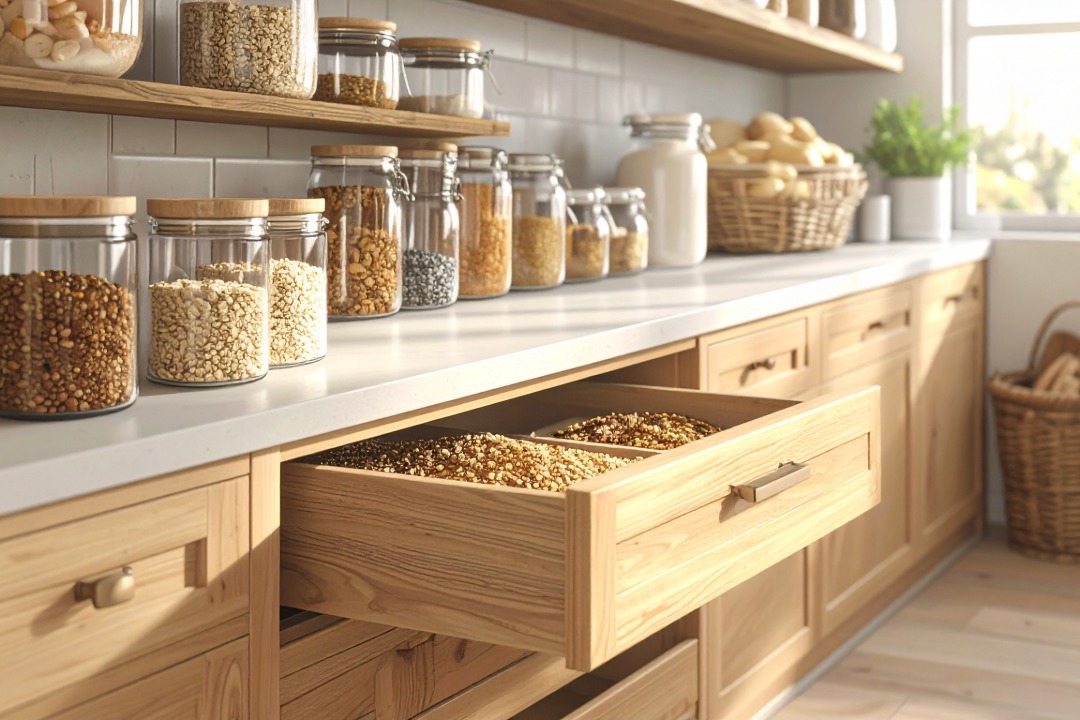
Open any Indian kitchen cabinet and you will find the same story. Steel vessels stacked three deep. Pressure cooker lids jammed behind mixing bowls. Spice packets stuffed into corners you cannot reach without pulling everything out first. The kitchen has enough space. The problem is that the space is not organised to handle what Indian cooking actually demands.
The right kitchen storage accessories change that completely. Pull-out baskets, corner carousels, tandem drawers, bottle racks, and tall pantry units turn cluttered cabinets into systems where every item has a place and every place is easy to reach. These are not luxury add-ons. For Indian kitchens that handle three meals a day with heavy cookware and dozens of ingredients, they are practical necessities.
This guide covers the most useful modular kitchen accessories for Indian homes, explaining what each one does, where it fits, and why it matters for daily cooking.
Pull-Out Baskets: The Foundation of Organised Kitchen Cabinet Storage
A kitchen pull out basket is a wire or stainless steel tray mounted on telescopic channels inside a base cabinet. Instead of opening a door and reaching blindly into a dark cabinet, you pull the entire basket out towards you. Everything stored inside becomes visible and accessible in one motion.
Indian kitchens store heavy steel vessels, stainless steel thaalis, kadhai sets, and pressure cookers in base cabinets. Without pull-out baskets, these items pile on top of each other. You lift three pots to get to the one at the bottom. Pull-out baskets eliminate this problem entirely. Each basket slides out fully, so you see and reach every item without moving anything else.
Pull-out baskets come in different depths and widths to match standard modular kitchen cabinet sizes. Choose stainless steel SS304 grade for baskets near the sink and wet zone because it resists corrosion from moisture and cleaning liquids. Chrome-plated baskets work well for dry storage in upper cabinets. The telescopic channels should have soft-close mechanisms to prevent slamming and reduce wear on the cabinet body over time.
Corner Carousels and Magic Corners: Rescuing Dead Space
Every L-shaped and U-shaped kitchen has at least one deep corner where items go to disappear. The corner is too deep to reach, too dark to see into, and too awkward for standard shelves. Without a proper solution, that corner becomes wasted space or a dumping ground for things you rarely use.
A corner carousel kitchen unit solves this with rotating circular trays mounted on a central pole inside the corner cabinet. Open the door and the trays spin, bringing items from the back to the front. You can store heavy vessels, mixing bowls, and serving dishes on a carousel without ever reaching into the dark.
Magic corners take this further. A magic corner system uses connected pull-out trays that swing out of the cabinet when you open the door. The front tray pulls out first, and the rear tray follows on a linkage mechanism. This gives you full access to the entire corner depth without any rotating motion. For kitchens with deep L-shaped corners, magic corners extract more usable storage than standard carousels.
Both options should be planned during the kitchen design stage, not retrofitted later. The cabinet dimensions, door hinge side, and internal clearances all need to match the corner unit specifications. A factory-built modular kitchen that pre-engineers these measurements during design avoids the alignment problems that happen with aftermarket installations.
Tandem Drawers: Heavy-Duty Storage That Glides
A tandem drawer kitchen system replaces standard cabinet doors with full-extension metal-sided drawers. Instead of a shelf behind a door, you get a deep drawer that slides out completely on precision ball-bearing channels. The entire contents are visible from above.
Tandem drawers are ideal for storing heavy Indian cookware. Pressure cookers, cast iron tawas, idli moulds, and large steel vessels all fit comfortably. Good tandem systems handle 30 to 50 kilograms of load while still gliding smoothly. Soft-close dampers ensure the drawer shuts silently even when loaded to capacity.
In Indian kitchens, tandem drawers work best for the base cabinet under the hob, the pot-and-pan storage zone, and deep grocery drawers. They transform the lowest, hardest-to-reach cabinets into the most accessible storage in the kitchen. For families that use heavy cookware daily, tandem drawers are one of the most impactful modular kitchen hardware upgrades available.
Bottle Pull-Outs: Using Every Narrow Gap
Indian cooking uses multiple oils, vinegars, sauces, and tall spice containers daily. Keeping all of these on the countertop creates clutter. A bottle pull out kitchen unit is a tall, narrow basket mounted on vertical telescopic channels that fits into gaps as slim as 150mm between cabinets.
Pull the handle and the entire unit slides out, revealing two or three shelves of bottles standing upright. Cooking oil, sesame oil, mustard oil, vinegar, soy sauce, and tall masala containers all stay organised and within reach. The vertical design uses space that would otherwise remain a dead gap between cabinets or between the refrigerator and the wall.
Bottle pull-outs should be placed next to the hob for quick access during cooking. Stainless steel construction handles the oil drips and occasional spills better than chrome. Make sure the channel supports the combined weight of full glass bottles without sagging.
Tall Pantry Units: Vertical Storage for Bulk Groceries
Indian families often shop for groceries monthly. Ten-kilogram bags of atta, dal packets, rice, sugar, multiple oil tins, and dozens of spice containers need storage space that most base cabinets cannot provide. A kitchen pantry unit solves this by going vertical. These tall, slim units stand floor-to-ceiling and pull out on heavy-duty channels to reveal six to eight shelves of adjustable storage.
A good pantry unit slides out fully so you see every shelf at eye level. Adjustable shelf heights let you accommodate everything from small spice jars to large pressure cooker bodies. For urban apartments where kitchen floor space is limited, a single tall unit replaces an entire separate storage rack and keeps everything concealed behind a clean shutter face.
Tall units require reinforced mounting and high-quality telescopic channels rated for heavy loads. The shutter weight, shelf load, and total pull-out weight combined can exceed 60 kilograms. This is where modular kitchen hardware quality matters most. Channels from trusted brands like Hettich and Blum handle this load reliably. Cheaper channels sag within a year of daily use.
Cutlery Trays, Spice Racks, and Drawer Organisers
Every drawer in the kitchen benefits from internal organisation. Without dividers, spoons mix with forks, ladles tangle with spatulas, and rolling pins slide against masala boxes. Cutlery trays with fixed compartments keep daily utensils sorted and instantly accessible. These trays are usually made from food-grade plastic or formed stainless steel and sit inside the top drawer near the cooking zone.
Spice racks are another essential among kitchen storage accessories Indian home cooks rely on. A pull-out spice rack fits beside the hob and holds 15 to 20 standard spice containers in labelled rows. No more opening three cabinets to find jeera or haldi. Everything is visible and within arm’s reach while you cook.
Under-sink organisers keep cleaning supplies, detergent bottles, scrubbers, and garbage bags tidy. A pull-out bin system under the sink with separate compartments for wet and dry waste also simplifies daily waste management. These small modular kitchen accessories make a surprisingly large difference in how smooth the kitchen runs.
Why Kitchen Accessories Should Be Planned During Design, Not After
The most common mistake homeowners make is choosing accessories after the kitchen cabinets are already manufactured. This leads to wrong fitments, misaligned channels, and accessories that rattle or jam because the cabinet dimensions do not match the hardware specifications.
Accessories like corner carousels, magic corners, and tall pantry units require specific cabinet widths, depths, and hinge placements. A carousel needs a minimum corner cabinet opening of 900mm. A bottle pull-out needs a precise gap width. A tandem drawer needs reinforced side panels to support the channel load. All of these must be engineered into the cabinet design before production begins.
When a modular kitchen is designed and manufactured in a single factory, the cabinet engineers specify every accessory slot, channel position, and mounting point during the design phase. This integrated approach eliminates the guesswork and incompatibility issues that happen when cabinets and accessories are sourced separately.
Choosing the Right Material Grade for Kitchen Hardware
Not all stainless steel is the same. SS202 grade is cheaper but rusts faster in humid Indian conditions. SS304 grade costs more but resists corrosion significantly better. For baskets, pull-outs, and accessories in the wet zone near the sink, SS304 is the right choice. For upper cabinets and dry zones, chrome-coated or SS202 accessories work adequately.
Channel quality determines how long accessories perform smoothly. Ball-bearing channels from brands like Hettich, Blum, and Hafele are tested for 50,000 to 100,000 cycles. That translates to 10 to 15 years of daily opening and closing. Cheap unbranded channels lose their smooth action within one to two years and start sagging under load.
A manufacturer with their own factory setup tests accessory fitment and channel alignment before shipping. At Holzbox, every pull-out, carousel, and drawer system is mounted and tested in the factory, then disassembled for packing. This pre-fitment step catches misalignments before the kitchen reaches your home, saving the frustration of on-site corrections. For a full cost picture of accessories and other kitchen components, read this cost breakdown of modular kitchens in India.
Frequently Asked Questions
Which kitchen storage accessories are most important for small Indian kitchens?
For small kitchens, start with pull-out baskets for base cabinets, a corner carousel or magic corner for the L-shaped junction, and a tall pantry unit for vertical grocery storage. These three accessories solve the biggest problems in compact Indian kitchens: inaccessible base cabinets, wasted corner space, and insufficient grocery storage. A bottle pull out kitchen unit next to the hob also saves valuable counter space. Prioritise these before adding cutlery trays and spice racks, which are useful but less impactful in tight spaces.
Should I choose SS202 or SS304 stainless steel for kitchen baskets?
SS304 is the better choice for baskets in the wet zone near the sink and dishwasher because it resists rust and corrosion from water and cleaning agents. SS202 is acceptable for upper cabinets and dry storage zones where moisture exposure is minimal. In coastal cities or areas with high humidity, SS304 across all kitchen zones is worth the extra cost for long-term reliability. Always check the grade marking on the basket before purchase.
Can kitchen accessories be added to an existing modular kitchen later?
Some accessories like cutlery trays, drawer organisers, and simple pull-out baskets can be retrofitted. However, corner carousels, magic corners, and tandem drawer systems require specific cabinet dimensions that must match the hardware. If the existing cabinets were not designed for these accessories, retrofitting is difficult and often results in poor fitment. The best approach is to plan accessories during the initial kitchen design phase when cabinet dimensions can be engineered around the hardware.
How much do modular kitchen accessories typically cost in India?
Prices vary by type, brand, and material grade. Basic pull-out baskets start from around 1,500 to 3,000 rupees per unit. Corner carousels range from 5,000 to 15,000 rupees depending on mechanism type and brand. Tandem drawer systems cost 3,000 to 8,000 rupees per drawer. Tall pantry units with channels and shelves range from 15,000 to 40,000 rupees. Bottle pull-outs cost 1,500 to 4,000 rupees. Total accessory cost for a full kitchen typically adds 15 to 25 percent to the overall kitchen budget.
What brands are recommended for modular kitchen hardware in India?
Hettich, Blum, and Hafele are the three most widely trusted brands for modular kitchen hardware in India. All three offer soft-close channels, tandem box systems, corner solutions, and pull-out mechanisms tested for heavy-duty use. Ebco and Dorset are also reliable options at a more accessible price point. The brand matters most for load-bearing components like tandem channels and tall unit runners. For simpler items like cutlery trays and spice racks, standard SS304 stainless steel products from domestic manufacturers perform well.