
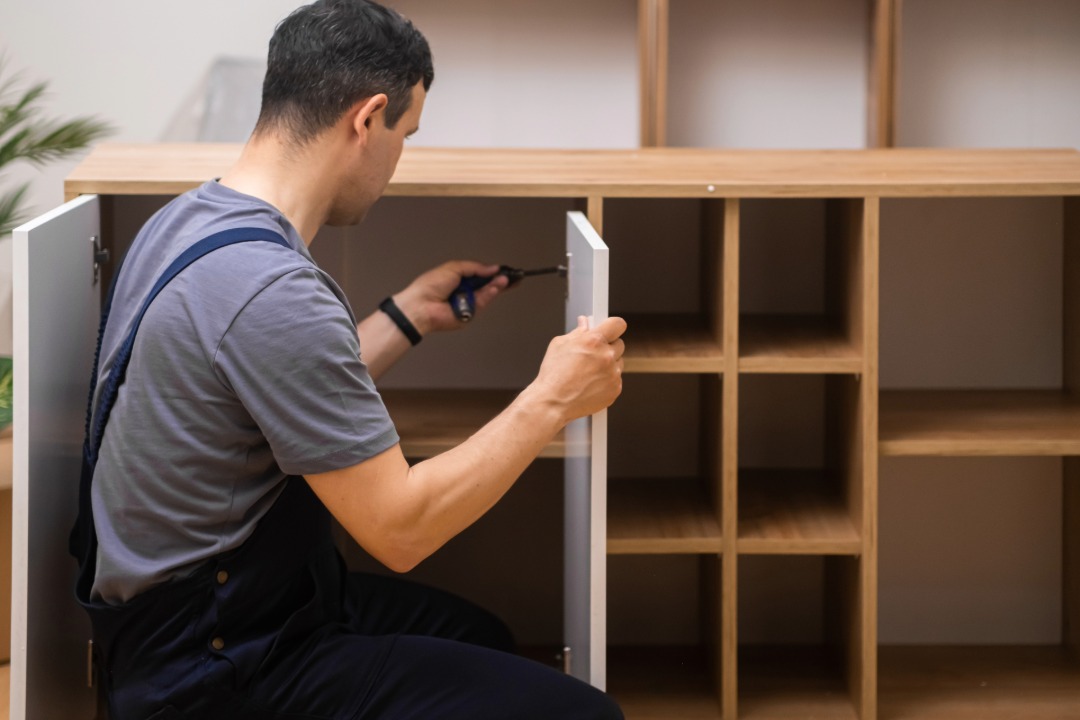
A modular wardrobe arrives at your home in six flat-packed boxes. Each box contains CNC-cut panels, pre-drilled hardware points, edge-banded surfaces, and bagged hardware. The panels are labelled. The assembly sequence is specified. The hardware is sorted by module.
Now imagine handing those boxes to the building watchman’s recommended carpenter. He has never seen these modules before. He does not know the hinge calibration depth. He does not understand why the soft-close mechanism needs a specific mounting offset. He installs the hinges by eye, tightens the screws with whatever drill bit he has, and leaves.
Within a month, the doors do not close properly. The soft-close stops working. A drawer rubs against the frame. The homeowner blames the furniture. But the furniture left the factory in perfect condition. The installation failed it.
This scenario plays out in thousands of Indian homes every year. And it illustrates why professional furniture assembly is not a convenience service. It is the final quality gate that determines whether your modular furniture performs as designed or fails despite being well built.
The Factory-to-Site Continuity That Changes Everything
The most important benefit of professional assembly is continuity. The person who installs the furniture understands how it was manufactured. They know the panel thickness. They know the hardware specifications. They know the tolerance ranges.
A manufacturer that sends its own trained technicians to the installation site closes the loop between production and delivery. The same quality standard that governed the CNC cutting governs the on-site assembly. The same dimensional accuracy that the factory verified is maintained during positioning and levelling.
Third-party assembly services break this continuity. The technician has never visited the factory. They do not know whether the hinge is designed for an 18mm panel or a 16mm panel. They do not know the correct torque for the cam lock connector. They apply generic assembly skills to a product that requires specific knowledge.
This distinction is invisible to most homeowners. But it is the reason why two identical wardrobes from the same factory can perform differently in two different homes. The wardrobe installed by the manufacturer’s team operates smoothly for years. The one installed by a freelance technician develops problems within months.
Precise Hardware Calibration
Modular furniture hardware is engineered to operate within narrow tolerance ranges. A soft-close hinge from Hettich requires mounting at a specific depth, angle, and distance from the panel edge. The three-dimensional adjustment screws on the hinge allow fine-tuning of door position after mounting. But this fine-tuning only works correctly when the initial mounting is accurate.
A professional installer calibrates each hinge after mounting. They check the door gap at the top, bottom, and sides. They verify that the soft-close action engages at the correct closing angle. They test the door with multiple open-close cycles to confirm smooth operation.
Drawer runners require similar precision. Full-extension ball-bearing runners must be mounted exactly parallel to each other. If one runner is tilted by even 2 degrees, the drawer pulls to one side. Over months of daily use, this misalignment causes the roller mechanism to wear unevenly. The drawer starts jamming.
A trained installation technician uses a spirit level for every runner. They verify the extension and retraction at full load. They test the soft-close action with the drawer loaded to simulate real-world conditions. These checks take minutes per drawer. But they prevent years of frustration.
Damage-Free Module Handling
Modular furniture panels are finished before they leave the factory. Laminate, acrylic, PU, or veneer surfaces are ready for use. Any scratch, dent, or chip during transportation or assembly is visible immediately and often irreparable without replacing the entire panel.
Professional assembly teams handle modules with padded gloves. They use protective blankets when positioning panels against walls. They never drag a module across a tiled floor. They lift, position, and lower with coordinated team movement.
When connecting base cabinets in a modular kitchen, the team levels each unit before securing it to the adjacent module. They use shims on uneven floors to ensure the countertop sits perfectly flat. They install the countertop last, after all base units are levelled and connected, so the stone or quartz slab rests on a stable, uniform surface.
A freelance carpenter installing the same kitchen may drag the base units into position. The laminate chips against the tile edge. The countertop is placed on an unlevelled base and develops a slight wobble. These damages are small individually. Together, they reduce the kitchen’s lifespan and daily performance.
Plumbing and Electrical Coordination
Kitchen installation involves more than assembling cabinets. The sink needs plumbing connections. The dishwasher needs a water inlet and drainage outlet. The chimney needs duct routing to the external wall. The hob needs a gas connection. The microwave, water purifier, and fridge need electrical points at specific heights.
A professional installation team coordinates these connections as part of the assembly process. They verify that the plumbing rough-in aligns with the sink cutout. They confirm that the electrical outlet behind the fridge is accessible after the module is positioned. They test the chimney suction after completing the duct connection.
This coordination is built into the professional installation process. The team arrives with the installation drawings that show every connection point. They cross-reference the on-site rough-in with the factory specifications. If a plumbing point is offset by two inches, they identify the correction needed before the countertop is installed, not after.
Without this coordination, the homeowner discovers the misalignment after the countertop is cut and fitted. Correcting a plumbing offset under an installed countertop is expensive, messy, and sometimes impossible without removing the slab.
Wall Anchoring and Structural Safety
Wall-mounted cabinets and tall wardrobe units must be anchored securely. An overhead kitchen cabinet holding 15 to 20 kilograms of crockery needs to be fastened to the wall studs or masonry with load-rated fasteners. A floor-to-ceiling wardrobe must be anti-tipped with L-brackets at the top to prevent forward toppling.
Professional installers check the wall composition before drilling. Brick walls need different anchors than concrete walls. Hollow partition walls need toggle bolts or specialised cavity fixings. Drilling into a concealed electrical conduit or water pipe is a real risk that trained technicians know how to avoid by checking the installation drawings and using a wire detector.
A freelance technician without this training may drill into a water line behind the kitchen wall. Or anchor a heavy cabinet with undersized screws that pull out under load. Or skip the anti-tip bracket on a tall wardrobe because it “looks stable enough.”
The safety implications are serious. A wall cabinet that falls during use can cause injury and damage the countertop, flooring, and the cabinet itself. An unsecured tall wardrobe can topple when a child climbs or hangs on the door. These risks are eliminated when the installation follows a verified safety protocol.
Installation Sequence That Prevents Rework
Professional teams follow a specific installation sequence designed to minimise handling damage and access conflicts.
In a home interior design project spanning multiple rooms, the kitchen is installed first. It requires the most coordination with plumbing and gas connections. The bedroom wardrobes come second because they are the largest modules and need maximum corridor clearance for delivery. Living room units, study desks, and shoe cabinets are installed last because they are smaller and easier to position.
Within each room, the sequence is equally important. Base cabinets are positioned and levelled before wall cabinets are mounted. The countertop is installed after all base cabinets are connected and the sink cutout is verified. Shutters and drawers are fitted last to prevent damage during the heavy-lifting phase.
A freelance technician may install components in whatever order seems convenient. Mounting wall cabinets before levelling the base creates alignment conflicts. Installing drawers before the countertop risks scratching the drawer fronts during slab handling. The wrong sequence creates rework that a correct sequence avoids entirely.
Post-Installation Quality Walkthrough
The final benefit of professional assembly is the structured walkthrough that happens after every installation is complete.
The installation supervisor walks through every room with the homeowner. They open every door. Pull every drawer. Test every soft-close mechanism. Check every edge alignment. Verify every handle position. Inspect every surface for scratches or defects.
Any issue identified during this walkthrough is logged and corrected on the spot or scheduled for immediate follow-up. A shutter that does not align perfectly is adjusted by recalibrating the hinge. A drawer that rubs is corrected by shimming the runner. A laminate chip noticed during inspection is photographed and a replacement panel is ordered from the factory.
This walkthrough is the manufacturer’s quality handover. It transfers ownership from the installation team to the homeowner with a verified record of the furniture’s condition. Without it, defects go unnoticed until they become problems weeks later. By then, the installation team has moved on and the correction requires a separate service visit.
Why the Manufacturer’s Own Team Matters Most
Holzbox sends its own trained technicians for every installation. Not outsourced labour. Not gig-economy assemblers. Full-time employees who work alongside the production team daily and understand the internal construction of every module they install.
When the same company designs, manufactures, and installs, the quality chain is unbroken. The designer’s intent is preserved in the factory production. The factory’s precision is preserved in the on-site assembly. The homeowner receives a finished product that matches the 3D render they approved months earlier.
This end-to-end ownership is the most important benefit of professional furniture assembly. It is not about convenience. It is about ensuring that a product manufactured to sub-millimetre accuracy is not degraded by a careless final step. The installation is the last link in the quality chain. When that link is strong, everything before it holds.
Frequently Asked Questions
Why can I not just hire a local carpenter to assemble modular furniture?
A local carpenter may have general woodworking skills but lacks the specific knowledge of modular hardware calibration. Soft-close hinges, full-extension runners, push-to-open mechanisms, and cam-lock connectors all require precise mounting at factory-specified depths and angles. Incorrect installation causes hardware to malfunction within months. A manufacturer’s trained technician knows the exact specifications for every component because they work with the same products daily.
How long does professional modular furniture installation take?
A standard L-shaped modular kitchen takes two to three days. A floor-to-ceiling bedroom wardrobe takes one day. A complete 2BHK interior with kitchen, two wardrobes, TV unit, and study desk takes five to seven days. These timelines include module positioning, levelling, hardware calibration, plumbing and electrical coordination, and the quality walkthrough. Professional teams work in planned sequences that eliminate rework, making the process faster than unstructured assembly.
Does professional installation cost extra or is it included?
Most modular furniture manufacturers include installation in their per-square-foot pricing or total project cost. The installation charge is built into the overall quotation. Some companies list it as a separate line item for transparency, typically ranging from 2,000 to 8,000 rupees depending on project scope. Always confirm whether installation is included before comparing quotations. A lower furniture price that excludes installation may actually cost more when the assembly charge is added separately.
What should I check during the post-installation walkthrough?
Open every cabinet door and verify smooth, even closing with proper soft-close action. Pull every drawer to full extension and push it back to confirm silent closing. Check shutter alignment by looking at the gaps between adjacent doors. Inspect all surfaces for scratches or chips. Test internal lights if fitted. Verify that the countertop sits flat without wobble. Confirm that plumbing connections do not leak. Document any issues with photographs and get a written commitment for correction from the installation team.
Can professional assembly services handle furniture relocation?
Yes. A manufacturer with in-house manufacturing can disassemble, transport, and reinstall modular furniture when you move homes. The technicians know the assembly and disassembly sequence for every module they originally installed. Panels, hardware, and accessories are handled with the same care as during the original installation. Minor adjustments are made for the new room dimensions. This service is significantly safer than hiring general movers who may force-disassemble modules and damage panels, connectors, or hardware in the process.