
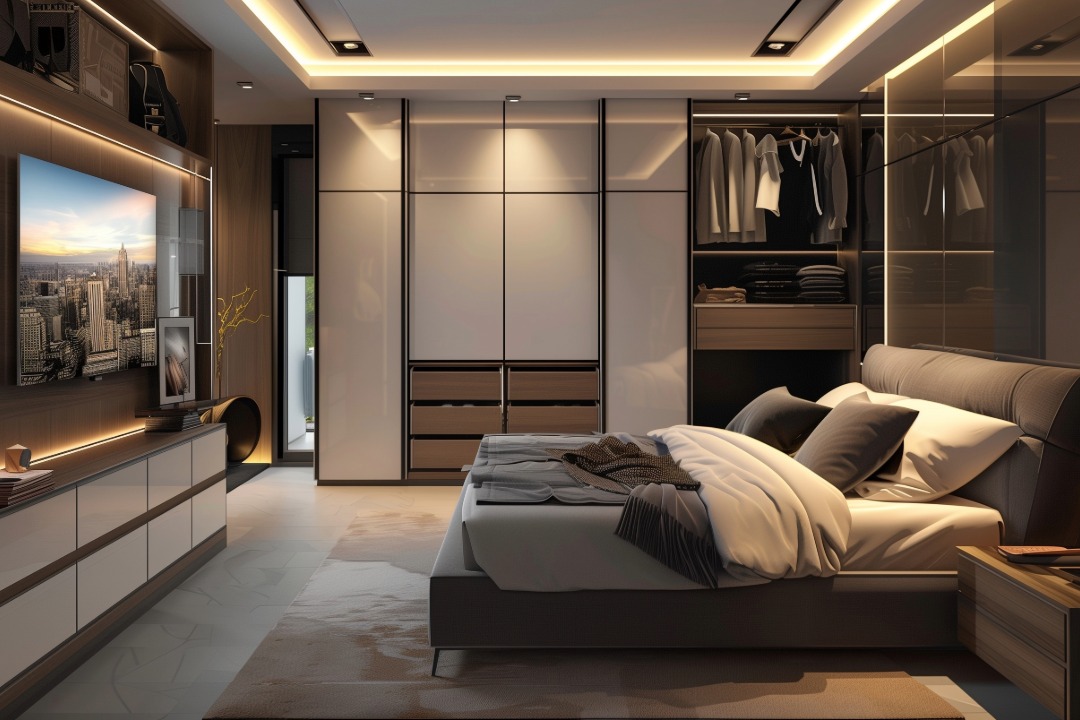
A modular wardrobe is not something you replace every few years. It is built into your bedroom. You use it every morning and every night. It stores your most personal belongings. If it is built well, it serves you quietly for over a decade. If it is built poorly, it becomes a daily source of frustration within the first year.
The design matters. The materials matter. But the manufacturer matters most. Because the same design drawn on screen can result in two completely different products depending on who builds it and how.
This guide covers the practical steps for evaluating modular wardrobe manufacturers. Not brand rankings. Not showroom impressions. The real checks that determine whether your wardrobe will hold up after five years of daily use.
Understand the Difference Between a Manufacturer and a Dealer
This is the first and most important distinction. Many companies that present themselves as wardrobe manufacturers are actually dealers or assemblers. They take your order, outsource the production to a third-party fabricator, and coordinate the installation.
A true manufacturer operates a factory. They cut panels on their own CNC machines. They apply edge banding on their own production line. They assemble modules, test hardware, and inspect every unit before it leaves the facility.
The difference shows up in three areas. First, dimensional accuracy. Factory-cut panels fit together with sub-millimetre precision. Outsourced panels from different vendors often have slight variations that cause alignment issues during assembly.
Second, edge quality. Factory edge banding is applied under controlled temperature and pressure. It bonds tightly and resists peeling. Outsourced edge work is often done manually with inconsistent results.
Third, accountability. When one company designs, manufactures, and installs, there is a single point of responsibility. When production is outsourced, blame gets passed between the designer, the fabricator, and the installer whenever something goes wrong.
Check the Carcass Material They Use
The carcass is the structural body of the wardrobe. It includes the side panels, top, bottom, back, and internal shelves. It holds all the weight. It anchors the hinges and runners. If the carcass fails, the entire wardrobe fails.
Ask your manufacturer what material they use for the carcass. BWR-grade plywood is the most durable option for Indian conditions. It resists moisture, holds screws firmly, and does not swell in humid environments.
HDHMR is a good alternative for dry-zone locations. It is denser than MDF, offers decent moisture resistance, and provides a smooth surface.
Standard MDF should only be used for shutter panels, not for the carcass. It absorbs moisture through exposed edges and swells permanently. Particle board is the cheapest option and the weakest. It is acceptable for temporary setups but not for a wardrobe you expect to last a decade.
A credible modular wardrobe manufacturer will specify the exact board grade and brand. They will not use vague terms like “imported engineered wood” or “premium board.” If the material specification is unclear in the quotation, that is a red flag.
Evaluate the Internal Layout Design Process
A wardrobe is only as useful as its internal organisation. The external design gets the attention, but the internal layout is what you interact with every day.
A good manufacturer starts with a detailed consultation about your storage habits. How many hanging garments do you own? Do you need a long-hang section for sarees, kurtas, or dresses? How many folded items do you store? Do you need dedicated drawers for accessories, jewellery, or watches? Where do you keep your shoes? What about bedding and seasonal items?
Based on your answers, the manufacturer should design the internal layout with specific zones. A long-hang section for ethnic and formal wear. A short-hang section for shirts and blouses. A shelf stack for folded clothes. Pull-out drawers for accessories. A top loft for luggage and rarely used items.
If the manufacturer offers only fixed layouts from a catalogue without asking about your habits, they are not designing for you. They are selling a product that may or may not match your needs.
Inspect the Hardware Specification
Hardware is the part of the wardrobe you physically touch every day. Hinges. Drawer runners. Hanging rods. Pull-out mechanisms. Soft-close dampers. These components determine whether the wardrobe feels smooth and reliable or stiff and frustrating.
Ask specifically which hardware brand is included. Hettich, Blum, and Hafele are the most trusted names in India. Ask for the hinge type and its rated cycle life. A good soft-close hinge should be rated for at least 50,000 cycles. That translates to more than ten years of daily use.
Drawer runners should be full-extension and ball-bearing type. Budget runners are roller-based and tend to jam after a few months. Full-extension runners let you see and access the entire drawer depth, which makes a real difference when searching for items in deep drawers.
Hanging rods should be steel or chrome-plated and rated for the weight of heavy winter clothing and thick ethnic garments. Aluminium rods are lightweight and can bend under sustained load.
Also check whether the wardrobe hardware cost is included in the base quotation or listed as an upgrade. Some companies quote a low price with basic hardware and then charge extra when you ask for soft-close fittings. Get this clarity before you compare prices.
A well-specified custom modular wardrobe uses premium hardware as standard, not as an optional extra.
Ask for a 3D Render Before Approving
A floor plan sketch is not enough. You need to see exactly how the wardrobe will look in your room before production begins. A 3D render shows the wardrobe from multiple angles with the chosen finish, handle style, and proportions visible in the context of your bedroom.
The render also helps catch design errors early. A shutter that is too wide for the room’s proportions. A loft that is too high to reach comfortably. A drawer section placed where the bed frame blocks it from opening fully.
Any serious wardrobe design company offers 3D visualisation as part of the design consultation. If the manufacturer skips this step and moves straight to production based on a rough drawing, they are cutting a corner that could cost you an expensive correction later.
Compare Quotations on Material Specifications
Price comparison only works when you are comparing identical specifications. A quotation of 60,000 rupees from one company and 1.2 lakhs from another tells you nothing if the first uses particle board with basic hinges and the second uses BWR plywood with Hettich soft-close fittings.
Ask every manufacturer for an itemised quotation. It should list the carcass material and grade, the shutter material and finish, the hardware brand and type, the internal accessories, and the installation charges. It should also clearly state what is excluded.
Common exclusions include loft units, internal lighting, mirror panels, and electrical work for built-in lights. If these are not listed, they will show up as surprise charges after the order is placed.
A manufacturer confident in their product will welcome detailed price transparency. A company that resists itemisation is usually hiding lower-grade materials behind a round number.
Visit the Factory
This step alone separates serious manufacturers from everyone else. A factory visit tells you more about a company than any website or showroom ever can.
Look at the machines. Are panels cut on CNC routers or by hand? Is edge banding applied with automated equipment or a handheld iron? Is there a quality inspection station at the end of the production line?
Look at the material storage. Are boards kept in a covered, dry area or stacked outdoors? Are incoming batches labelled with brand and grade information? Does the company test raw materials before they enter the cutting line?
A manufacturer with in-house manufacturing will be proud to show you their facility. Holzbox, for example, designs and manufactures modular wardrobes in its own factory. Every panel is cut, edged, assembled, and inspected under one roof. That level of integration ensures dimensional accuracy and finish consistency that outsourced production cannot match.
If a company declines or deflects a factory visit request, you are not dealing with a manufacturer. You are dealing with a middleman.
Confirm the Warranty and After-Sales Policy
A modular wardrobe should come with a written warranty. The warranty should specify what is covered, for how long, and what the service response process looks like.
Good warranties cover the carcass, shutter finish, and hardware separately because each has a different expected lifespan. Hardware warranties from branded manufacturers like Hettich or Blum are often longer than the shutter finish warranty.
Ask about the after-sales process. Is there a dedicated service team? What is the typical response time? Can damaged panels or accessories be replaced individually without dismantling the entire unit?
A company that manufactures in its own facility can stock replacement parts and dispatch them quickly. A company that sourced from external vendors may struggle to find matching parts two or three years after installation.
Check References From Past Clients
Online reviews help but they are not the full picture. Ask the manufacturer for references from clients who received their wardrobe at least two years ago. Speak to them. Ask how the finish has held up. Ask whether the hardware still operates smoothly. Ask whether any service calls were needed and how they were handled.
A two-year-old wardrobe tells you more than a two-week-old one. Day one looks are easy. Year two performance is the real test.
Trust the Process, Not the Pitch
The right modular wardrobe manufacturer will ask more questions than they answer in the first meeting. They will want to know your room dimensions, your clothing inventory, your bedroom interior design preferences, your door type preference, and your budget range before they propose a single design.
A company that jumps straight to a quotation without understanding your home interior design needs is selling a product, not solving a problem. Choose the one that listens first.
Frequently Asked Questions
What is the most important factor when choosing a modular wardrobe manufacturer?
Whether they manufacture in their own factory or outsource production. A factory-built wardrobe offers tighter dimensional tolerances, better edge sealing, tested hardware integration, and a single point of accountability. An outsourced wardrobe assembles parts from multiple vendors with no guarantee of system-level quality. This single factor affects everything from durability to after-sales service.
How much does a modular wardrobe cost in India in 2026?
Costs depend on size, material, finish, and hardware. A basic modular wardrobe for a standard bedroom wall starts at 30,000 to 50,000 rupees with laminate finish and standard hardware. A mid-range wardrobe with BWR plywood, soft-close Hettich hardware, and acrylic or PU shutter finish costs 70,000 to 1.5 lakh rupees. Premium walk-in or full-wall wardrobes with imported fittings can exceed 2 lakhs. Always compare itemised quotations to understand what each price includes.
What carcass material is best for wardrobes in humid Indian cities?
BWR-grade plywood is the most reliable choice for cities like Mumbai, Chennai, Kochi, and Kolkata where indoor humidity stays high, especially during monsoon. It resists swelling, holds screws firmly, and lasts over a decade with proper edge banding. HDHMR is a viable alternative for moderately humid conditions. Standard MDF and particle board are not recommended for carcass use in humid environments.
How long should a good modular wardrobe last?
A well-built modular wardrobe with BWR plywood carcass, factory-sealed edges, and branded hardware lasts 12 to 15 years with minimal maintenance. The hinges and drawer runners may need minor adjustment once or twice over that period. The shutter finish retains its appearance for 8 to 12 years depending on the finish type and daily use patterns. Laminate finishes are the most durable for everyday use in Indian conditions.
Can I relocate a modular wardrobe if I move homes?
Yes. Modular wardrobes are built as independent boxes that can be disassembled, transported, and reinstalled. The carcass, shutters, hardware, and most internal fittings remain reusable. Minor adjustments to the width or height may be needed if the new room has different dimensions. This relocatability is a significant advantage over carpenter-built wardrobes which are fixed to the wall and typically get damaged during removal.