
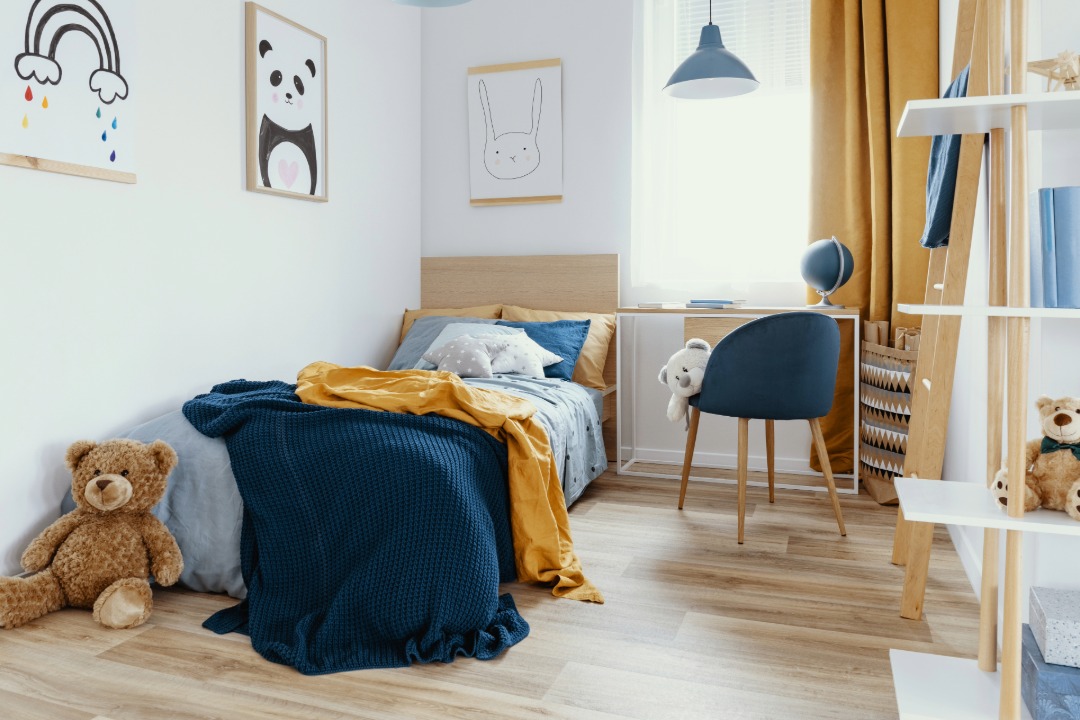
Children do not use their rooms the way adults do. They climb on furniture. They hang from shelves. They slam drawers with full force. They fall off beds. They put their fingers in every gap. They eat in their room, spill on every surface, and draw on the walls when nobody is watching.
Designing a kids room that is both safe and functional means anticipating every one of these behaviours and building the room to handle them. Not with aftermarket guards and stick-on corner pads. But with furniture and fittings that are safe by design from the moment they leave the factory.
This guide covers the safety and functionality aspects that matter most for Indian homes. Not generic tips you have already read. The specific material choices, hardware decisions, and layout principles that protect children while keeping the room genuinely usable for sleeping, studying, playing, and growing.
Safety Starts at the Material Level
The most important safety decisions in a kids room are invisible. They happen inside the board, inside the paint, and inside the adhesive. Not on the surface.
Low-VOC materials are essential. VOC stands for Volatile Organic Compound. These chemicals off-gas from paints, laminates, adhesives, and engineered boards. In a sealed room with closed windows and an air conditioner running, VOC levels accumulate. Children breathe faster than adults. Their lungs are smaller. Their bodies absorb these chemicals at higher rates.
Standard MDF and particle board use urea-formaldehyde resin that continues to off-gas for months after installation. Low-emission boards rated E1 or better reduce formaldehyde release to safe levels. BWR plywood uses phenol-formaldehyde resin which off-gases less and cures more completely during manufacturing.
Low-VOC paints are now widely available from Asian Paints, Berger, and other major Indian brands at minimal price premiums. Water-based finishes on furniture surfaces eliminate solvent exposure entirely.
A manufacturer that controls its own material sourcing can verify the emission certification of every board, laminate, and adhesive before they enter the production line. A carpenter buying boards from a local dealer has no way to verify this.
Edge Profiles That Prevent Injuries
Sharp edges on furniture are the most common cause of childhood injuries at home. A 90-degree corner on a bed frame at shin height. A protruding shelf edge at forehead height. A table corner at eye level for a toddler.
Factory-produced modular furniture can be specified with rounded edge profiles during the CNC cutting process. The machine routes a 5mm or 10mm radius on every exposed corner. This rounding is built into the panel, not glued on as an afterthought. It cannot peel off. It cannot be pulled away by small fingers.
PVC edge banding with rounded profiles provides the same protection on board edges. Factory-applied edge banding bonds flush with the panel surface. Manual edge banding from a carpenter often leaves a slight lip where the strip meets the board. That lip catches tiny fingers and eventually peels, exposing the raw board underneath.
For a kids room, specify rounded edge profiles on every piece of furniture. Beds. Wardrobes. Study desks. Shelves. TV units. Even skirting boards and window ledges if they are within reach. The incremental cost is negligible during factory production. The injury prevention is significant.
Soft-Close Hardware Is Not a Luxury in a Kids Room
Children slam doors. They pull drawers open and let them snap back. They push cabinet doors with their full body weight. Standard hinges and runners allow these actions to happen with full force. The result is jammed fingers, bent hardware, and bruised hands.
Soft-close hinges slow the door to a gentle stop in the last few centimetres of travel. A child can push the door as hard as they want. The mechanism absorbs the force and closes the door quietly. No slamming. No finger injuries.
Soft-close drawer runners do the same for drawers. A child pulls the drawer out and pushes it back carelessly. The runner catches the drawer and guides it to a smooth, silent close.
The cost of soft-close hardware for a kids room wardrobe and study unit is typically 3,000 to 6,000 rupees. That is a fraction of the furniture cost. And it prevents the most common furniture-related injury that children experience in Indian homes.
Anti-tip brackets are another essential. Children climb. A wardrobe or bookshelf that is not secured to the wall can topple when a child pulls on the top shelf or hangs from a door. A single L-bracket at the top, screwed into the wall stud, prevents the entire unit from tipping forward. Every tall piece of furniture in a kids room should be wall-anchored.
Designing Functional Zones Within One Room
A kids room serves multiple functions simultaneously. The same room is a bedroom, a study, a play area, and a storage zone. In most Indian apartments, this all happens within 60 to 100 square feet.
The key to making this work is clear zone separation. Not with walls. With furniture placement and visual cues.
The sleep zone should be against the wall furthest from the door. This creates a sense of shelter and calm. The bed should be away from the window to avoid direct sunlight on the face during early morning hours.
The study zone should sit near the window for natural light. The desk surface should face the wall or the window, not the door. When the door is in the child’s line of sight during study, every movement in the corridor becomes a distraction.
The play zone occupies whatever floor space remains after the bed, wardrobe, and desk are placed. Keeping this zone clear is the goal. Every other piece of furniture should be wall-mounted or integrated to avoid consuming floor area that the child needs for movement and play.
The storage zone is the wardrobe and any additional shelving. A well-organised kids wardrobe holds clothes, school supplies, toys, and books in a dedicated layout. A kids study desk with integrated shelving keeps textbooks and stationery within arm’s reach. Dedicated sections for each category reduce clutter and teach the child organisational habits from a young age.
These child safe design principles, combined with low VOC materials throughout every surface, create a room where parents can relax knowing the environment protects their child physically and chemically.
A kids room design service that understands Indian apartment dimensions will plan these zones with exact measurements. A generic design from a catalogue does not account for the column in the corner, the window placement, or the door swing that determines how much usable floor space you actually have.
Age-Appropriate Design That Evolves
The safety and functionality requirements of a kids room change significantly at three life stages.
For toddlers and preschoolers aged two to five, safety dominates every decision. All furniture should be low-height. Shelves should be accessible without climbing. Every edge should be rounded. Every door should have soft-close. The bed should be close to the ground with a guard rail. Electrical outlets should have child-proof covers. The play zone should be the largest area in the room.
For school-age children aged six to twelve, functionality shifts toward study and storage. The desk becomes the central piece. The wardrobe needs more hanging space for uniforms and more shelf space for books. The play zone shrinks as the study zone grows. Safety remains important but the focus shifts from fall prevention to ergonomic support. The chair height should match the desk height. The monitor or book should be at eye level to prevent neck strain.
For teenagers aged thirteen and above, the room needs to function as a private retreat. More storage for a growing wardrobe. A larger desk surface for a laptop, books, and project materials. Privacy elements like a curtain or a partition if the room is shared. The design should feel mature enough that the teenager does not feel embarrassed having friends over.
The smartest approach is to build permanent elements in neutral, timeless configurations. A wardrobe with adjustable shelves. A desk with a height-adjustable chair. A bed frame that works from age five through eighteen. Then change only the temporary elements like bedding, wall art, and accessories as the child grows.
Electrical Safety That Goes Beyond Outlet Covers
Outlet covers protect toddlers from inserting objects into sockets. But electrical safety in a kids room extends further than that.
All wiring should be concealed within the wall or behind the furniture carcass. Exposed cables on the floor or behind the desk are tripping hazards and chewing temptations for very young children.
Light switches should be positioned at the child’s height. A five-year-old should be able to turn their own room light on and off without climbing on furniture. A switch at standard adult height of 120 centimetres is too high for a small child. Install a second switch at 80 centimetres or use a smart switch that can be controlled from a bedside panel.
Charging points for devices should be built into the study desk or the bedside unit rather than relying on extension cords that trail across the floor. A single integrated USB charging port in the desk eliminates the need for a loose adapter and cable.
Night lights should be automatic. A motion-sensor night light near the bed or along the path to the bathroom prevents the child from navigating in the dark. LED night lights consume negligible electricity and last for years.
These electrical details should be planned during the home interior design stage, not added after the furniture is installed. Retrofitting electrical points behind a finished wardrobe means dismantling the unit, re-wiring, and reinstalling. Planning them upfront costs nothing extra and avoids future disruption.
The Factory Advantage for Child-Safe Furniture
Every safety feature discussed above depends on manufacturing precision. Rounded edges require CNC routing at exact radii. Soft-close hinges require precise mounting at factory-specified depths. Edge banding requires industrial adhesive applied under controlled temperature. Anti-tip bracket positions require accurate panel drilling.
Holzbox manufactures kids room furniture in its own factory. Every panel is CNC-cut with rounded edge profiles. Every hinge is mounted at calibrated depths. Every edge is factory-sealed. Every tall unit is drilled for anti-tip brackets before dispatch. The safety features are built into the production process, not added on site as afterthoughts.
A carpenter working in your home cannot replicate this consistency. Hand-cut edges are sharp. Manual edge banding peels. Hinge depths vary based on the carpenter’s skill that day. In a room used by a child, these manufacturing inconsistencies are not just quality issues. They are safety risks.
When the furniture is built right at the factory, the child is safer at home. That is the most important benefit of in-house manufacturing for any parent designing a kids room.
Frequently Asked Questions
What is the most important safety feature in kids room furniture?
Soft-close hardware on all doors and drawers. Finger injuries from slamming cabinet doors are the most common furniture-related injury for children in Indian homes. Soft-close hinges and drawer runners eliminate this risk completely by absorbing the closing force and guiding the door or drawer to a gentle stop. The cost of upgrading to soft-close on a kids room wardrobe and study unit is 3,000 to 6,000 rupees. That investment prevents years of potential injuries.
Are low-VOC materials really necessary for a kids room?
Yes. Children spend more time in their bedrooms than adults and breathe faster relative to their body size. Standard MDF and particle board off-gas formaldehyde for months after installation. In a room with closed windows and air conditioning, these chemicals accumulate. Low-emission boards rated E1 or better, low-VOC paints, and water-based finishes significantly reduce indoor air pollutant levels. The price premium is minimal and the health benefit is substantial.
How do I design a kids room that works for different ages?
Build permanent elements like the wardrobe, bed frame, and desk in neutral finishes and adaptable configurations. Use adjustable shelves in the wardrobe so heights can change as the child grows. Choose a desk with a height-adjustable chair that serves from age six through eighteen. Change only temporary elements like bedding, wall decals, cushion covers, and display items every few years. This approach avoids the cost and disruption of a full redesign at each life stage.
Should all tall furniture in a kids room be anchored to the wall?
Absolutely. Any wardrobe, bookshelf, or storage unit taller than four feet should be secured to the wall with an anti-tip L-bracket at the top. Children climb furniture. They pull open heavy drawers that shift the centre of gravity. They hang from doors. An unsecured tall unit can topple forward with catastrophic consequences. Wall anchoring takes ten minutes per unit and uses hardware costing less than 200 rupees. There is no reason to skip it.
How do I verify that kids room furniture uses safe materials?
Ask the manufacturer for the board emission rating. E1 or E0 rated boards have low formaldehyde emissions. Ask about the paint and laminate VOC levels. Check whether edge banding uses industrial-grade adhesive or manual application. A manufacturer with in-house manufacturing can provide material test certificates for every component. A dealer or carpenter sourcing from local suppliers typically cannot verify these specifications because they do not control the supply chain.