
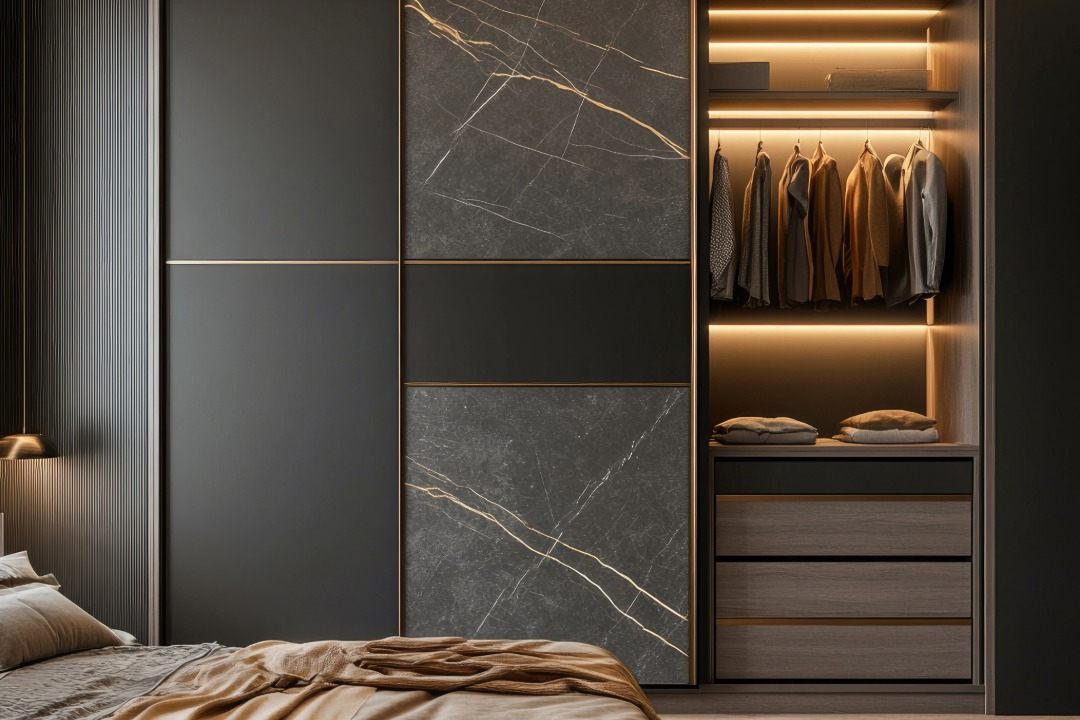
Every bedroom needs a wardrobe. But the moment you start shopping, the first fork in the road appears. Sliding doors or swing doors? Both look good in showroom photos. Both promise to hold your clothes. But in daily life, they behave very differently.
The wrong choice does not just look bad. It blocks walkways. It limits how you arrange your furniture. It makes mornings slower because you cannot see everything at once. And once it is built and installed, changing your mind costs real money.
This guide walks you through both wardrobe types in practical detail. Not theory. Not vague pros and cons. Real factors that matter when you live with the wardrobe every day for the next ten to fifteen years.
How Swing Wardrobes Work
A swing wardrobe uses hinged doors. Each shutter is attached to the frame with two or three metal hinges. When you pull the handle, the door swings outward into the room at a 90-degree angle or wider.
This is the traditional wardrobe design used in most Indian homes. It has been around for decades. It is simple, reliable, and easy to repair. If a hinge loosens, a screwdriver fixes it in minutes. If the door sags, tightening the hinge plate corrects the alignment.
Swing doors open fully. Both sides of the wardrobe are visible at the same time. You can see every shelf, every hanger, every drawer without moving a panel out of the way. This makes finding things faster, especially during rushed mornings.
The inside of the door is also usable. You can mount hooks for belts, scarves, ties, and bags. That extra surface adds storage without taking up any internal shelf space.
How Sliding Wardrobes Work
A sliding wardrobe uses doors that glide horizontally on tracks. One track sits at the top of the frame. Another sits at the bottom. Rollers mounted on the door panels allow them to slide left or right along these channels.
The doors do not swing outward at all. They stay flat against the wardrobe surface. This means the wardrobe needs zero clearance space in front. You can place a bed, a chair, or a side table right up against it and still open it without obstruction.
Sliding wardrobes look sleek and contemporary. The unbroken surface of the door panel creates a clean, minimal aesthetic that suits modern bedroom interior design. Floor-to-ceiling sliding panels especially make a room feel larger and more streamlined.
However, only one section of the wardrobe is accessible at a time. When you slide the left panel open, it covers the right side. This means you never get a full view of the entire wardrobe in one glance.
Space Requirements: The Deciding Factor
This is where most decisions should start. Measure the area in front of your wardrobe. If you have less than two feet of clearance between the wardrobe and your bed or opposite wall, swing doors will hit something every time you open them.
A standard swing door needs at least 24 inches of clear space to open fully. In compact bedrooms common in Indian apartments, especially in cities like Mumbai, Bangalore, Hyderabad, and Delhi, that clearance often does not exist.
Sliding wardrobes solve this problem completely. They need zero room to open. The doors stay within the footprint of the wardrobe itself. This makes them the default choice for small bedrooms, narrow corridors, and rooms where the bed sits close to the wardrobe wall.
If your room has generous floor space and the wardrobe sits along a wall with nothing in front of it, swing doors work perfectly. You get full access, easy maintenance, and a lower price point.
Internal Layout and Storage Efficiency
Swing wardrobes allow the full width of the interior to be divided freely. Shelves, hanging rods, drawers, and pull-out trays can span the entire width because no section is permanently blocked by a door panel.
Sliding wardrobes have a structural limitation. The overlapping door panels mean the internal compartments need to align with the door openings. A three-door sliding wardrobe, for example, only reveals one-third of the interior at a time. This affects how you organise clothes, especially if you have a large collection.
That said, skilled wardrobe design can overcome this. A good modular wardrobe manufacturer plans the internal layout so that the most-used sections align with the widest openings. Everyday clothing stays in the centre. Seasonal or rarely used items go behind the overlapping zones.
This kind of planning is only possible when the wardrobe is custom-built. Off-the-shelf units force you to adapt to their fixed layout. Factory-built custom wardrobes adapt the layout to your habits.
Hardware Quality Matters More Than You Think
The biggest difference between a wardrobe that works for years and one that frustrates you within months is the hardware. Not the wood. Not the finish. The hinges, tracks, rollers, and soft-close mechanisms.
Swing wardrobe hardware is straightforward. Good-quality European hinges with soft-close action last ten to fifteen years with minimal maintenance. They are inexpensive and widely available. Replacement is simple.
Sliding wardrobe hardware is more complex. It involves aluminium tracks, precision rollers, anti-jump clips, and buffer stops. Cheap hardware causes doors to derail, stick, or sag. The rollers wear unevenly. The tracks collect dust and grit that grinds against the mechanism.
This is where in-house manufacturing makes a measurable difference. A manufacturer who builds wardrobes in their own factory tests hardware combinations before they reach your home. They match roller weight capacity to panel size. They use anti-corrosion tracks that hold up in humid Indian climates. They calibrate the alignment so doors glide without wobble from day one.
A trading company sourcing components from five different suppliers cannot guarantee that level of integration. The track comes from one vendor. The rollers from another. The panel from a third. Nothing is tested as a system.
Finish and Aesthetic Options
Both wardrobe types accept a wide range of finishes. Laminates, veneers, PU-coated surfaces, lacquered panels, and mirror inserts all work on swing and sliding doors.
Sliding doors offer one visual advantage. The large, unbroken surface of a floor-to-ceiling sliding panel creates a statement wall effect. A full-length mirror on a sliding door doubles as a dressing mirror. Frosted glass panels add depth without visual clutter.
Swing doors offer more flexibility for mixed finishes. You can have a different colour or material on each shutter. Louvred panels, CNC-routed patterns, and raised moulding details are easier to execute on hinged doors because each panel is handled independently during manufacturing.
For modern, minimal home interior design, sliding wardrobes tend to look cleaner. For classic, textured, or pattern-heavy aesthetics, swing wardrobes offer more creative freedom.
Cost Comparison
Swing wardrobes are more affordable. The hardware is simpler. The manufacturing process requires standard hinges and straightforward assembly. A well-built swing wardrobe in plywood with laminate finish starts at a lower price point than an equivalent sliding wardrobe.
Sliding wardrobes cost more because of the specialised track system, precision rollers, and the additional engineering required for smooth operation. The larger the wardrobe, the wider the price gap. A floor-to-ceiling sliding unit with three or four panels involves significantly more hardware than a comparable swing version.
However, the cost should be weighed against the space it saves. In a compact bedroom where the swing doors would block the walkway, the sliding wardrobe’s premium is justified by the usability it provides. You are not just paying for a door mechanism. You are paying for functional floor space.
Maintenance and Longevity
Swing wardrobes require almost no maintenance. Oil the hinges once a year. Tighten the screws if a door sags. That is it. The mechanism is mechanical and forgiving.
Sliding wardrobes need regular attention. Dust accumulates in the floor track. Rollers need lubrication. If the panels are knocked hard, the alignment shifts and the doors no longer slide smoothly. Getting them back on track sometimes requires a technician.
With high-quality hardware and proper manufacturing, a sliding wardrobe can last just as long as a swing version. But the keyword is quality. Cheap tracks and plastic rollers are the most common reason sliding wardrobes fail within three to five years.
A manufacturer with its own factory can control this variable completely. Holzbox, for instance, selects and tests every component in-house before assembly. That kind of quality control at the production stage is what determines whether your sliding wardrobe still glides perfectly in year ten.
Room-by-Room Recommendations
Master bedroom with space: Swing wardrobe. You get full access, lower cost, and easy long-term maintenance.
Compact urban bedroom: Sliding wardrobe. No clearance needed. The doors stay within the wardrobe footprint.
Kids’ room: Swing wardrobe. Simpler hardware survives rough handling better. Hinges are easier to repair.
Guest bedroom or rental property: Sliding wardrobe. The modern look adds perceived value. The space efficiency suits varied furniture layouts.
Walk-in closet: Combination. Use swing doors for the entry and sliding panels for internal partitions.
Wardrobe along a corridor or passage: Sliding wardrobe. There is no room for doors to swing into a walkway.
The Right Choice Is the One That Fits Your Room
There is no universal winner between sliding and swing wardrobes. The right answer depends on your room dimensions, your daily habits, and your budget. A swing wardrobe is simpler and cheaper. A sliding wardrobe saves space and looks contemporary.
What matters most is the build quality behind the door. A beautifully designed wardrobe with poor hardware is a daily frustration. A well-engineered wardrobe with tested components is something you stop thinking about because it just works.
Choose the type that fits your room. Then choose a manufacturer who builds it to last.
Frequently Asked Questions
Which wardrobe type is better for small Indian bedrooms?
Sliding wardrobes are the better choice for small rooms. They do not need clearance space in front of the wardrobe because the doors glide sideways on tracks. In compact apartments common across Indian cities, where the bed often sits within two feet of the wardrobe, swing doors would hit the bed frame every time you open them. Sliding panels eliminate this problem entirely and keep the walkway clear.
Are sliding wardrobes more expensive than swing wardrobes?
Yes. Sliding wardrobes typically cost more because of the specialised track system, precision rollers, and anti-jump hardware required. The price difference ranges from 15 to 30 percent depending on the size and finish. However, in rooms where swing doors would block movement, the premium pays for itself through better daily usability and space efficiency.
How long do sliding wardrobe tracks last?
With quality hardware, sliding wardrobe tracks last ten to fifteen years. The key factors are the material of the track, the weight rating of the rollers, and how well they are maintained. Aluminium tracks with sealed ball-bearing rollers perform best in Indian conditions. Cheap plastic rollers and thin steel tracks tend to fail within three to five years. Regular cleaning of the floor track and occasional lubrication extends the lifespan significantly.
Can I combine sliding and swing doors in the same wardrobe?
It is technically possible but not common. Some custom modular wardrobe designs use swing doors for a narrow side section and sliding doors for the wider main section. This works well in L-shaped wardrobes or walk-in closet configurations. However, it requires precise manufacturing to ensure both mechanisms align correctly with the internal layout. This kind of hybrid design is best handled by a manufacturer with in-house production capability.
What should I check before ordering a custom wardrobe?
Start with accurate room measurements. Note the floor-to-ceiling height, wall width, and distance between the wardrobe wall and the nearest piece of furniture. Decide whether swing or sliding doors suit your clearance space. Then discuss the internal layout. Specify how many shelves, hanging rods, drawers, and pull-out accessories you need. Ask about the hardware brand and weight capacity. Finally, confirm whether the company manufactures in their own factory or outsources to third parties. Factory-built wardrobes offer tighter tolerances, better hardware integration, and more reliable long-term performance.